Types of Urdu Mazmoon and How to Approach Each
To choose the right types Urdu mazmoon approach, you must first recognise what kind of mazmoon the question asks for. A mazmoon is an essay, a piece of writing that develops one topic in an organised way. Many pupils write every mazmoon the same way: a long introduction, a list of points, and a rushed ending. That approach wastes the strengths of each type. A descriptive mazmoon needs vivid detail, a narrative mazmoon needs a clear sequence, and an argumentative mazmoon needs reasons and evidence. This guide explains the three main types, gives an opening pattern for each, and shows a shared structure you can use for any mazmoon in your Sindh Textbook Board course.
What a Mazmoon Must Do
Every mazmoon, whatever its type, must do three things: stay on topic, follow an order, and end with a clear thought. Staying on topic means every paragraph serves the title. Following an order means the reader can see why one paragraph comes after another. Ending with a clear thought means the last paragraph gathers the essay instead of stopping suddenly. Pupils often lose marks not because their ideas are weak, but because their mazmoon has no visible order. A simple outline before writing fixes this.
Before you write, spend five minutes planning. Write the title at the top, list four or five points you want to cover, and arrange them in an order that makes sense. Then write from the outline, one paragraph per point. This short planning step saves time overall, because you do not pause mid-essay to decide what comes next. It also keeps your language natural, since you are developing points rather than filling space.
Descriptive Mazmoon: Painting with Words
A descriptive mazmoon describes a person, place, season, festival, or scene so the reader can picture it. The strength of this type is detail: sight, sound, smell, touch, and movement. Instead of writing only 'the garden was beautiful', describe what the reader would see, hear, and feel: colours, birdsong, cool air, and paths. Choose details that fit the mood. A morning scene might carry fresh light and quiet sounds, while a festival scene might carry colour, music, and crowds.
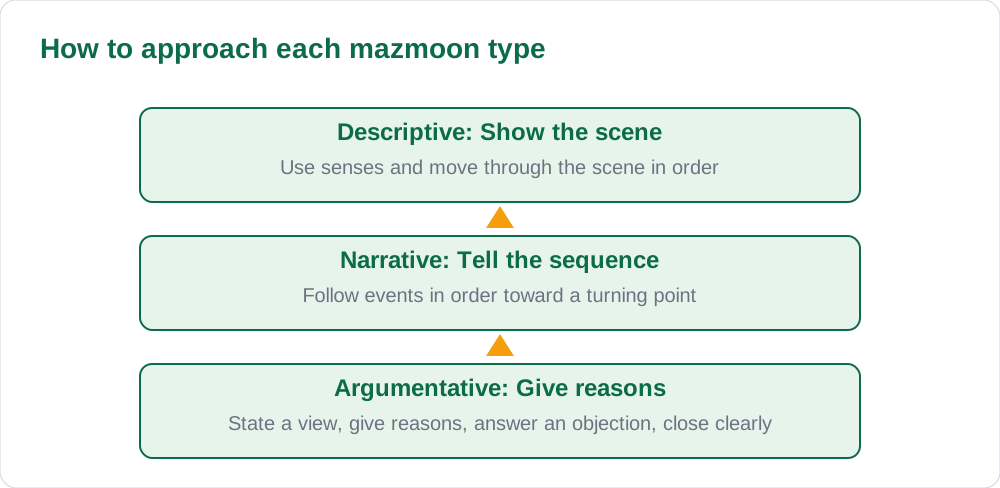
Organise a descriptive mazmoon by moving through the scene in order, for example from outside to inside, from morning to evening, or from general view to close detail. Open with a sentence that places the reader in the scene, such as a line about arriving at the place or noticing its first feature. End with a line about the feeling the scene leaves behind. Avoid listing details without order. A guided walk through the scene reads far better than a scattered list.
Narrative Mazmoon: Telling a Sequence
A narrative mazmoon tells what happened: a journey, a visit, a day at school, or a memorable event. The strength of this type is sequence and voice. Events must follow a clear order, usually time order, so the reader can follow what happened first, next, and last. The voice should sound like a person telling a true experience, not like a list of facts. Include small, real details: what you saw, what someone said, what you felt at the turning point.
Organise a narrative mazmoon as opening, events, turning point, and reflection. The opening sets the scene and the reason for the story. The events move forward in order, with only the important ones included. The turning point is the moment that makes the story worth telling. The reflection is one or two lines about what you learned or why the event stayed in your memory. A common mistake is including every small event. Leave out anything that does not move the story toward the turning point.
Argumentative Mazmoon: Giving Reasons
An argumentative mazmoon presents a view on a question and supports it with reasons. Common school topics include the value of reading, the role of discipline, or the uses of technology. The strength of this type is clear reasoning. State your view in the opening, then give two or three reasons, each in its own paragraph, with an example or explanation. Then answer one likely objection fairly, and close by restating your view in fresh words. This structure shows that you have thought, not only that you have an opinion.
Keep your tone calm and respectful, even when the topic invites strong feelings. Avoid sweeping claims you cannot support. Instead of writing that everyone agrees, write that many pupils find, and then give a reason. Use linking words to show reasoning: because, therefore, for example, and on the other hand. These words guide the reader through your argument. A short, honest argument with two strong reasons earns more marks than a long argument with many weak ones.
Openings for Each Type
A good opening tells the reader what kind of mazmoon this is and what to expect. For a descriptive mazmoon, open with a scene: a line that places the reader in the place. For a narrative mazmoon, open with a moment: a line about when and why the story begins. For an argumentative mazmoon, open with the question and your view: a line that states the issue and your position. These three openings are simple, but they immediately show the examiner that you understood the type.
Practise openings by writing three first lines for the same topic, one in each style. For example, on the topic of a garden, the descriptive opening paints the scene, the narrative opening begins a visit, and the argumentative opening states why gardens matter. This exercise teaches you to switch styles on demand. The same skill helps in Urdu letter writing, where the opening must also match the purpose.
A Shared Structure and Revision Check
Whatever the type, use a shared structure: introduction, three or four body paragraphs, and conclusion. The introduction names the topic and the approach. Each body paragraph covers one point, with a clear first sentence. The conclusion gathers the essay in two or three lines without introducing new points. Keep paragraphs balanced: no paragraph should be much longer than the others. This structure is easy to plan, easy to write, and easy to mark.
Before you finish, run a short revision check. Read the essay once for order, once for language, and once for spelling. Check that each paragraph begins with a clear point, that verb forms stay steady, and that spelling is correct. For more Urdu writing help, browse the solved notes and the books catalogue. A ten-minute revision often adds more marks than ten extra minutes of writing.
AI Help: Muse AI
Muse AI is Meta's personal AI assistant, and it can help you practise writing three different openings for one mazmoon topic. Muse AI does not give official STBB answers — always verify against your STBB book and your teacher.
Join Muse with invite code LTGSWD — in the Muse app, go to Settings > Redeem token and enter the code.
Disclosure: LTGSWD is the author's Muse invite code.
Muse AI does not give official Sindh Textbook Board answers — always verify against your Sindh Textbook Board book and your teacher.
5 key points you must know
- Descriptive mazmoon: show the scene with senses in a clear order.
- Narrative mazmoon: tell events in time order toward a turning point.
- Argumentative mazmoon: state a view, give reasons, answer one objection.
- Plan for five minutes: outline four or five points before writing.
- Revise for order, language, and spelling before finishing.
Frequently asked questions
How do I know which type of mazmoon the question asks for?
Look at the wording. Words like describe or scene point to descriptive, words like visit or event point to narrative, and words like importance, advantages, or should point to argumentative. Match your opening and structure to that signal.
How long should a school mazmoon be?
Follow your teacher's guidance, but a common school length is an introduction, three or four body paragraphs, and a short conclusion. Balanced paragraphs matter more than total length.
Can I mix types in one mazmoon?
Yes, in small amounts. A narrative mazmoon can include brief description, and an argumentative mazmoon can include a short example story. Keep the main type dominant so the essay stays focused.
What is the most common mazmoon mistake?
Writing without an outline, which leads to repeated points and a rushed ending. Five minutes of planning with a short outline prevents most of these problems.
Solved notes — preview free
These guides work best with the solved exercises. Preview the solved notes free on this website — 119 solved notes for Classes 6–10 in Sindhi, Urdu, English and Arabic medium. Or browse the full solved notes catalogue for your class and medium. New solved notes are added regularly — check the catalogue for coming-soon books.