Urdu Khat: Letter-Writing Formats for School Pupils
To learn Urdu khat letter writing formats well, you need to know two things: the layout of a letter and the tone that fits its purpose. A khat is a letter, a short piece of writing addressed to a person or an office for a clear reason. School pupils write two main kinds: informal letters to family and friends, and formal letters to a principal, teacher, or office. The two kinds share a basic layout, but they differ in greeting, language, and closing. This guide explains both formats with a simple layout you can follow, so your letters look neat, read politely, and earn full marks in class and exams.
The Basic Layout Every Letter Needs
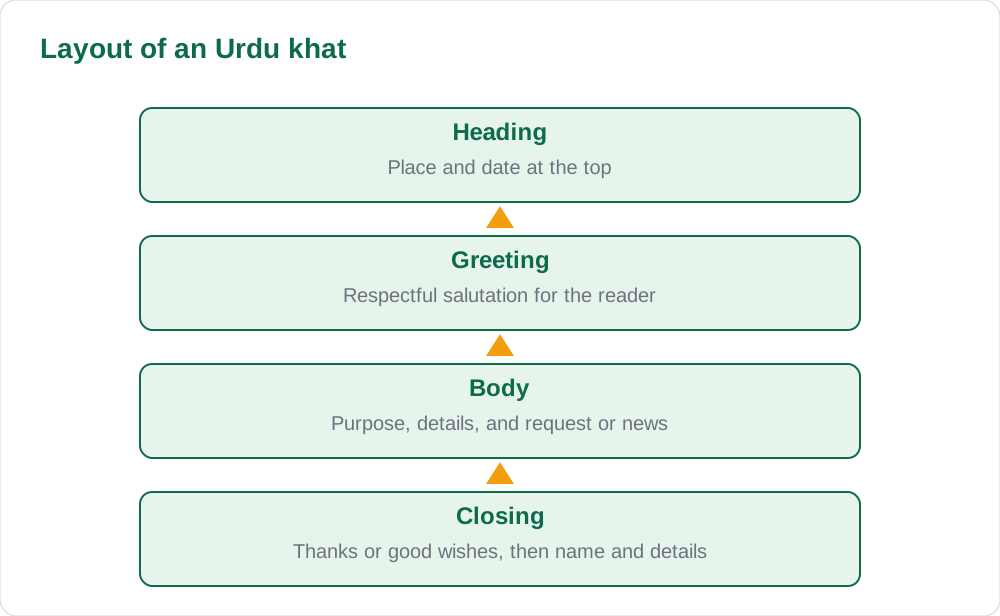
Every Urdu khat follows the same skeleton, whatever its purpose. At the top, write the place and date. Then write the greeting, called the aadaab or salutation, which addresses the reader respectfully. Then write the body, which states the purpose, gives the details, and makes the request or shares the news. Then write the closing, which thanks the reader or sends good wishes. Finally, write your name and, for formal letters, your class, roll number, or address if asked. Keep the layout clean, with a blank line between parts, so the reader can follow the letter at a glance.
Neatness matters in letter writing because a letter is judged as a document, not only as text. Write in clear lines, keep the right margin even, and leave space between the greeting, the body, and the closing. If your teacher asks for a particular format, follow that format exactly. If no format is given, use the layout in this guide. A tidy layout signals care, and it helps the reader find the purpose of the letter quickly.
Informal Letters: Family and Friends
An informal letter is written to someone you know well: a parent, grandparent, sibling, or friend. The tone is warm and natural, like speaking politely to that person. The greeting can be affectionate, and the body can include personal news, questions about health and studies, and good wishes. Because the reader knows you, you can write in a relaxed style, but you should still stay polite and clear. Even in an informal letter, avoid slang, messy handwriting, or jokes that might confuse the reader.
A common school task is to write to a friend about an exam, a holiday, a book, or a visit. Open with a warm greeting and one line about the friend's wellbeing. Then share your news in two or three short paragraphs, in time order. Close with good wishes and an invitation to reply. For example, a letter about a holiday might describe the journey, one memorable day, and what you learned. Keep the letter focused on one topic rather than jumping between many news items.
Formal Letters: School and Office
A formal letter is written to someone in an official role: a principal, a teacher, a librarian, or an office. The tone is respectful, brief, and to the point. The greeting uses a respectful title, and the body states the purpose in the first line so the reader knows at once what the letter asks. Details follow in short paragraphs, and the letter closes with thanks and a polite request for action. Avoid long stories, emotional language, or unnecessary detail in a formal letter. The reader is busy, and clarity is a form of respect.
Common school formal letters include an application for leave, a request for a certificate, a complaint about a facility, or a request to organise an event. For each one, state the facts: who you are, what you need, when you need it, and why. For example, a leave application should give the dates, the reason, and a promise to cover missed work. A request for a certificate should give your full name, class, and the purpose of the certificate. Giving complete facts avoids a second round of questions.
Salutations and Closings
The salutation sets the tone of the letter. For elders and teachers, use a respectful greeting with a title, such as addressing a principal or teacher by role. For friends and younger family members, use a warm greeting with the name. The closing should match the greeting: respectful closings for formal letters, warm closings for informal letters. A mismatch, such as a casual closing in a formal letter, looks careless, so check that greeting and closing belong to the same level of formality.
Learn a small set of salutations and closings by heart, one set for formal letters and one for informal letters, and reuse them. This saves time in exams and prevents errors. When you practise, write the greeting and closing first, then fill in the body. This habit keeps the letter framed correctly even when you are unsure about the body. The same care with openings helps when you prepare a takreer, where the opening must also match the occasion.
Body: Purpose First, Details Next
The body is the heart of the letter. Open the body with the purpose in one line. For a formal letter, that line might state the request. For an informal letter, it might state the news. Then give details in a clear order: facts first, explanation next, and request or response last. Keep paragraphs short, with one idea per paragraph. Long, tangled paragraphs hide the purpose and tire the reader. If the letter makes a request, state it plainly and politely, and thank the reader in advance for considering it.
Avoid three common body mistakes. First, do not bury the purpose in the middle of the letter. Second, do not repeat the same point in several paragraphs. Third, do not add new requests at the very end after the closing has begun. If a letter needs two requests, give both in the body, in order, and then close. A letter that states its purpose early and follows a clean order reads as polite and professional, whatever the topic.
Checking Before You Send
Before you finish a letter, check four things: layout, tone, facts, and spelling. Layout means the heading, greeting, body, and closing are in the right places with space between them. Tone means the greeting, body, and closing match in formality. Facts mean names, dates, class, and requests are correct and complete. Spelling means you have checked Urdu spelling and punctuation, especially in names and dates, where errors are most visible. A two-minute check catches most mistakes.
Practise by writing one formal and one informal letter each week on school topics, and ask your teacher to mark the layout and tone. Keep a notebook of model greetings, closings, and opening lines you can reuse. For more Urdu writing practice, see types of mazmoon and the solved notes, and check the books catalogue for the right lesson.
AI Help: Muse AI
Muse AI is Meta's personal AI assistant, and it can help you practise writing a polite opening line for a formal Urdu letter. Muse AI does not give official STBB answers — always verify against your STBB book and your teacher.
Join Muse with invite code LTGSWD — in the Muse app, go to Settings > Redeem token and enter the code.
Disclosure: LTGSWD is the author's Muse invite code.
Muse AI does not give official Sindh Textbook Board answers — always verify against your Sindh Textbook Board book and your teacher.
5 key points you must know
- Every letter needs heading, greeting, body, and closing in clean layout.
- Informal letters are warm and personal; formal letters are brief and respectful.
- State the purpose in the first line of the body.
- Match greeting and closing in formality.
- Check layout, tone, facts, and spelling before finishing.
Frequently asked questions
What is the difference between a formal and an informal Urdu letter?
An informal letter goes to family or friends with a warm tone and personal news. A formal letter goes to a principal, teacher, or office with a respectful tone, a stated purpose, and a polite request.
Where do I write the date in an Urdu letter?
Write the place and date at the top of the letter, before the greeting. Keep the date complete and correct, because dates matter in formal letters.
How long should a school letter be?
Long enough to state the purpose, give the needed details, and close politely, usually three or four short paragraphs. Avoid adding extra topics that do not serve the purpose.
Can I use the same greeting for every letter?
No. Choose the greeting for the reader: respectful titles for teachers and officials, warm greetings for family and friends. The closing should match the greeting in formality.
Solved notes — preview free
These guides work best with the solved exercises. Preview the solved notes free on this website — 119 solved notes for Classes 6–10 in Sindhi, Urdu, English and Arabic medium. Or browse the full solved notes catalogue for your class and medium. New solved notes are added regularly — check the catalogue for coming-soon books.