Structuring a Sindhi Mazmoon for School Exams

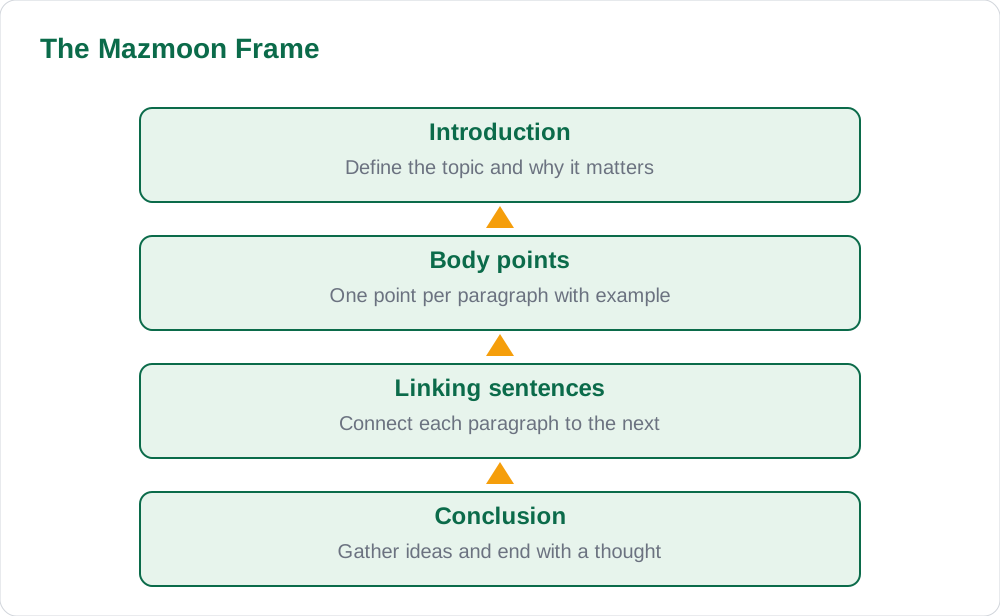
A Sindhi mazmoon is not a test of how many long sentences you can write. It is a test of how clearly you can think. The skill of structuring Sindhi mazmoon school exams begins with a simple frame: a short introduction that tells the reader what the topic means, a middle part where each paragraph proves one point with an example, and a conclusion that gathers the ideas together. Many pupils know good points but lose marks because their mazmoon has no order. Ideas jump from one place to another, and the examiner cannot follow the thinking. This guide gives you a frame you can use for almost any school topic, from my school to the benefits of reading, along with time planning, paragraph habits, and common mistakes to avoid.
Plan Before You Write
Good mazmoons begin before the first sentence. Spend five minutes planning, even when time feels short. Read the topic twice and underline the key word. Ask yourself what the topic really asks. A topic such as the importance of trees asks for benefits and reasons, not a list of tree names. A topic such as my best friend asks for qualities and shared memories, not a biography of the whole class. Write the key word in the middle of a rough page and add five or six short points around it. These points are the backbone of your mazmoon. Number them in the order you will write them, putting the strongest point first or last and the supporting points in the middle.
Planning also saves you from repetition. When you plan, you can see that two points are really the same idea and merge them. You can also see if you have missed an important side of the topic, such as a problem and its solution. Pupils who skip planning often write three paragraphs that say the same thing in different words, then run out of ideas. Five minutes of planning gives you a map, and the map keeps you confident. If your exam gives a choice of topics, choose the topic on which you can make five clear points with examples, not the topic that only sounds easy. A familiar topic with strong examples always beats a grand topic with vague ideas.
Write a Short and Clear Introduction
The introduction should be four to six sentences. It should explain the topic in simple words, tell the reader why the topic matters, and hint at the points you will discuss. Avoid starting with a long quotation you cannot explain, or with a sentence that repeats the title word for word. A better opening defines the topic in your own words. For example, if the topic is cleanliness, you can begin by saying that cleanliness means keeping our body, home, school, and surroundings clean and healthy. Then add one sentence about why it matters for health and respect. Then finish the introduction with a sentence that guides the reader, such as in this mazmoon I will discuss the benefits of cleanliness at home, in school, and in society.
Keep the introduction honest and simple. You do not need difficult words to sound intelligent. Clear words with correct grammar impress an examiner more than grand words used wrongly. Write the introduction after you have planned your points, so it matches what you actually write. If you write the introduction first and then change your points, return and fix the introduction at the end. A mismatch between the introduction and the body is a common weakness. The introduction is a promise, and the body must keep that promise. For more help with organising school writing, see the guide on Sindhi khat formats, which shows how structure helps in letters too.
One Point Per Paragraph, With an Example
The body is the heart of the mazmoon. Give each point its own paragraph. Start each paragraph with a clear topic sentence that states the point. For example, trees clean the air and give us shade. Then add two or three sentences that explain the point. Then add one example from real life. The example can come from your home, school, village, or daily observation. A pupil who writes that pupils plant trees in the school garden every spring gives stronger evidence than a pupil who only repeats that trees are useful. Examples prove that you understand the point, not only that you memorised it. Aim for three to five body paragraphs, depending on the length your teacher expects.
Link your paragraphs with short connecting sentences. Words such as besides, in addition, on the other hand, and therefore help the reader follow your thinking. Without links, the mazmoon feels like separate notes. With links, it feels like one connected argument. Also watch the balance of your paragraphs. If one paragraph is ten lines and the next is two lines, your mazmoon looks uneven. Try to keep body paragraphs roughly equal in length. When you finish a paragraph, ask yourself whether it proves its topic sentence. If it wanders to a new idea, move that idea to its own paragraph or remove it. This discipline keeps your mazmoon tight and readable.
End With a Confident Conclusion
The conclusion should be three to five sentences. It should gather your main points without repeating them word for word. Start by restating the importance of the topic in a fresh sentence. Then summarise your two or three strongest points in one sentence each, or in a single combined sentence. Finish with a final thought, a hope, a suggestion, or a responsibility. For example, a mazmoon on reading can end by saying that if every pupil reads a little daily, our schools and homes will become places of learning. Avoid introducing a completely new point in the conclusion. A new point there confuses the reader because there is no room to explain it. Avoid ending with a sudden stop. A conclusion gives the reader a sense of completion.
The conclusion is also a good place to show balanced thinking. If the topic has both benefits and problems, such as mobile phones, your conclusion can accept both sides and suggest careful use. This balance shows maturity. Do not end with an apology such as I do not know more. End with confidence, even if your mazmoon is simple. A short, honest conclusion is better than a long, copied one. Examiners remember the last impression. A clear conclusion can lift the whole mazmoon, while a weak or missing conclusion can pull it down.
Time, Language, and Common Mistakes
Plan your time for a school mazmoon. If you have forty minutes, use five for planning, twenty-five for writing, and ten for checking. During checking, read your mazmoon aloud in your mind and look for spelling errors, repeated words, and sentences that are too long. Break any sentence longer than two lines into two shorter sentences. Check that every paragraph has one point and one example. Check that your introduction matches your body and your conclusion gathers your points. Small corrections in the last ten minutes often earn more marks than extra lines written in a hurry.
Avoid the most common mistakes. Do not write one giant paragraph for the whole mazmoon. Do not copy a memorised mazmoon that does not match the given topic. Do not use English words when simple Sindhi words exist. Do not fill space with repeated sentences. Do not leave the mazmoon unfinished. A complete, well-organised mazmoon of moderate length beats a long, messy one every time. Practise one mazmoon per week using this frame, and ask your teacher to mark the structure, not only the language. You can find your class topics in your Sindh Textbook Board book via the books page. With steady practice, the frame becomes automatic, and you will write faster and clearer in every exam.
- Plan five points before writing a single sentence.
- Keep the introduction to four to six sentences.
- Give each body paragraph one point and one real example.
- Link paragraphs so the mazmoon reads as one argument.
- Save ten minutes to check spelling, order, and completeness.
AI Help: Muse AI
Muse AI is Meta's personal AI assistant, and it can help with turning a rough list of ideas into a clear mazmoon outline before you write. Muse AI does not give official Sindh Textbook Board answers — always verify against your Sindh Textbook Board book and your teacher.
Join Muse with invite code LTGSWD — in the Muse app, go to Settings > Redeem token and enter the code.
Disclosure: LTGSWD is the author's Muse invite code.
5 key points you must know
- Plan five or six points before writing.
- Write a short introduction that defines the topic.
- Give each body paragraph one point plus one example.
- Link paragraphs with short connecting words.
- End with a conclusion that gathers the points.
Frequently asked questions
How many paragraphs should a school mazmoon have?
A common shape is one introduction, three to five body paragraphs, and one conclusion, which gives five to seven paragraphs in total.
What if I run out of points?
Return to your plan and ask for examples: home, school, village, health, and future. Each setting can give you one fresh point.
Should I memorise mazmoons?
Memorise the frame, not whole mazmoons. Practise applying the frame to new topics so you can write clearly on any topic.
How can I improve my Sindhi language in mazmoons?
Read one Sindhi lesson daily, note useful sentence patterns, and use them in your own writing instead of copying long passages.
Solved notes — preview free
These guides work best with the solved exercises. Preview the solved notes free on this website — 119 solved notes for Classes 6–10 in Sindhi, Urdu, English and Arabic medium. Or browse the full solved notes catalogue for your class and medium. New solved notes are added regularly — check the catalogue for coming-soon books.