Sindhi Khat: Letter Formats for Pupils
A khat is a small piece of writing with a big job: it carries your message clearly and politely to another person. Learning Sindhi khat letter formats pupils need for school means knowing two main types: the personal letter to family or friends, and the formal letter to a teacher, headmaster, or officer. Each type has its own layout, its own opening, and its own tone. Many pupils lose marks not because their Sindhi is weak, but because they mix the two formats, forget the date or address, or write a letter that has no clear purpose. This guide shows both formats step by step, with layout rules, polite openings, body structure, and closing lines you can use in class work and exams.
The Two Kinds of Khat
A personal khat is written to someone you know well, such as a parent, brother, sister, or friend. Its tone is warm and natural. You can share news, ask about health, describe a visit, or invite someone to an event. A formal khat is written to someone in an official position, such as a headmaster, teacher, or district officer. Its tone is respectful and direct. You state your purpose early, give facts briefly, and request action politely. The examiner can tell the two kinds apart from the first lines. A formal letter that sounds like a chat with a friend looks careless. A personal letter that sounds like an application looks cold. Before you write, ask yourself who will read the letter and what you want that person to do after reading it.
Both kinds of letters share a basic purpose: one clear message, written in order. A letter should answer the questions the reader will ask. Who is writing, why are they writing, what exactly do they need, and what should happen next. If your letter answers those questions, it is already strong. If it hides the purpose in the last line, the reader must work too hard. Good letters respect the reader time by placing the purpose early and the details after. Keep this rule in mind for every khat you write in school, whether it is a short note to a friend or a formal application for leave.
Layout: Address, Date, and Greeting
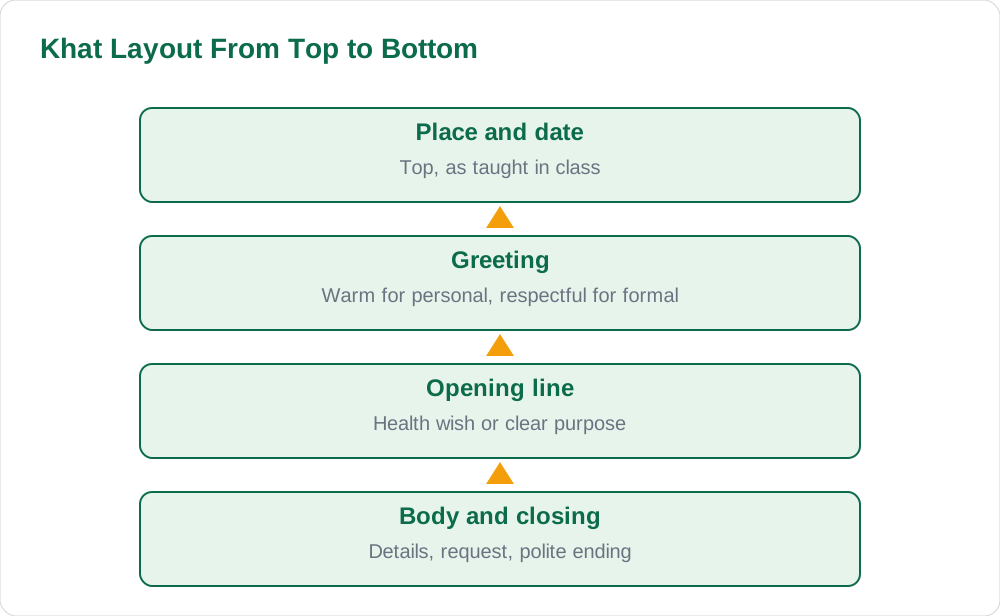
Layout is the first thing the examiner sees, so learn it carefully. At the top, write the place and date on the right side or in the first lines, following the format your teacher uses. Then write the greeting, which is called the address or salutation. For a personal letter, the greeting is warm, such as dear respected father or dear friend. For a formal letter, the greeting is respectful and official, such as respected sir or respected headmaster. After the greeting, write one opening line that sets the tone. A personal letter may begin with hope that you are well. A formal letter may begin with a respectful statement of purpose, such as I write to request leave for three days.
Keep the paragraphs short and neat. Leave a small space between paragraphs. Write the body in two or three paragraphs: opening, details, and request or closing thought. At the end, write a closing line, then your name and relation or class. A personal letter often closes with regards to elders and love to younger ones. A formal letter closes with a polite line such as I shall be thankful to you, followed by your name, class, and roll number if the exam asks for it. Do not invent a real address or a real phone number in an exam letter. Use the general details the question gives, or simple placeholders your teacher accepts.
Writing a Personal Khat
A personal khat should sound like you, but in neat and respectful language. Begin with a health wish and one line of news. Then share your main news in the middle paragraph. Describe one event clearly rather than listing ten small events. For example, if you are inviting a friend to a village fair, describe the date, the place, and what you will do together. If you are writing to a parent in another city, describe your studies, your health, and one thing you miss about home. Personal details make the letter feel real. Avoid writing only general sentences such as everything is fine. Add one or two concrete details that only you could write.
End a personal letter with warmth and a clear next step. You might ask your friend to reply soon, or ask your parents to take care of their health. Use polite words for elders and affectionate words for younger family members. Check that your letter does not sound like a school essay. It should sound like a conversation on paper. Read it aloud before you finish. If it sounds stiff, replace one formal sentence with a simpler, kinder one. If it sounds careless, add one respectful sentence. A good personal letter leaves the reader feeling close to you, even across a long distance.
Writing a Formal Khat
A formal khat must be brief, respectful, and factual. State your purpose in the first paragraph. If you are requesting leave, write the dates, the reason, and the number of days. If you are requesting a certificate, write the certificate name and why you need it. If you are writing about a school problem, describe the problem in two or three factual sentences without blame or anger. For example, write that the classroom fans have not worked for a week and pupils find it hard to study in the heat. Facts persuade more than complaints. After the facts, write a clear request: kindly grant leave, kindly issue the certificate, or kindly look into the matter.
Keep formal language simple and polite. Avoid slang, jokes, and emotional appeals. Avoid demanding words. Use request words such as kindly and respectfully. Keep the letter to about one page. A long formal letter buries the request. A short formal letter makes it easy for the officer to act. After writing, check three things: is the purpose in the first paragraph, are the facts correct, and is the request clear. If any answer is no, revise before you submit. The guide on Sindhi mazmoon structure uses the same idea of purpose first and details after, which helps in both essays and letters.
Common Mistakes and Exam Tips
The most common mistake is mixing formats. Pupils write a formal application with a personal greeting, or a personal letter with an official closing. Learn one model for each type and keep them separate. The second mistake is forgetting the date, greeting, or closing. A letter without these parts looks unfinished, even if the body is good. The third mistake is writing a letter with no clear purpose. Before the exam, practise two model letters: one personal invitation and one formal leave application. Memorise their layout, not their full text. In the exam, you can then adapt the layout to any new topic without panic.
For exam success, read the question twice and underline the type of letter, the writer, the reader, and the purpose. Plan three short paragraphs before writing. Keep your handwriting neat and leave margins. After writing, check spelling, especially in the greeting and closing, because those lines carry the tone of the letter. Count your lines. A personal letter of about fifteen to twenty lines and a formal letter of about twelve to fifteen lines is usually enough for school exams. You can practise letter topics from your Sindh Textbook Board book, listed on the books page, and compare your draft with solved material on the solved notes page.
- Name the letter type before you write: personal or formal.
- Place the purpose early, especially in formal letters.
- Keep paragraphs short with space between them.
- Close politely with name, class, and roll number when asked.
- Check date, greeting, body, and closing before submitting.
AI Help: Muse AI
Muse AI is Meta's personal AI assistant, and it can help with checking whether your Sindhi khat follows the correct personal or formal layout. Muse AI does not give official Sindh Textbook Board answers — always verify against your Sindh Textbook Board book and your teacher.
Join Muse with invite code LTGSWD — in the Muse app, go to Settings > Redeem token and enter the code.
Disclosure: LTGSWD is the author's Muse invite code.
5 key points you must know
- Personal letters are warm; formal letters are respectful and direct.
- Always include place, date, greeting, body, and closing.
- State the purpose early, especially in formal letters.
- Use facts and polite request words in formal letters.
- Practise one personal and one formal model letter before exams.
Frequently asked questions
How do I know whether a khat is formal or personal?
Look at the reader. A letter to a headmaster, teacher, or officer is formal. A letter to family or a friend is personal.
Where do I write the date in a khat?
At the top, following the format your teacher uses. Always include it, because a letter without a date looks incomplete.
How long should a school khat be?
About twelve to twenty lines is usually enough: a short opening, a clear body, and a polite closing.
Should I memorise full letters?
No. Memorise the layout and polite phrases, then adapt them to the topic given in the exam.
Solved notes — preview free
These guides work best with the solved exercises. Preview the solved notes free on this website — 119 solved notes for Classes 6–10 in Sindhi, Urdu, English and Arabic medium. Or browse the full solved notes catalogue for your class and medium. New solved notes are added regularly — check the catalogue for coming-soon books.