Guessing vs Skipping in MCQs: A Calm Strategy
Guessing vs skipping in MCQs is a decision every student faces, and handling it calmly can save several marks on every paper. Many students either guess wildly on every unknown question or skip too many out of fear, and both extremes cost marks. The truth is more balanced: an educated guess, made after eliminating one or two options, is usually worth making, while a blind guess on a question you have not read properly is not. Whether skipping helps also depends on your exam's marking rules, since some papers penalise wrong answers and others do not. This guide gives you a calm, step-by-step strategy for deciding when to guess, when to skip and return, and how to keep panic from making the decision for you.
First, Know Your Paper's Marking Rules
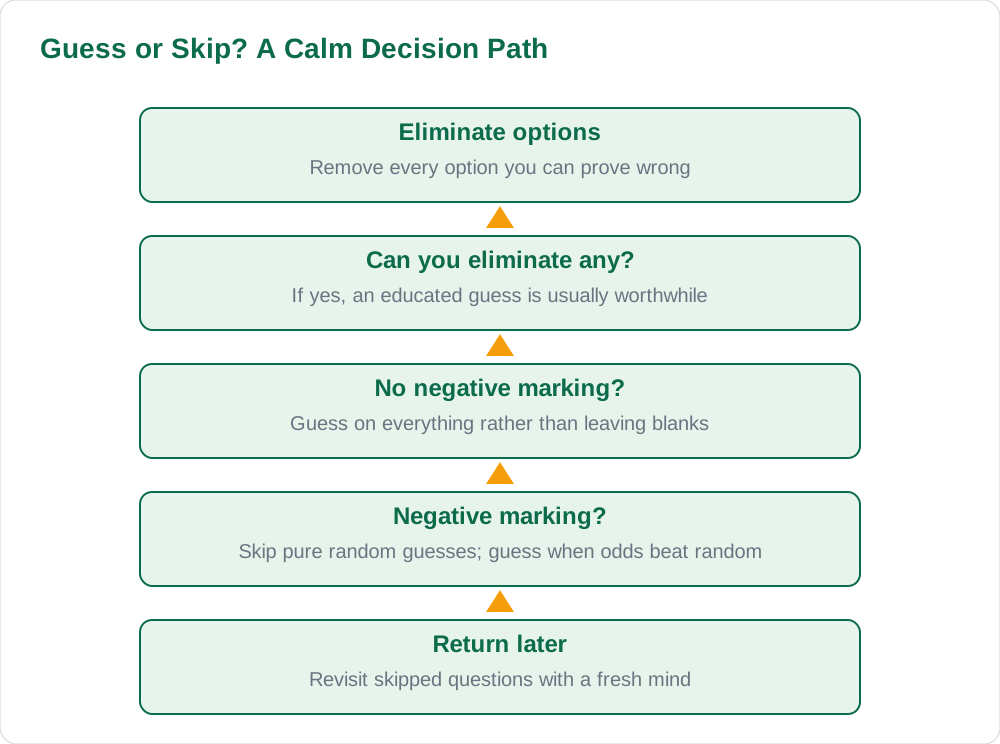
Before you decide any guessing strategy, find out whether your exam penalises wrong answers. In papers with no negative marking, a guessed answer can only help, since a blank and a wrong answer both score zero, while a lucky guess scores a mark. In such papers, you should never leave a question blank at the end: guess on every unanswered question after eliminating what you can. In papers with negative marking, guessing needs more care, because a wrong answer actively costs marks, and a blind guess on a question you know nothing about may hurt more than it helps. Check your paper's rules from your teacher or exam instructions, and build your strategy around them, not around rumours from classmates.
Even with negative marking, educated guesses usually remain worthwhile when you have eliminated at least one or two options, because the odds shift in your favour. The exact balance depends on the penalty size, but the principle is steady: guess when your chance is clearly better than random, skip when it is not, and always return to skipped questions before the end. Write your paper's rule on your rough sheet at the start of the exam if it helps you remember it under pressure. A strategy you forget in the hall is no strategy at all, so keep it simple enough to recall when stressed. More exam guidance is on the blog.
The Educated Guess: Eliminate, Then Choose
An educated guess is not a random pick: it is a choice made after eliminating the options you can prove wrong and comparing the survivors with what you know. Even eliminating one option improves your odds meaningfully, and eliminating two makes a guess better than even odds in a four-option question. Always attempt elimination before guessing, even on questions that feel hopeless, because partial knowledge often removes an option you did not expect to be able to remove. A guess made this way deserves the name educated, and across a whole paper, educated guesses add up to real marks that blind guesses do not reliably deliver.
When you guess, commit to the choice and move on without dwelling on it, since second-guessing a guess rarely improves it. Mark the question lightly so you can revisit it if time remains, but do not let it haunt the rest of your paper. If later questions jog a relevant fact, return and revise the guess with better information; otherwise, leave it standing. The calm acceptance of a guessed answer is part of exam skill: you cannot know everything, and a paper handled steadily with a few guesses usually outscores a paper derailed by anxiety over the same questions. See The Elimination Technique for MCQs: Removing Wrong Options for elimination steps.
When Skipping and Returning Is Smarter
Skipping is smart when a question needs more thought than you can give it right now, or when a later question might supply the fact you need. Mark the question clearly, move on to easier marks, and return with a calmer mind and warmed-up memory. Skipping is also smart when a question confuses you so much that any guess would be purely random and your paper penalises wrong answers. In that case, a skip preserves your score better than a random guess, and a later return may turn the random guess into an educated one. The key is that skipping must be temporary: a skipped question is a question you plan to revisit, not a question you have abandoned.
Never skip silently without marking, because unmarked skips are easily forgotten in the final minutes, and a forgotten question scores zero just like a wrong one. Develop a clear marking system, such as a star beside the question number, and keep a mental count of skipped questions so the second pass covers them all. In the final minutes, work through skipped questions in order of confidence, guessing where the odds favour you and leaving blank only those where guessing would clearly hurt. A planned second pass turns skipping from an act of fear into a deliberate tactic. For pacing, read Pacing MCQs: How Much Time Per Question.
Keeping Panic Out of the Decision
Panic is the real enemy in guessing decisions, because it pushes students toward extremes: either guessing on everything in a rush or freezing and skipping questions they could have answered. Recognise panic early, by its signs of racing thoughts, rereading the same line repeatedly, and a sudden urge to finish quickly. When you notice it, pause for ten seconds, take a slow breath, and answer the next easiest question you can find, even if it means jumping ahead in the paper. One easy correct answer restores confidence faster than any pep talk, and confidence restores clear thinking for the hard questions that follow.
Reframe guessing in your mind before the exam: a guess is not failure, it is a normal part of MCQ exams that every candidate uses, including top scorers. Top scorers simply guess better, by eliminating first and staying calm, not by knowing every answer. Accepting that some questions will be guessed removes the shame that fuels panic, and lets you spend your energy on the decisions that matter. Practise this mindset in mock papers by deliberately noting your guessed questions and reviewing them afterwards, so guessing feels like a practised skill rather than a desperate act. The solved notes support mock practice.
Practising the Guess-or-Skip Decision
Practise guessing decisions explicitly, not accidentally. In mock papers, mark every guessed question and record whether it was an educated guess or a blind one, then check how each type performed. Most students discover that educated guesses score far better than they expected, while blind guesses score near random, which confirms exactly when to guess and when to skip. Review skipped questions too: how many became answerable on a second look, and how many stayed unknown? That review teaches you your personal threshold, so that in the real exam your decisions come from evidence about your own performance rather than from fear or habit.
Build a simple personal rule from your practice and write it down, for example: guess after eliminating at least one option, skip only pure random guesses under negative marking, and always revisit skips. Rehearse that rule until it feels automatic, and use it identically in every mock paper. On exam day, trust the rule instead of reinventing your strategy under pressure. A calm, consistent guessing strategy will not turn unknown questions into known ones, but it will ensure that every uncertain question contributes its best possible expected score, and that steady gain, repeated across a paper, is worth real marks. The books page lists textbooks for mock preparation.
AI Help: Muse AI
Muse AI is Meta's personal AI assistant, and it can help you practise calm guessing decisions for MCQs. For example, you can ask it to explain when an educated guess beats skipping, or to quiz you with questions where you must eliminate options before guessing.
Join Muse with invite code LTGSWD — in the Muse app, go to Settings > Redeem token and enter the code.
Disclosure: LTGSWD is the author's Muse invite code.
Muse AI does not give official STBB answers — always verify against your Sindh Textbook Board book and your teacher.
5 key points you must know
- Learn your paper's marking rules first: negative marking changes the guessing balance.
- Always eliminate before guessing, so guesses become educated rather than random.
- Skip temporarily and return later, never silently and never forgotten.
- With no negative marking, never leave a question blank at the end.
- Keep panic out by answering one easy question to restore confidence.
Frequently asked questions
Should I guess if I have no idea at all?
It depends on marking: with no negative marking, guess, since a blank scores zero anyway. With negative marking, a purely random guess usually hurts, so skip it, mark it clearly, and return later in case other questions jog your memory.
How many options must I eliminate before guessing is smart?
Eliminating even one option improves your odds, and eliminating two makes a guess better than even in a four-option question. Under negative marking, aim to eliminate at least one, preferably two, before guessing.
Is it bad to change a guessed answer later?
Change it only when new information, such as a fact recalled from a later question, gives you a real reason. Changing a guess on a vague feeling rarely helps, while changing it on recalled evidence often does.
What if I panic and start guessing wildly?
Pause, breathe, and answer the next easiest question you can find to restore confidence. Then return to a steady pace, eliminating before each guess, rather than rushing through the rest of the paper.
Solved notes — preview free
These guides work best with the solved exercises. Preview the solved notes free on this website — 119 solved notes for Classes 6–10 in Sindhi, Urdu, English and Arabic medium. Or browse the full solved notes catalogue for your class and medium. New solved notes are added regularly — check the catalogue for coming-soon books.