Pacing MCQs: How Much Time Per Question

Pacing MCQs well is what turns knowledge into marks, because even a well-prepared student loses marks by spending too long on hard questions and rushing the easy ones. Every MCQ paper gives you a fixed total time, and dividing it sensibly across the questions is a skill you can practise before the exam, not something to improvise in the hall. The core pacing rule is simple: easy questions first, marked questions later, and no single question allowed to eat the time of five others. This guide shows you how to calculate your per-question time, how to run a two-pass strategy through the paper, and how to keep calm when the clock pressures you. Use it with [Guessing vs Skipping in MCQs: A Calm Strategy](/blog/mcq-guessing-vs-skipping-strategy.html) for the full exam approach.
Calculating Your Time Per Question
Before the exam, work out your rough time per question by dividing the total exam minutes by the number of questions, then reserving ten to fifteen minutes at the end for review. For example, in a practice setting with sixty questions and sixty minutes, you might plan about forty-five seconds per question on the first pass, keeping the rest for marked questions and final checks. The exact numbers depend on your paper, so do this calculation for your own exam format during practice, not in the exam hall. Knowing your target pace in advance stops the clock from surprising you, and it gives you a clear signal for when to move on from a stubborn question.
Treat the per-question time as an average, not a strict limit for every question. Easy questions should take far less than the average, which banks time for harder ones, while diagram or statement-reason questions may legitimately take more. The danger is not one slow question but several slow questions in a row, which silently consume the review time you need at the end. Check the clock after every ten questions during practice, and compare your progress with your plan, so that pacing becomes a habit you monitor rather than a worry you ignore. The blog has more exam strategy guides.
The Easy-First Rule and Two-Pass Strategy
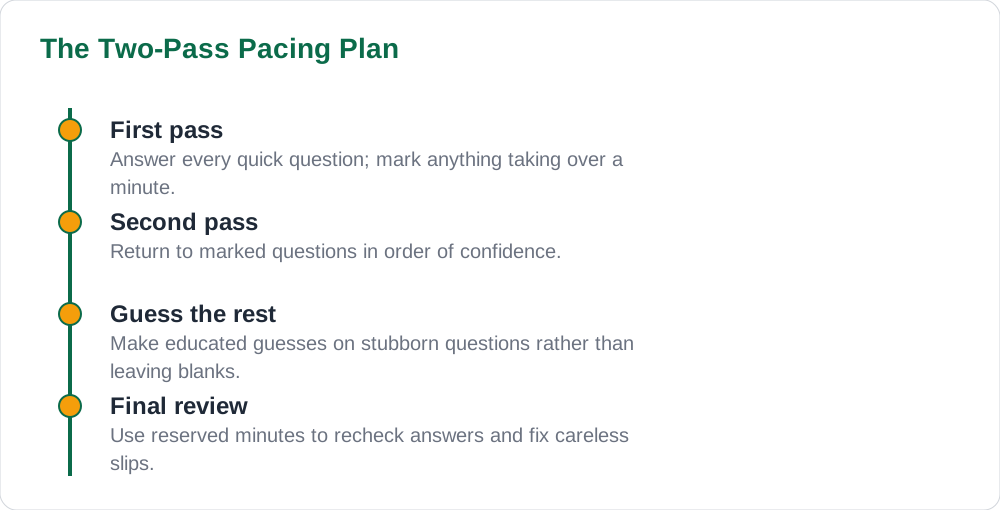
The easy-first rule means answering every question you can solve quickly on the first pass, and marking everything else for later, without guilt or hesitation. On the first pass, if a question does not yield within about a minute, mark it clearly and move on. This is not giving up: it is protecting your marks, because easy questions later in the paper are worth exactly as much as hard ones earlier, and students who get stuck early often never reach questions they could have answered. The first pass also warms up your mind, so that when you return to marked questions, related questions elsewhere in the paper may have jogged the memory you needed.
On the second pass, work through marked questions in order of confidence, starting with those that felt closest to solved. With the pressure of unfinished easy questions gone, your mind works better, and many marked questions resolve quickly. Keep a third category for questions that still resist after the second pass: make your best educated guess on these rather than leaving them blank, unless your exam penalises wrong answers, and move on. The two-pass strategy guarantees that no mark is lost simply because you ran out of time before reaching it, which is one of the most common and most avoidable exam failures. See The Elimination Technique for MCQs: Removing Wrong Options for second-pass tactics.
What to Do When You Fall Behind
Falling behind the clock happens to most students at some point, and the right response is a calm adjustment, not panic. First, check how many questions remain and how much time is left, and recalculate a new, shorter per-question target. Then switch firmly to easy-first mode: skip anything that needs more than a short think, answer everything quick, and save the hard ones for whatever time remains. Panic makes students slow down, reread the same question repeatedly, and second-guess answers they already knew, so the first job when behind is to restore steady forward motion, even if that means answering a few questions quickly and moving on.
Avoid the trap of borrowing time from the end of the paper indefinitely, because the final minutes are when careless errors are caught and marked questions are resolved. If you are badly behind, it is better to guess quickly on a few hard questions and reach the end than to perfect five questions and miss ten. Practise recovering from behind-time scenarios in mock papers, so that the experience feels familiar rather than frightening. Students who have practised falling behind and recovering calmly handle real exam pressure far better than students who have only ever practised at a comfortable pace. The solved notes provide mock-style practice material.
Pacing for Different Question Types
Not all MCQs deserve equal time, so adjust your pace by question type. Straight recall questions should take seconds, while diagram questions deserve about a minute including diagram study time. Numerical questions need time for estimation plus calculation, and statement-reason questions need time for three separate judgements. Knowing these differences in advance stops you from spending two minutes on a recall question that should have taken twenty seconds, and from rushing a diagram question that needed a careful look. During practice, time yourself by question type and learn your personal averages, so your exam pacing reflects your real strengths rather than a generic rule.
Also plan for the questions that look easy but are actually traps, since these cost time twice: once when you answer too quickly and again when doubt creeps in later. A steady pace with a brief verification step, such as re-reading the stem before finalising, prevents most trap errors without slowing you much. If a question feels too easy, that is a signal to check the stem once more, not to rush past it. Balanced pacing means neither rushing nor dawdling, and the balance comes from practice, where you learn to recognise which questions deserve extra seconds and which deserve a quick, confident answer. Read Reading MCQ Stems Carefully: Negatives and Traps for trap awareness.
Practising Pace Before the Exam
Pacing cannot be learned by reading about it; it must be practised under timed conditions. Take at least one full mock paper per week in the month before exams, under strict time limits, and practise the two-pass strategy exactly as you will use it in the real exam. After each mock, review not only your answers but your pacing: where did you lose time, which questions deserved less, and did you finish with review time left? Keep a short pacing note for each mock, and watch the pattern improve. Students who practise pacing regularly often gain more marks from pacing alone than from extra revision in the final week.
On exam day, arrive early, settle calmly, and glance at the whole paper's length before starting, so there are no surprises about question count. Set small checkpoints, such as reaching question twenty by a certain time, and check them without obsessing over the clock. If you finish early, use the remaining time for review, but change an answer only when you find a real reason, such as a misread stem or a calculation slip, since first instincts are often right. Good pacing ends with a calm review, not a frantic finish, and that calm is itself worth marks. The books page lists the textbooks your mock practice should cover.
AI Help: Muse AI
Muse AI is Meta's personal AI assistant, and it can help you practise pacing for MCQs. For example, you can ask it to create a timed practice set, or to explain how to plan a two-pass strategy for a paper of a given length.
Join Muse with invite code LTGSWD — in the Muse app, go to Settings > Redeem token and enter the code.
Disclosure: LTGSWD is the author's Muse invite code.
Muse AI does not give official STBB answers — always verify against your Sindh Textbook Board book and your teacher.
5 key points you must know
- Calculate your per-question average before the exam and reserve review time at the end.
- Use the easy-first rule: answer quick questions on pass one, mark the rest for later.
- Never let one question consume the time of five others; mark it and move on.
- If you fall behind, recalculate calmly and switch firmly to easy-first mode.
- Practise pacing with timed mock papers, reviewing time use as well as answers.
Frequently asked questions
How do I know when to give up on a question and mark it?
If a question has taken about a minute with no progress, or about double your average time, mark it and move on. You can return with a fresher mind on the second pass, and you protect the easy marks waiting later in the paper.
Should I check the clock often during the exam?
Check it at checkpoints, such as after every ten questions, rather than constantly. Constant clock-watching raises anxiety and wastes time, while checkpoint checks keep your pace on track without distraction.
What if I finish the paper early?
Use the remaining time to review marked questions and check for careless errors, such as misread stems or wrong units. Change an answer only when you find a concrete reason, since first instincts are often correct.
Does pacing matter if I know the subject well?
Yes, because knowledge without pacing still loses marks to unfinished questions and rushed errors. Even strong students benefit from easy-first ordering and reserved review time, which convert knowledge into the highest possible score.
Solved notes — preview free
These guides work best with the solved exercises. Preview the solved notes free on this website — 119 solved notes for Classes 6–10 in Sindhi, Urdu, English and Arabic medium. Or browse the full solved notes catalogue for your class and medium. New solved notes are added regularly — check the catalogue for coming-soon books.