Expanding an Urdu Mazmoon into a Full Long Answer

Expanding Urdu mazmoon full long answer writing starts from a short outline, not from a blank page. A mazmoon — an Urdu essay — usually arrives as a brief outline: a topic, a few headings, and perhaps a line or two under each. The exam asks you to turn that skeleton into a complete, flowing answer with an introduction, developed points, and a conclusion. Students often fail by either copying the outline as-is, which is too thin, or by writing freely until they run out of time and structure. This guide gives a general method for expanding an outline point by point, with examples drawn from everyday topics rather than any textbook content, so you can apply it to whatever mazmoon your class has studied.
Start from the outline, not from a blank page
An outline is a gift: it already contains the order of your answer. Read it fully before writing, and number its headings in the order they appear. Each heading will become one paragraph or one group of paragraphs in the final answer. If a heading is very broad, split it into two smaller points; if two headings overlap, merge them so the answer does not repeat itself. This five-minute step is the difference between an answer that grows logically and one that wanders.
Next, add one note under each heading: what will this paragraph actually say? A phrase or a single example is enough at this stage. Do not write full sentences in the plan, or the plan becomes a first draft that eats your time. The goal is a skeleton with just enough flesh to guide you — a heading, a point, and an example — so that when you start writing, you are expanding notes rather than inventing ideas under pressure.
Expand each heading into a paragraph
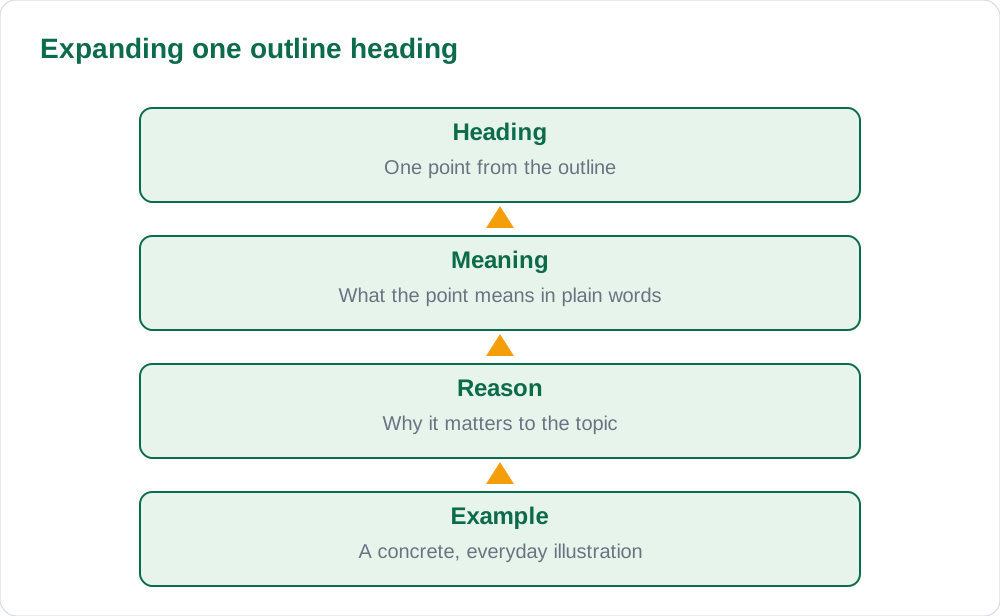
Expanding a heading means answering three questions about it: what does it mean, why does it matter, and what example shows it? A heading on its own is a label; a paragraph built from those three answers is an argument. Start the paragraph with a sentence that states the point in your own words, then explain it in two or three sentences, then give a concrete, everyday example that a reader can picture. End with a sentence that connects the point back to the mazmoon's main topic, so the paragraph does not float free of the whole.
Use examples from ordinary life, general knowledge, and your own observation, not invented textbook material. An example about daily routine, family life, school, or the local community is easy to write accurately and easy for the examiner to follow. Keep the language natural: a mazmoon should read like thoughtful writing, not like a list of memorised phrases. If a sentence sounds forced or ornamental, simplify it — clarity and sincerity carry more weight than decoration.
Writing the introduction and conclusion
The introduction to an expanded mazmoon should present the topic, explain why it matters, and preview the headings you will develop. Three or four sentences are enough: a general opening, a sentence narrowing to the topic, and a sentence mapping the points to come. Avoid long, flowery openings that delay the real content; the examiner values an introduction that gets to the subject quickly and honestly. Write the introduction after planning the body, so it matches what you actually go on to say.
The conclusion should gather the developed points and state the overall message or lesson of the mazmoon, without introducing new headings. It should feel like an ending, not a repetition: restate the main idea in light of the examples and reasons you gave, and close with a calm, thoughtful sentence. A conclusion that merely repeats the introduction suggests the body added nothing; a conclusion that draws on the body shows that the expansion was genuine. More on conclusions generally is in Writing a Strong Conclusion That Synthesises a Long Answer.
- Open with the topic and why it matters, in three or four sentences.
- Preview the headings so the examiner can follow the expansion.
- Close by drawing on the points actually developed in the body.
- Introduce no new heading in the conclusion.
- Keep both introduction and conclusion proportionate to the body.
Length, balance, and language
Balance matters more than total length. An expanded mazmoon in which one heading fills half the answer and the rest are squeezed into a line each looks lopsided, however long it is. Give each heading roughly similar space, expanding the most important one a little more but never at the expense of the others. If you notice imbalance while writing, adjust immediately — shorten the long paragraph or add an example to the short one — rather than hoping the examiner will not notice.
Language should be clear, correct, and appropriate to the register your class uses for mazmoon writing. Use vocabulary you genuinely understand; a simple word used correctly beats an impressive word used wrongly. Read each paragraph back and check its grammar and flow, especially the connections between sentences. A mazmoon is judged as writing, not just as content, so neat presentation, clear paragraphs, and careful language are part of the marks.
Practising expansion before the exam
Practise expansion on outlines for everyday topics first, before applying it to class mazmoon topics. Take a short outline — for example, on the value of reading or the importance of cleanliness — and expand it into a full answer in a set time. Then check the result: does every heading have a paragraph, does every paragraph have an example, and do the introduction and conclusion match the body? This general practice builds the skill without depending on memorised material.
In class revision, apply the same method to the mazmoon outlines your teacher has given, always working from your own book and notes and never inventing textbook content. Ask your teacher to check one expanded mazmoon for balance and language; that feedback will improve every later attempt. You can organise your revision with books and solved notes, and the general frame is explained in Introduction, Body, Conclusion: A Frame for Long Questions.
AI Help: Muse AI
Muse AI is Meta's personal AI assistant. You can ask it to explain a concept in simple words, summarise a lesson, or make practice questions for revision.
For this topic, ask Muse AI to suggest everyday examples for an outline heading, or to check whether a draft paragraph stays on its heading.
Join Muse with invite code LTGSWD — in the Muse app, go to Settings > Redeem token and enter the code.
Disclosure: LTGSWD is the author's Muse invite code.
Muse AI does not give official STBB answers — always verify against your Sindh Textbook Board book and your teacher.
5 key points you must know
- An outline already gives the order: each heading becomes a paragraph.
- Expand each heading with meaning, reason, and a concrete everyday example.
- The introduction previews the headings; the conclusion draws on the body.
- Keep headings balanced — no single point should swallow the answer.
- Practise expansion on everyday topics before applying it to class outlines.
Frequently asked questions
How long should an expanded mazmoon be?
Long enough to develop every heading with an explanation and an example, and no longer. Balance matters more than total length: an answer that develops all headings evenly scores better than a very long answer dominated by one point.
Can I add my own headings to the outline?
You may split a broad heading or add a closely related point if it genuinely serves the topic, but do not abandon the given outline. The outline is the structure the question expects, so keep it as the backbone of your answer.
What kind of examples work best in a mazmoon?
Concrete, everyday examples from ordinary life, school, family, or the community. They are easy to write accurately and easy for the examiner to follow, unlike invented or half-remembered material.
Should I memorise full mazmoon answers?
No. Memorised answers often miss the question's exact wording and collapse under pressure. Learn the expansion method instead, so you can build a full answer from any outline your class has studied.
Solved notes — preview free
These guides work best with the solved exercises. Preview the solved notes free on this website — 119 solved notes for Classes 6–10 in Sindhi, Urdu, English and Arabic medium. Or browse the full solved notes catalogue for your class and medium. New solved notes are added regularly — check the catalogue for coming-soon books.