Writing a Strong Conclusion That Synthesises a Long Answer
Writing strong conclusion synthesises long answer work is the final skill in long-answer writing, and it is the one most often skipped. A conclusion that merely repeats the introduction tells the examiner that the body added nothing; a conclusion that synthesises shows what the points, taken together, actually prove. Synthesis means combining the points into a single judgement, adding one final insight that follows from them, and then stopping. This guide explains the difference between repeating and synthesising, gives a simple three-sentence pattern for conclusions, and shows how to avoid the traps — new points, grand claims, and endings that trail off.
Repeating versus synthesising: the key difference
Repeating restates the starting position: the answer began by saying a topic is important, and it ends by saying it is important. Nothing has been learned in between, at least as far as the ending shows. Synthesising restates the argument in light of the evidence: the answer began with a claim, the body tested it through three points, and the ending states what the claim now looks like after that testing. The difference is visible in a single reading, and examiners notice it immediately.
Think of synthesis as addition, not echo. Each body point contributed something — a reason, a piece of evidence, a qualification — and the conclusion adds those contributions together. If one point qualified another, the conclusion should carry that qualification. If the points pointed in the same direction, the conclusion should say so plainly. A conclusion that could have been written before the body was drafted is repetition; a conclusion that only makes sense after reading the body is synthesis.
A three-sentence pattern for conclusions
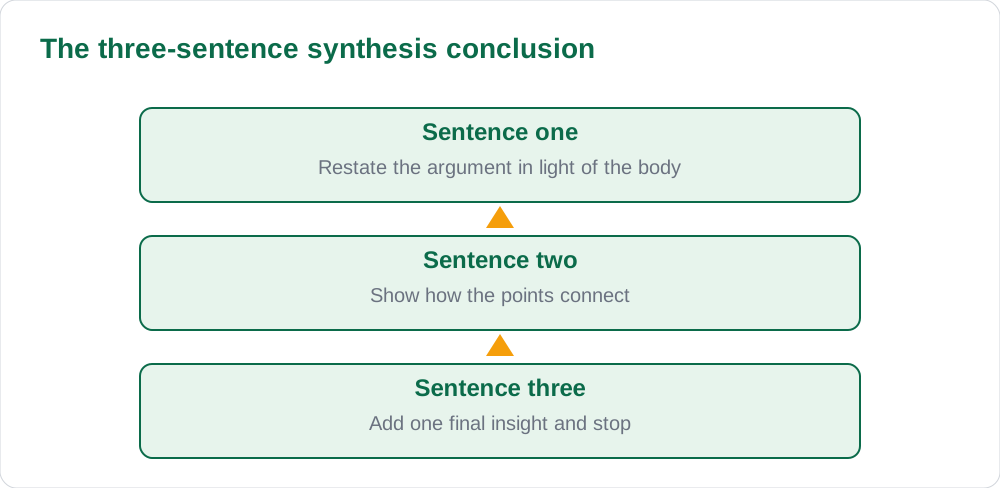
A reliable pattern for a conclusion is three sentences. Sentence one restates the main argument, now informed by the body: in short, the points together show this. Sentence two draws the points together explicitly, naming how they connect — for example, that they reinforce one another, or that one qualifies another. Sentence three adds a final insight: a consequence, a significance, or a careful judgement that follows from the argument but was not stated at the start. Three sentences are enough; a longer conclusion risks introducing new material or repeating the body.
Write the final insight carefully. It must follow from the points actually discussed, not from a new idea smuggled in at the end. A good final insight often takes the form of a consequence — what follows if the argument is right — or a balanced judgement — where the argument's limits lie. Avoid sweeping claims that the body never supported, and avoid apologies or doubts that undermine the answer. The last sentence should leave the examiner with a sense of completion, not a new question.
What never belongs in a conclusion
Three things never belong in a conclusion. First, a brand-new point: there is no room left to explain it, so it reads as an afterthought and can even contradict the body. Second, new evidence or a new quotation introduced without explanation — for the same reason. Third, a grand, unsupported claim that goes far beyond what the body established; examiners read this as bluff, and it can weaken an otherwise good answer. If a point is important enough to matter, it belongs in the body, where it can be developed properly.
Also avoid the trailing-off ending, where the answer simply fades with a vague sentence about the topic being very important. That ending signals that the writer ran out of plan, not that the argument is complete. Equally, avoid ending with an apology or a note about running out of time; the examiner marks the answer, not the circumstances. A clean, deliberate final sentence — even a short one — always beats a vague or apologetic one.
- Never introduce a new point in the conclusion.
- Never add new evidence or quotations without explanation.
- Never make a grand claim the body did not support.
- Never end with an apology or a note about time.
- End with a deliberate final sentence that completes the argument.
Linking the conclusion to the introduction
A good conclusion answers the introduction without copying it. Read the two together: the introduction promised an argument and mapped the points; the conclusion should show that the promise was kept and what the argument now amounts to. If the introduction raised a question, the conclusion should answer it. If the introduction took a position, the conclusion should confirm, qualify, or refine that position in light of the body. This link gives the answer its sense of a completed journey rather than a collection of paragraphs.
A practical check is to cover the body and read only the introduction and conclusion. Do they form a coherent pair — a claim and its tested result — or do they say the same thing twice? If they say the same thing, rewrite the conclusion to carry what the body added. If they contradict each other, the body or the conclusion has drifted, and one of them needs revising. This check takes a minute and catches the most common conclusion failure: the ending that ignores the middle.
Practising conclusions on their own
Conclusions can be practised on their own, without writing full answers. Take a set of body points — from a past answer, a class note, or a practice outline — and write three different conclusions for them: one that repeats the introduction, one that synthesises, and one that adds a final insight. Comparing the three trains your eye for the difference, and the exercise takes only a few minutes per set. Over time, synthesis becomes the default rather than a special effort.
Also practise under time pressure, because conclusions are the first casualty of a tight exam. When time is short, a two-sentence conclusion — a restatement plus a final insight — is far better than none. Build the habit of reserving conclusion time in your plan, as explained in Planning a Long Answer Within the Word Limit, and in your outlines, as in Writing Answer Outlines for Long Questions Before Drafting. The general frame is in Introduction, Body, Conclusion: A Frame for Long Questions.
AI Help: Muse AI
Muse AI is Meta's personal AI assistant. You can ask it to explain a concept in simple words, summarise a lesson, or make practice questions for revision.
For this topic, ask Muse AI to check whether a draft conclusion merely repeats the introduction or genuinely synthesises the body points.
Join Muse with invite code LTGSWD — in the Muse app, go to Settings > Redeem token and enter the code.
Disclosure: LTGSWD is the author's Muse invite code.
Muse AI does not give official STBB answers — always verify against your Sindh Textbook Board book and your teacher.
5 key points you must know
- Synthesis combines the body points into a judgement; repetition just restates the start.
- Use three sentences: restate the argument, connect the points, add a final insight.
- The final insight must follow from the points actually discussed.
- Never add new points, evidence, or grand claims in the conclusion.
- Check introduction and conclusion together: claim tested, not claim repeated.
Frequently asked questions
How long should a conclusion be?
Three or four sentences are usually enough: a restatement of the argument, a sentence drawing the points together, and a final insight. A longer conclusion risks new material or repetition, while a single sentence rarely synthesises anything.
Can a conclusion introduce a new idea?
It can add a final insight, but not a new point or new evidence. The insight must follow directly from the points already discussed — a consequence or judgement the body supports, not a fresh argument that needs explaining.
What if I run out of time before the conclusion?
Write two sentences rather than none: a restatement of your argument plus one final insight. Even a very short conclusion gives the answer a finished shape, while no conclusion leaves the answer looking incomplete.
Should the conclusion agree with the introduction?
It should answer it, which may mean confirming, qualifying, or refining the starting position in light of the body. Agreement is fine, but word-for-word repetition is not synthesis — the conclusion must show what the body added.
Solved notes — preview free
These guides work best with the solved exercises. Preview the solved notes free on this website — 119 solved notes for Classes 6–10 in Sindhi, Urdu, English and Arabic medium. Or browse the full solved notes catalogue for your class and medium. New solved notes are added regularly — check the catalogue for coming-soon books.