Introduction to Organic Chemistry and Hydrocarbons
Organic chemistry is the chemistry of carbon, and carbon is the element that life is built from. Every living thing — plants, animals, and you — is made of carbon compounds, and so are fuels, plastics, medicines, and most of the food you eat. This guide introduces organic chemistry through its simplest family, the hydrocarbons: compounds made of carbon and hydrogen only. You will learn why carbon is special, how carbon atoms link into chains, and how the first few hydrocarbons are named and used. We keep the chemistry concrete: the gas in a kitchen stove, the petrol in a motorbike, and the wax in a candle are all hydrocarbons, and understanding them is understanding organic chemistry at its foundation. You will also build models from everyday materials — a hands-on method that makes molecular shapes easy to remember. By the end you will be able to name the first hydrocarbons, draw their structures, and explain why they burn the way they do.
Why Carbon Is Special
Carbon is special because each carbon atom can form four bonds, and carbon atoms can bond to each other in long chains, branches, and rings. No other element builds structures with such variety. A carbon atom with four bonds can link to four hydrogen atoms, or to other carbons, or to a mix of both, and each arrangement is a different compound with different properties. This is why there are millions of known carbon compounds — far more than compounds of any other element — and why organic chemistry is a whole branch of chemistry on its own.
Carbon's four bonds come from its electron arrangement, 2,4: four outer electrons, needing four more to complete its shell, which it gains by sharing. That sharing gives covalent bonds, the bond type of nearly all organic compounds. The other elements in organic compounds — hydrogen, oxygen, nitrogen — fit around the carbon skeleton. Learn to see every organic molecule as a carbon skeleton with other atoms attached, and the whole subject becomes a matter of recognising skeletons.
Hydrocarbons: Carbon Plus Hydrogen
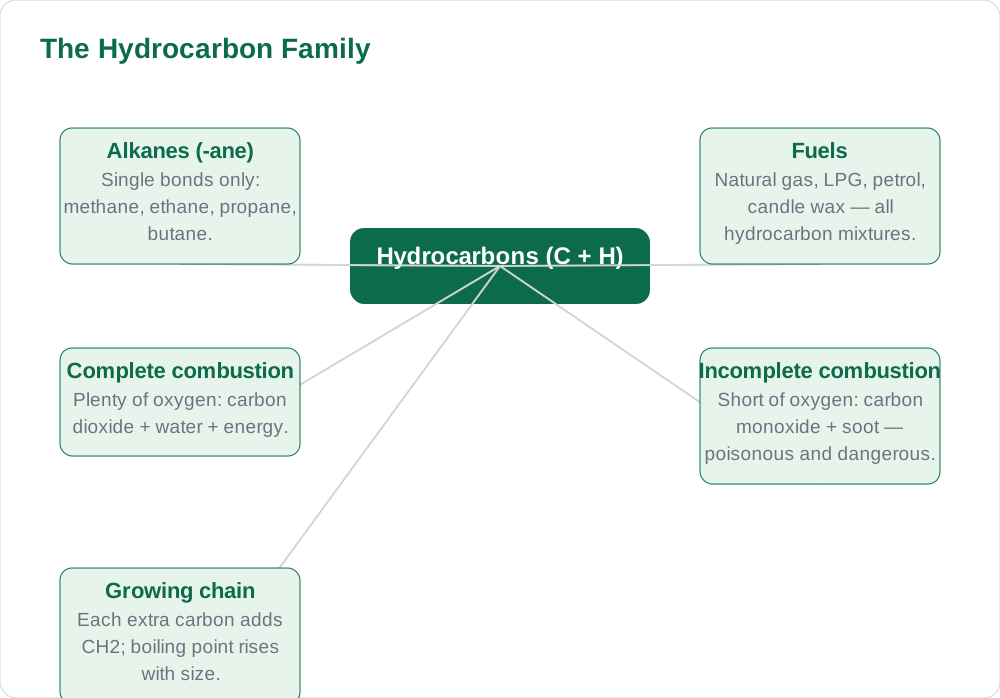
Hydrocarbons are the simplest organic compounds: they contain only carbon and hydrogen. The family is named by the number of carbon atoms: one carbon is methane, two is ethane, three is propane, four is butane. The endings tell you about the bonds: -ane means all single bonds, -ene means one double bond, -yne means one triple bond. For school chemistry, the -ane family, the alkanes, matters most, and the first four alkanes are worth memorising with their formulae: methane CH4, ethane C2H6, propane C3H8, butane C4H10.
Each alkane differs from the next by one carbon and two hydrogens — CH2 — a pattern called a homologous series. Members of a series show a steady change in properties: boiling points rise as molecules get larger, because bigger molecules need more energy to separate. The pattern means you can predict properties of a hydrocarbon you have never met, simply from its position in the series. That predictive power is one of the great satisfactions of organic chemistry.
Fuels: Hydrocarbons in Everyday Life
The most familiar hydrocarbons are fuels. Natural gas is mostly methane, used for cooking and heating. LPG, the gas in cylinders used in many homes, is mostly propane and butane. Petrol is a mixture of larger hydrocarbons, and candle wax is a mixture of still larger ones. All of them burn in oxygen to release energy, producing carbon dioxide and water when burning is complete: hydrocarbon + oxygen -> carbon dioxide + water + energy. That word equation is the same for every hydrocarbon fuel, and it is one of the most useful equations in school chemistry.
Incomplete burning, when oxygen is short, produces carbon monoxide and soot instead of carbon dioxide — both dangerous. Carbon monoxide is a poisonous gas that stops blood carrying oxygen, which is why gas heaters and stoves need ventilation and why car exhausts are harmful in closed spaces. When you answer questions about fuels, always distinguish complete from incomplete combustion, name the products of each, and mention the safety consequence. For energy in living things, see Ecosystem Energy Flow.
Building Models from Everyday Materials
Molecular models make organic chemistry visible, and you do not need a bought kit. Use small balls of modelling clay or rolled paper for atoms — black for carbon, white for hydrogen — and matchsticks or toothpicks for bonds. Build methane first: one black ball with four toothpicks, a white ball on each end. Then build ethane: two black balls joined by a toothpick, with three white balls on each carbon. Then propane: three carbons in a chain. Counting the bonds at each carbon — always four — checks your model, and seeing the shapes makes the formulae memorable.
Models also show why structures matter. Butane's four carbons can form a straight chain or a branched shape, and the two arrangements are different compounds with different properties — a phenomenon called isomerism. You can discover this yourself by building butane two ways and seeing that both use four black and ten white balls. That discovery, made with your own hands, teaches more than any textbook paragraph, and it is exactly the kind of concrete learning that examiners reward when you describe it.
From Hydrocarbons to the Rest of Organic Chemistry
Hydrocarbons are only the beginning. Replace one hydrogen atom in methane with an -OH group and you get methanol, an alcohol. Replace it with a -COOH group and you get an acid. Add oxygen, nitrogen, or other elements to the carbon skeleton and you get the other families of organic chemistry: alcohols, acids, esters, and the huge molecules of life such as sugars, fats, and proteins. Each family has its own ending and its own properties, but the carbon skeleton underneath follows the same rules you learned with hydrocarbons.
Keep two habits as you go deeper. First, always count bonds at each carbon — four, every time — because a carbon with three or five bonds has an error. Second, learn each family's functional group, the small group of atoms that gives the family its behaviour. Organic chemistry rewards pattern-spotters: once you see the skeleton-and-group pattern, each new family is a variation on a theme you already know. For vocabulary skills that help with naming, see Science Vocabulary Roots and Lab Report Writing.
AI Help: Muse AI
Muse AI is Meta's personal AI assistant, and it can help with this topic by testing your naming: ask it for a number of carbon atoms and try to name the alkane and write its formula before checking your answer. Muse AI does not give official Sindh Textbook Board answers — always verify against your Sindh Textbook Board book and your teacher.
Join Muse with invite code LTGSWD — in the Muse app, go to Settings > Redeem token and enter the code.
Disclosure: LTGSWD is the author's Muse invite code.
5 key points you must know
- Organic chemistry is the chemistry of carbon, the element of life and fuels.
- Each carbon atom forms four covalent bonds and links into chains and rings.
- Hydrocarbons contain carbon and hydrogen only; alkanes end in -ane.
- Complete combustion gives carbon dioxide + water + energy; incomplete gives carbon monoxide and soot.
- Build models with clay and matchsticks — count four bonds at every carbon.
Frequently asked questions
What is a hydrocarbon?
A compound containing carbon and hydrogen only. Examples include methane, ethane, propane, and butane. Fuels such as natural gas, LPG, and petrol are hydrocarbons or mixtures of hydrocarbons.
Why can carbon form so many compounds?
Each carbon atom forms four covalent bonds and can bond to other carbon atoms in chains, branches, and rings, producing an enormous variety of skeletons with different atoms attached.
What are the first four alkanes?
Methane CH4, ethane C2H6, propane C3H8, and butane C4H10. Each differs from the next by CH2, and their boiling points rise as the molecules get larger.
What is the difference between complete and incomplete combustion?
Complete combustion in plenty of oxygen gives carbon dioxide + water + energy. Incomplete combustion in limited oxygen gives carbon monoxide and soot, which are dangerous.
What is isomerism?
Isomerism is when two compounds share the same formula but have different structures — for example, butane's straight chain and branched forms. The different arrangements give different properties.
Solved notes — preview free
These guides work best with the solved exercises. Preview the solved notes free on this website — 119 solved notes for Classes 6–10 in Sindhi, Urdu, English and Arabic medium. Or browse the full solved notes catalogue for your class and medium. New solved notes are added regularly — check the catalogue for coming-soon books.