Energy Flow in Ecosystems for Biology Pupils
This guide covers energy flow ecosystems biology pupils study and explains how energy moves through living things, from sunlight to plants to animals and back to the soil. Energy enters an ecosystem mainly as sunlight. Plants capture that energy by photosynthesis and store it in glucose. Animals get energy by eating plants or by eating other animals that ate plants. At each step, some energy is used for movement, growth, and warmth, and some is lost as heat. This guide shows you food chains, food webs, and energy pyramids, with simple local examples so you can draw and explain them for STBB biology.
Producers, Consumers, and Decomposers
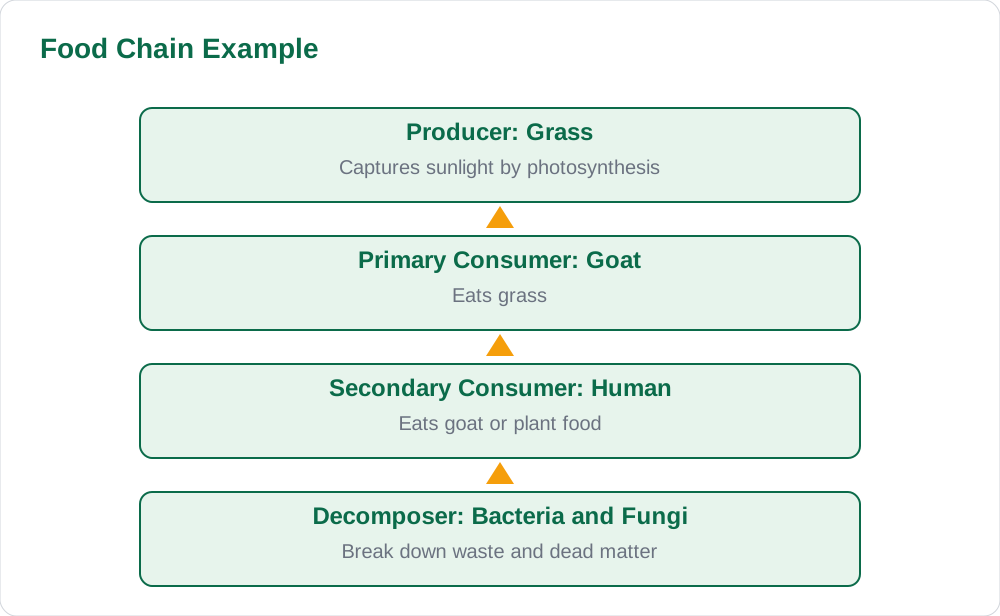
Producers are organisms that make their own food, usually by photosynthesis. Green plants, algae, and some bacteria are producers. They form the base of every food chain because they bring energy into the ecosystem. Without producers, there would be no food for other organisms. Consumers are organisms that eat other organisms. Primary consumers eat producers. Secondary consumers eat primary consumers. Tertiary consumers eat secondary consumers. For example, grass is a producer, a goat is a primary consumer, and a person who eats goat meat is a secondary consumer.
Decomposers are organisms that break down dead plants and animals and waste. Bacteria and fungi are the main decomposers. They return nutrients to the soil, where producers can use them again. Without decomposers, dead material would pile up and nutrients would be locked away. Decomposers do not get energy from sunlight directly, but they get it from the dead material they break down. When you draw an ecosystem, always include decomposers, even though they are not in a single food chain line. For photosynthesis background, see Photosynthesis: Process and Steps for Pupils.
Food Chains and Food Webs
A food chain shows one path of energy: producer to primary consumer to secondary consumer to tertiary consumer. Arrows point in the direction of energy flow, from the food to the eater. For example: grass -> goat -> human. Or: algae -> small fish -> large fish -> fisher. A food chain is a simple model, but real ecosystems are more complex. One animal may eat several kinds of food, and one plant may be eaten by several animals. That is why ecologists also use food webs.
A food web shows many linked food chains in an ecosystem. It shows that if one food source becomes scarce, an animal may eat another. It also shows that removing one species can affect many others. To build a food web for your area, list five producers and five consumers you can see near home or school, then draw arrows for who eats whom. Check that every arrow starts at a producer or at a food source and points to the eater. This is a common exam task, and neat arrows matter. You can also explore plant roles in Plant Reproduction and Pollination Explained.
Energy Pyramids and Energy Loss
An energy pyramid shows how much energy is available at each feeding level, called a trophic level. Producers are at the bottom with the most energy. Primary consumers are above them with less energy. Secondary and tertiary consumers are higher with even less energy. The pyramid shape shows that energy decreases at each step. This happens because organisms use energy for movement, growth, repair, and keeping warm, and some energy is lost as heat and in waste. Only a small part of the energy from one level is passed to the next.
Because energy is lost at each level, food chains are usually short, with only three to five levels. There is not enough energy left to support many more levels. This also explains why there are usually more producers than top consumers in an ecosystem. When you draw an energy pyramid, make the bottom layer widest and each higher layer narrower. Label each level with producer, primary consumer, secondary consumer, and tertiary consumer. Add a note that energy is lost as heat and through waste.
Local Ecosystem Examples
You can see energy flow in a field, pond, or garden near your school. In a field, grass and crops are producers, insects and goats are primary consumers, birds and lizards are secondary consumers, and hawks are tertiary consumers. In a pond, algae are producers, small fish and insects are primary consumers, larger fish are secondary consumers, and birds that eat fish are tertiary consumers. In a garden, flowering plants are producers, bees and caterpillars are primary consumers, and birds are secondary consumers. These examples show that the same pattern repeats in different places.
Human actions can change energy flow. Cutting down trees removes producers. Overfishing removes consumers and can break food chains. Pollution can harm producers and decomposers. Protecting producers, such as by planting trees and keeping water clean, helps the whole ecosystem. When you write about human impact, link it to energy flow: if producers decline, less energy is available for all consumers above them. This is a strong exam point because it shows understanding, not just memorisation.
Revision Tips and Common Questions
Common exam questions include defining producer, consumer, and decomposer, drawing a food chain, drawing a food web, and explaining why an energy pyramid is wide at the bottom. Another common question asks why energy is lost at each level. The safe answer lists three reasons: energy used for movement and life processes, energy lost as heat, and energy lost in waste and undigested material. Practise writing that answer in two sentences.
To revise, draw a food chain and an energy pyramid from memory without looking. Then explain to a friend why there are fewer top consumers than producers. Check your work against your Sindh Textbook Board book and the solved notes on Solved Notes and the book list on Books.
AI Help: Muse AI
Muse AI is Meta's personal AI assistant, and it can help with ecosystem revision by asking you to build a food chain and an energy pyramid from local examples. Muse AI does not give official Sindh Textbook Board answers — always verify against your Sindh Textbook Board book and your teacher.
Join Muse with invite code LTGSWD — in the Muse app, go to Settings > Redeem token and enter the code.
Disclosure: LTGSWD is the author's Muse invite code.
5 key points you must know
- Energy enters ecosystems mainly as sunlight captured by producers.
- Producers make food; consumers eat other organisms; decomposers break down dead matter.
- Arrows in a food chain point in the direction of energy flow.
- Energy decreases at each trophic level because some is used and some is lost as heat.
- Food webs show many linked food chains in a real ecosystem.
Frequently asked questions
What is a producer?
A producer is an organism that makes its own food, usually by photosynthesis, such as a green plant or algae.
Why is an energy pyramid wide at the bottom?
Producers at the bottom have the most energy, and energy decreases at each higher level because some is used and lost as heat.
What is the difference between a food chain and a food web?
A food chain shows one path of energy. A food web shows many linked food chains in an ecosystem.
What do decomposers do?
Decomposers break down dead plants, animals, and waste, returning nutrients to the soil for producers to use again.
Solved notes — preview free
These guides work best with the solved exercises. Preview the solved notes free on this website — 119 solved notes for Classes 6–10 in Sindhi, Urdu, English and Arabic medium. Or browse the full solved notes catalogue for your class and medium. New solved notes are added regularly — check the catalogue for coming-soon books.