Changing Subjects or Groups: General Board Process
Choosing subjects and a group — science, humanities, commerce or another stream — is one of the biggest decisions of school life, and sometimes the first choice turns out to be wrong. A pupil may discover a subject is far harder than expected, develop a new interest, or realise that a different group fits their career plans better. Boards do allow changes, but only through a defined process, only within certain windows, and usually only through the school. This guide outlines the general process for requesting a subject or group change, what to consider before asking, and what happens after approval. Exact rules, deadlines and fees differ between boards, so confirm every detail with your school and your board's official notice before acting.
Thinking Before You Ask
A change of subject or group is not a small administrative fix; it can mean a new syllabus, new textbooks, new teachers and a different examination. Before asking, work out why you want the change. If the reason is a difficult teacher or a poor test result, the problem may be fixable with extra help or a different study method, and a change may not be needed. If the reason is a genuine mismatch — you chose science but your strengths and interests are clearly in humanities, for example — then a change may be the right move, and the sooner it is made, the less syllabus you have to catch up.
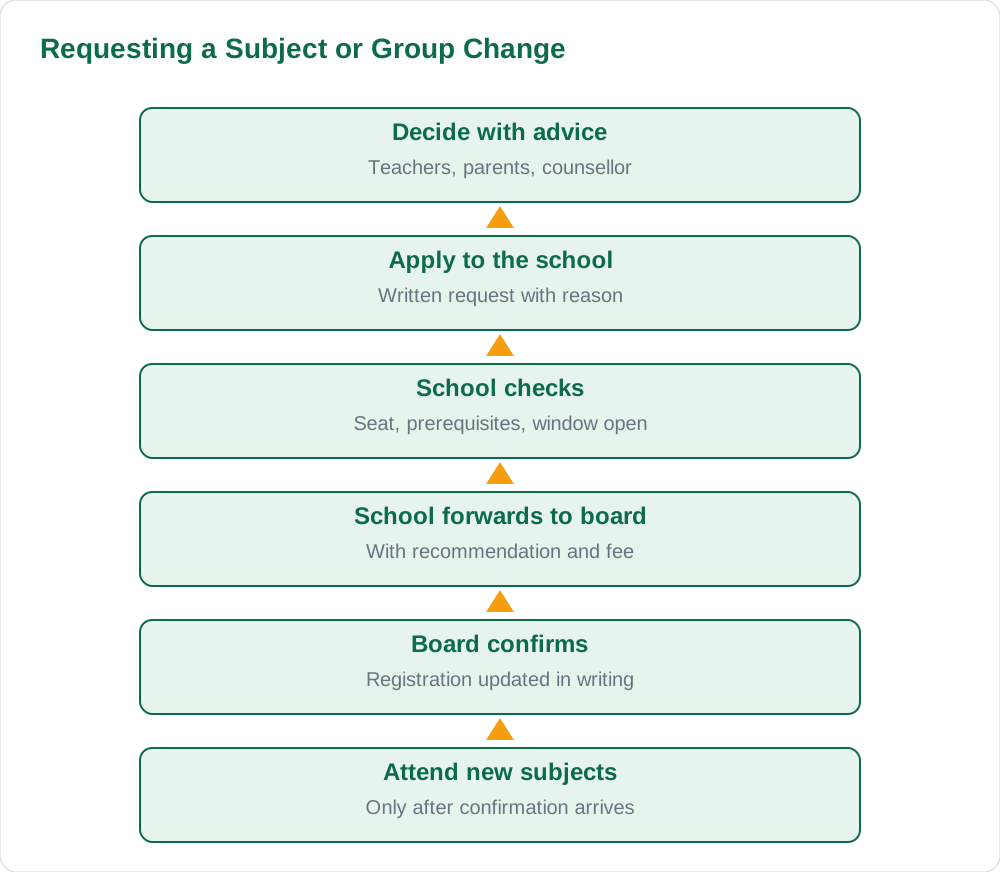
Talk to your teachers, your parents and, if your school has one, a career counsellor before deciding. Ask which subjects the new group requires, how much syllabus you have missed, and whether the new subjects affect your options after school, such as college admission requirements for particular programmes. A change that feels like freedom now can close doors later, for instance if a programme you want requires a subject you are dropping. Make the decision with full information, not in the heat of a bad week, and give yourself a few days to be sure before submitting anything.
The General Process Through Your School
In almost all cases, the request starts at the school, not at the board office. The pupil, usually with a parent, submits a written application to the school stating the current subjects or group, the requested change, and the reason. The school checks whether the change is possible: whether the new subject is taught at the school, whether there is a seat, whether the pupil meets any prerequisite, and whether the board's window for changes is still open. If the school supports the request, it forwards it to the board with its recommendation and any required fee.
The board then updates the pupil's registration record, and the change is confirmed, usually in writing through the school. Until that confirmation arrives, the pupil should continue attending the original subjects, because the old registration remains in force and the roll number slip will still show the old subjects. Never stop attending a subject on the assumption that a change is approved; if the application is refused or delayed, the pupil who stopped attending has lost both the old subject and time. Keep a copy of the application and any receipt, and follow up with the school if no reply comes within a reasonable time.
When Changes Are Possible — and When They Are Not
Timing is the biggest constraint. Changes are usually easiest early in the school year, when little syllabus has been covered and the board's registration has not yet been finalised. Once registration is locked, changes become harder and may require a formal board procedure with a deadline and a fee. After a certain point, often well before the examination, changes may not be allowed at all, because the board has already prepared roll number slips and examination material. A pupil who wants to change should therefore ask as early as possible, not in the final term.
Some changes are harder than others. Changing one optional subject for another within the same group is usually simpler than changing groups entirely, because the core subjects stay the same. Changing from science to humanities, or the reverse, usually means a new set of subjects and a large catch-up, and schools may require the pupil to show they can cope, for example through a test or a trial period. Changing to a subject the school does not teach is generally not possible without changing schools, which is a separate process with its own rules, covered in the migration certificate guide.
Catching Up After a Change
Approval is only the halfway point; the real work is catching up on the missed syllabus. Ask the new subject teachers for a list of topics already covered, borrow notes from a reliable classmate, and make a catch-up plan that spreads the missed work over several weeks rather than cramming it in a few nights. Prioritise the topics that later topics depend on, because in most subjects the syllabus builds on itself, and a gap in the foundations makes everything after it harder. Use your textbook systematically, chapter by chapter, and test yourself on each missed topic before moving on.
Do not neglect the subjects you kept while catching up, because falling behind in those at the same time creates a second problem. A balanced timetable that gives the new subject extra hours without starving the others is the practical answer, and a teacher can help you draw one up. If the catch-up proves too large, be honest with yourself and your teachers early, while there is still time to adjust the plan or reconsider, rather than struggling silently until the examination. Pupils who change subjects and catch up successfully usually share one habit: they asked for help early and often.
Mistakes to Avoid
The most common mistake is stopping the old subject before the change is confirmed, which leaves the pupil unregistered for anything if the application fails. The second is assuming a verbal promise from a teacher or a friend is the same as board approval; only a written confirmation through the school counts. The third is changing for the wrong reason, such as following friends into a group or escaping one difficult topic, and discovering the new group is no easier. The fourth is ignoring the effect on future options, such as a college programme that requires a dropped subject.
Avoid unofficial shortcuts altogether. No one outside the school and the board can change a board registration, and anyone who offers to do so for payment is running a scam that can damage the pupil's record. Keep every document — the application, the school's forwarding note, the fee receipt and the board's confirmation — in one file, because if a later document such as the roll number slip shows the old subjects, that file is the evidence you need to get it corrected quickly. If the slip does show an error, the name correction guide describes the general correction route, and your school can advise on the subject-change equivalent. For revision in the new subjects, the solved notes library and the books catalogue are good starting points.
AI Help: Muse AI
Muse AI is Meta's personal AI assistant, and it can help you weigh a subject change, for example by summarising the syllabus differences between two groups or by building a catch-up plan for the topics you have missed.
Join Muse with invite code LTGSWD — in the Muse app, go to Settings > Redeem token and enter the code.
Disclosure: LTGSWD is the author's Muse invite code.
Muse AI does not give official STBB answers — always verify against your Sindh Textbook Board book and your teacher.
5 key points you must know
- Decide with teachers, parents and a counsellor — a change can close future options.
- Apply in writing through your school, never directly to unofficial channels.
- Keep attending your old subjects until the board confirms the change in writing.
- Ask as early as possible — changes get harder or impossible once registration locks.
- Catch up systematically, topic by topic, and ask teachers for help early.
Frequently asked questions
Can I change my subjects myself at the board office?
Regular pupils normally apply through their school, which checks feasibility and forwards the request to the board. Only the board's written confirmation changes your registration.
When is the best time to request a change?
As early in the school year as possible, when little syllabus has been covered and registration has not yet been finalised. Late changes may be refused or may require a formal procedure with a deadline.
Is changing groups harder than changing one subject?
Usually yes. Changing one optional subject within the same group keeps the core subjects, while changing groups means a new set of subjects and a much larger catch-up.
What if my new subject is not taught at my school?
Then the change is generally not possible without changing schools, which is a separate process. Ask your school what options exist before assuming a transfer is possible.
Should I stop attending my old subject once I apply?
No — keep attending until the board confirms the change in writing. If the application is refused or delayed, stopping early leaves you behind in the old subject as well.
Solved notes — preview free
These guides work best with the solved exercises. Preview the solved notes free on this website — 119 solved notes for Classes 6–10 in Sindhi, Urdu, English and Arabic medium. Or browse the full solved notes catalogue for your class and medium. New solved notes are added regularly — check the catalogue for coming-soon books.