Migration Certificates: Purpose and General Process
When a pupil moves from one board to another — or from one province's board system to a different institution — the new place needs proof that the pupil's earlier record is genuine and that the pupil is free to enrol. That proof is often a migration certificate. It sounds like a small piece of paper, but without it, admission can stall at the counter while staff wait for verification. This article explains what a migration certificate is, why institutions ask for it, and the general steps pupils follow to request one. The exact process, fee, and timeline vary by board, so always confirm the current requirements with your school or the board's official notification. This is a general guide, not the board's own rulebook.
What a Migration Certificate Is
A migration certificate is a document issued by a board confirming that a pupil was registered or enrolled with that board and is released to join another board or institution. It is sometimes called a migration or transfer certificate at board level, although schools also issue their own leaving certificates — the two are different documents, and an institution may ask for either or both.
The certificate typically confirms your identity, your registration or enrolment details, and the examination record the board holds for you. It does not repeat your full marksheet; it simply certifies your standing with the issuing board so the receiving institution can admit you without doubt.
Why Institutions Ask for One
A new board or college needs to know that you are not enrolled in two places at once, and that your previous record is authentic. The migration certificate gives them that assurance in a standard form. Without it, the receiving institution may delay admission, ask you to produce extra proof, or place your enrolment on hold until the board confirms your record.
Pupils usually need a migration certificate when they move between boards — for example, from one city's board to another's — or when they join an institution that falls under a different board. If you are staying with the same board, you usually do not need one. When in doubt, ask the receiving institution directly: they will tell you exactly which documents they require.
The General Steps to Request One
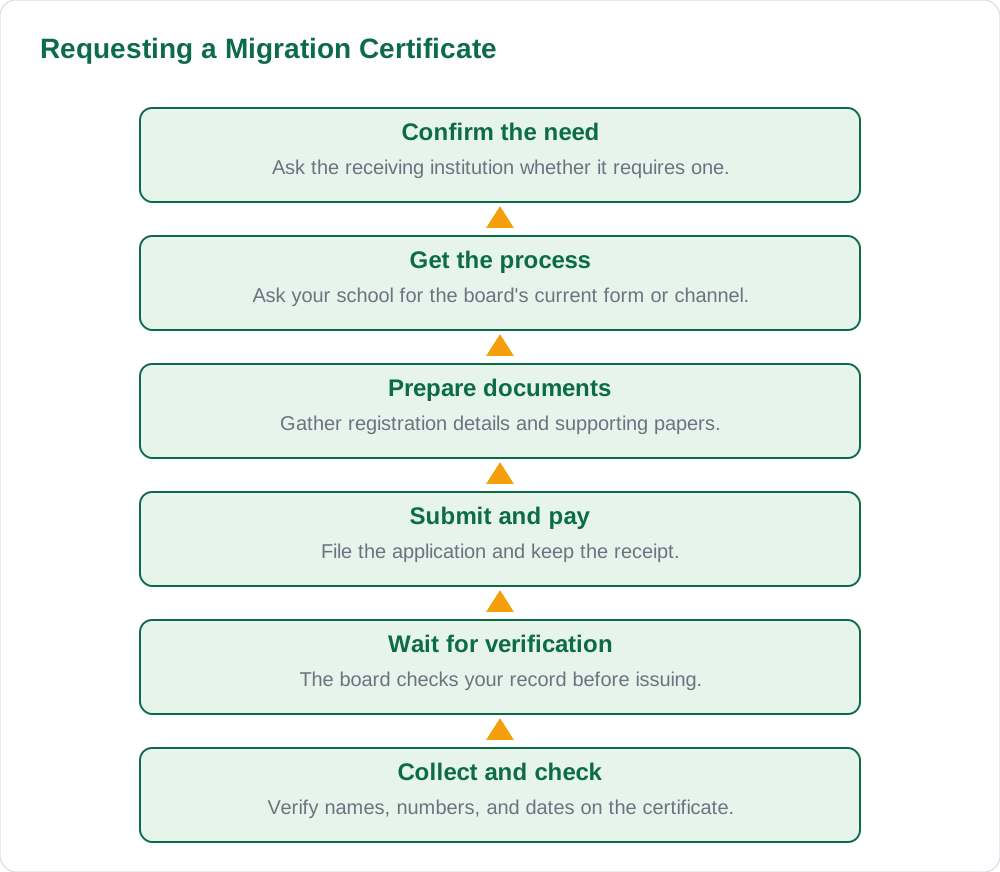
The general process usually begins at your school or current institution, which guides you on the board's prescribed form or online process. You typically submit an application with your personal and registration details, attach the documents the board asks for, and pay the prescribed fee. The board then verifies your record and issues the certificate, which you collect or receive through the channel the board specifies.
Because every board's process differs in detail, confirm the current steps, fee, and timeline with your school or the board's official notification before you apply. Do not rely on a friend's experience from a previous year — requirements and channels change. Keep copies of your application and any receipts until the certificate is safely in your hands.
Documents Pupils Usually Prepare
The exact list varies by board, but pupils are commonly asked for proof of identity, their board registration or enrolment details, their latest result or marksheet, and a leaving or school certificate. Some boards also ask for a forwarding note from the school. Having these ready before you start saves a second trip to the office.
Before you submit anything, make clear photocopies or scans of every document for your own file. Check that the names and numbers on your papers match each other. A small mismatch — a different spelling of a name, for example — can slow the process, so it is worth checking early. Your school can confirm the exact list the board currently requires.
- Identity proof, as the board currently requires.
- Board registration or enrolment number and details.
- Latest marksheet or result record.
- School leaving or transfer certificate, if asked for.
- Any forwarding note from your school, if required.
Timing Tips: Apply Early
Migration certificates take time, because the board must verify your record before issuing. Applying early — as soon as you know you will move — gives you room for delays without missing admission deadlines. If you wait until the last week, even a small query can become a crisis.
While you wait, keep studying. The certificate is paperwork; your preparation is the real work. Use the solved notes and your textbooks to keep revision on track, and check the admission requirements of the receiving institution so you can complete them the day the certificate arrives. A short, structured revision block helps — see how to finish the syllabus in 30 days.
Checking the Certificate When It Arrives
When you receive the certificate, check it the way you would check a marksheet: confirm your name, your father's name, your registration number, and any dates or examination details. If anything is wrong, report it to your school or the board promptly and ask about the correction process. A certificate with an error is of little use at the admission counter, so it is better to catch the problem before you travel to the new institution.
Store the original safely and keep a scanned copy. If the receiving institution keeps the original, make sure you have a clear copy first, and ask for a receipt for anything you hand over. Small habits like these save a great deal of trouble later. You can also browse the blog listing for more board guides.
AI Help: Muse AI
Muse AI is Meta's personal AI assistant. If you are moving boards, you can ask Muse AI to help you draft a checklist of questions to ask your school about the migration process, or to explain any unfamiliar term on the form. Muse AI does not give official Sindh Textbook Board answers — always verify against your Sindh Textbook Board book and your teacher.
Join Muse with invite code LTGSWD — in the Muse app, go to Settings > Redeem token and enter the code.
Disclosure: LTGSWD is the author's Muse invite code.
5 key points you must know
- A migration certificate confirms your standing with one board so another can admit you.
- It is different from a school leaving certificate — an institution may ask for either or both.
- Confirm the current process, fee, and timeline with your school or the board's notification.
- Prepare identity proof, registration details, and your latest result before applying.
- Apply early and check the certificate carefully when it arrives.
Frequently asked questions
What is a migration certificate used for?
It certifies that you were registered with one board and are released to join another board or institution. The receiving institution uses it to confirm your record is genuine and that you are not enrolled in two places at once.
Do I need a migration certificate if I stay with the same board?
Usually not. Migration certificates are generally needed when you move between boards or to an institution under a different board. Confirm with the receiving institution whether it requires one.
How long does it take to get a migration certificate?
The timeline varies by board and depends on verification of your record. Apply as soon as you know you will move, and confirm the current processing time with your school or the board's official notification.
Is a migration certificate the same as a school leaving certificate?
No. A school leaving certificate is issued by your school, while a migration certificate is issued by the board. An institution may ask for either or both, so check the exact requirement.
What if my migration certificate has a spelling error?
Report it to your school or the board promptly and ask about the correction process. Do not use a certificate with an error at the admission counter — get it corrected first.
Solved notes — preview free
These guides work best with the solved exercises. Preview the solved notes free on this website — 119 solved notes for Classes 6–10 in Sindhi, Urdu, English and Arabic medium. Or browse the full solved notes catalogue for your class and medium. New solved notes are added regularly — check the catalogue for coming-soon books.