Building a Weekly Study Planner for School Pupils

A weekly study planner is the single most useful tool a school pupil can own, because it turns a vague intention to study into a concrete plan for each day. Without a planner, homework piles up, revision gets pushed to the night before a test, and the subjects you find hardest quietly get ignored. With one, every subject gets its turn, every evening has a purpose, and you can see at a glance whether the week is balanced or overloaded. This guide shows you how to block school hours, homework, and revision into a realistic weekly planner that fits a real pupil's life in Sindh, including family time, rest, and play. The examples here are sample routines only, not official school schedules, and you should always adapt them to your own school timings and your teacher's instructions.
Start with the fixed parts of your week
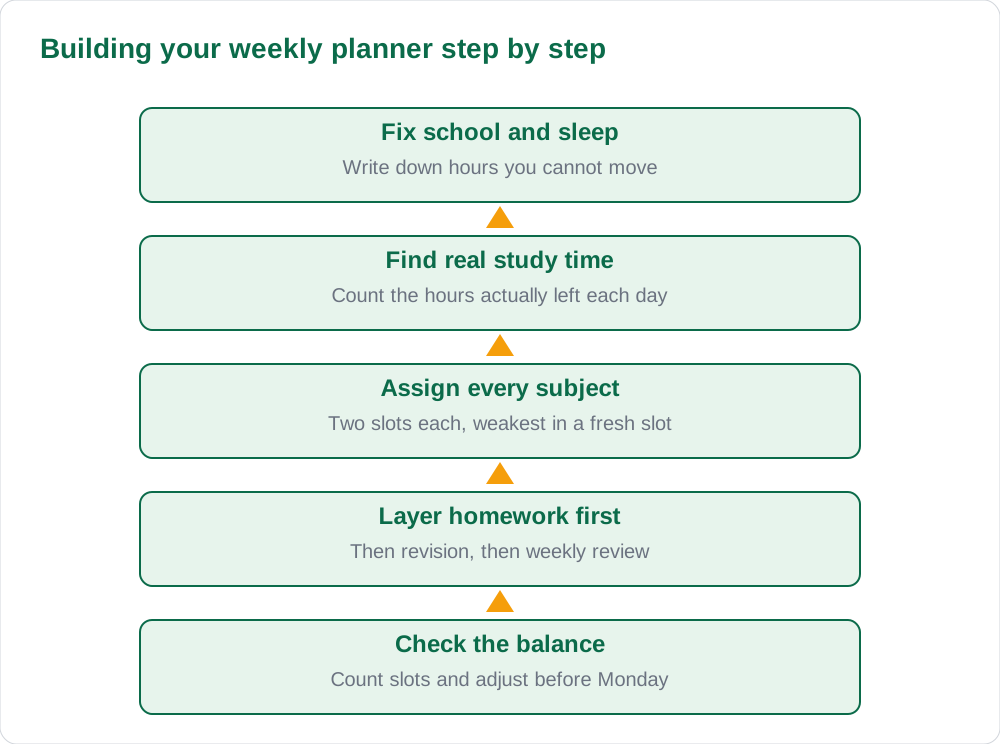
Every good planner starts with the parts of the week you cannot move. Write down your school hours first, including travel time, then add regular commitments such as tuition, family duties, meals, and sleep. What is left is your real study time, and it is usually smaller than pupils expect — often just two or three hours on a school day. Seeing this honestly is the whole point: a planner that pretends you have five free hours every evening will fail on the first day, while one built on your true free time can actually be followed.
Once the fixed blocks are in place, protect them. A planner works only if school and sleep are treated as non-negotiable, not as time you can borrow from when homework runs late. Pupils who cut sleep to finish homework usually pay for it twice: they work slowly that night and remember less the next day in class. Build your study blocks around a full night's sleep and a proper meal, and treat the remaining time as the budget you must spend wisely across your subjects.
Give every subject a regular slot, not a leftover slot
The most common planning mistake is giving favourite subjects the best slots and leaving hard subjects for whenever time remains, which is usually never. Instead, assign every subject at least two slots in the week, and place your weakest subject in one of your freshest slots, such as the first study block after school. Strong subjects still need regular slots, because even easy material fades without revision, but they do not need the prime position every day.
A simple way to check balance is to count slots at the end of the week. If Mathematics appears five times and Islamiat or Sindhi appears once, the week is not balanced, however busy it felt. Rotation also helps memory: returning to a subject every two or three days keeps it alive far better than a single long session once a week. For ideas on choosing which subjects need more attention, look at solved notes and your recent classwork to spot the gaps honestly before you plan.
Build the week in three layers: homework, revision, and review
Think of each study block as belonging to one of three layers. The first layer is homework: the work your teacher set for tomorrow, which must be finished before anything else, because unfinished homework creates trouble the very next day. The second layer is revision: going back over recent lessons, practising questions, and memorising key material. The third layer is weekly review: a short session, often on the weekend, where you look back over the whole week's lessons and note what still feels weak.
Keeping these layers separate stops the common trap of calling homework revision. Finishing tonight's homework is necessary, but it does not revise last week's chapter, and pupils who only ever do homework often feel shocked before a test because they never actually revised. A balanced evening might spend the first block on homework and the second on revision of an older topic. The planner makes this visible, so neither layer quietly disappears for weeks at a time.
Keep the planner visible and easy to change
A planner hidden inside a notebook that you never open is not a planner at all. Put it where you will see it every day: on your study wall, on the inside of a folder, or as the first page of your homework diary. Use pencil or erasable pen at first, because a new planner always needs adjusting in its first two weeks. The goal is a plan you actually follow, not a beautiful chart you are afraid to change.
Change is part of the system, not a failure of it. If a subject slot keeps getting missed, move it to a better time instead of feeling guilty every week. If a family event takes an evening, shift that evening's revision to the weekend rather than dropping it silently. A weekly planner should be reviewed for ten minutes every Sunday: what worked, what was missed, and what needs a different slot next week. That short review is what turns a one-week experiment into a lasting habit.
A sample week and the mistakes to avoid
As an example only, a school pupil might study for about two hours on a school evening: the first hour for homework, the second for revision of one or two subjects, with a short break between them. Saturday could hold a longer review session in the morning, and Sunday a light session for weak topics only. These timings are illustrations, not rules: your school hours, subjects, and energy are different, so adjust the example to your own week rather than copying it exactly.
Avoid three common mistakes. First, do not plan every free minute: a week with no rest built in will collapse by Wednesday. Second, do not copy a friend's planner, because their subjects, tuition, and energy pattern are not yours. Third, do not judge the planner after one bad day; judge it after two full weeks, and change one thing at a time. Pupils who keep a realistic planner usually find that homework stress falls, because the work has a place and a time instead of hanging over every evening. Browse books to match your planner to the subjects you are actually studying this term, and the blog for more study planning guides.
AI Help: Muse AI
Muse AI is Meta's personal AI assistant. You can ask it to explain a concept in simple words, summarise a lesson, or make practice questions for revision.
For this topic, ask Muse AI to help you draft a sample weekly planner: tell it your subjects and free hours, and ask it to suggest a balanced layout you can then adjust to your own school timings.
Join Muse with invite code LTGSWD — in the Muse app, go to Settings > Redeem token and enter the code.
Disclosure: LTGSWD is the author's Muse invite code.
Muse AI does not give official STBB answers — always verify against your Sindh Textbook Board book and your teacher.
5 key points you must know
- Start a weekly planner from fixed hours: school, travel, meals, and sleep come first.
- Give every subject at least two slots a week, with your weakest subject in a fresh slot.
- Separate homework, revision, and weekly review so revision is never crowded out.
- Keep the planner visible and review it for ten minutes every Sunday.
- Judge a planner after two full weeks, and change one thing at a time.
Frequently asked questions
How many hours should a school pupil study each evening?
There is no single correct number, because school hours and subjects differ. Many pupils manage well with about two focused hours on a school evening, split between homework and revision. What matters more than the total is regularity: a steady two hours every day beats five hours one day and nothing the next three days.
Should I plan study time on weekends too?
Yes, but lighter than weekdays. A weekend review session helps you catch up on the week's lessons and spot weak topics before they grow. Keep at least one part of the weekend free for rest and family, or the planner will feel like a punishment and you will stop using it.
What if I keep missing one subject's slot?
Move the slot instead of blaming yourself. A missed slot usually means the time was wrong, not that you are lazy. Try placing that subject earlier in the day, pairing it with a subject you enjoy, or shortening the session. If it still fails after two moves, ask your teacher for help with that subject.
Is it better to study one subject for a long time or several subjects briefly?
For most pupils, two subjects in one evening works better than one very long session. Shorter, focused blocks keep attention fresh, and returning to a subject every few days strengthens memory. Very long single-subject sessions often end in staring at the page rather than learning.
How do I start if I have never used a planner before?
Start with just one week and only three habits: write down fixed hours, assign every subject a slot, and put homework first each evening. Do not try to perfect the design. After that week, keep what worked, move what did not, and add one improvement at a time.
Solved notes — preview free
These guides work best with the solved exercises. Preview the solved notes free on this website — 119 solved notes for Classes 6–10 in Sindhi, Urdu, English and Arabic medium. Or browse the full solved notes catalogue for your class and medium. New solved notes are added regularly — check the catalogue for coming-soon books.