Bridging Math Terminology for Urdu-Medium Learners

Many Urdu-medium pupils understand the maths but stumble on the words. They know how to solve a sum in Urdu, yet freeze when the same idea appears in English as numerator, denominator, or perimeter. This guide builds a practical Urdu medium math terminology bridge: every key term paired with its English equivalent, its meaning in plain words, and a worked example. With a small daily routine, pupils can switch languages without losing meaning.
Why Maths Feels Harder in a Second Language
Maths is a language of its own, and Urdu-medium pupils are effectively learning it in two languages at once. In class, the teacher may say shumar kuninda for numerator, while the textbook, a past paper, or a tuition note uses the English word. When the pupil cannot connect the two labels to one idea, even a simple fraction question feels like a new topic. The difficulty is not the maths; it is the missing bridge between the two vocabularies.
The fix is to treat terminology as a skill, not as memorisation. Instead of cramming long word lists, pupils should meet each term inside a real example, say it in both languages, and use it in a sentence. A pupil who can say that the denominator tells how many equal parts the whole is divided into, in Urdu or in English, truly owns the term. For general study habits that support this kind of daily practice, see how to finish the syllabus in 30 days.
- One idea, two labels: always learn the Urdu and English term together, never alone.
- Meaning before spelling: if you cannot explain the term in your own words, you do not know it yet.
- Example first: meet each term inside a worked sum, then name it.
- Say it aloud: speaking both versions fixes the pair in memory far faster than silent reading.
Build a Two-Column Term Bank
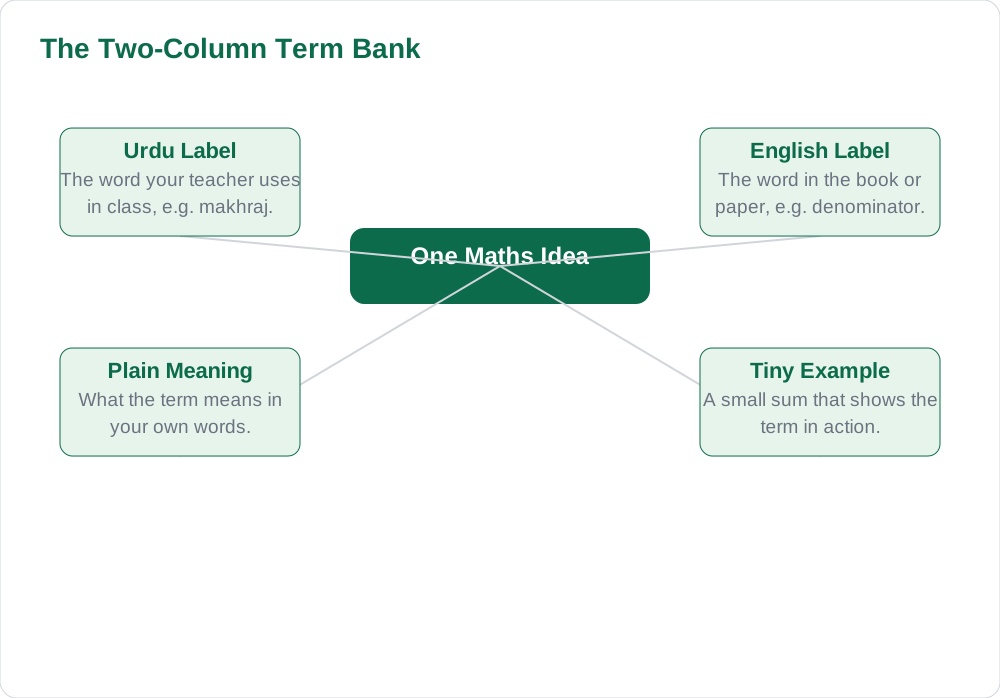
A term bank is a simple notebook page with two columns: Urdu term on the left, English term on the right, and a tiny example underneath each pair. Start with the twenty terms your current chapter actually uses, not a dictionary of hundreds. For fractions, that means pairs such as kasr and fraction, shumar kuninda and numerator, makhraj and denominator. For geometry, pairs such as muheet and perimeter, raqba and area, zawiya and angle. Keep the bank on one page per chapter so revision is quick.
Review the bank in short bursts: cover one column, recall the other, then check. Three minutes at the start of homework beats one long weekend session. Pupils who keep a tidy bank also find it easier to read solved material, including the worked examples on solved notes. Add new terms only when the chapter introduces them, and mark the ones you keep forgetting with a small star so they get extra turns.
- One page per chapter keeps the bank usable instead of overwhelming.
- Write a one-line meaning plus a tiny number example under each pair.
- Star the terms you miss twice; those get reviewed every day until they stick.
- Test both directions: Urdu to English and English to Urdu.
From Urdu Sentence to English Working
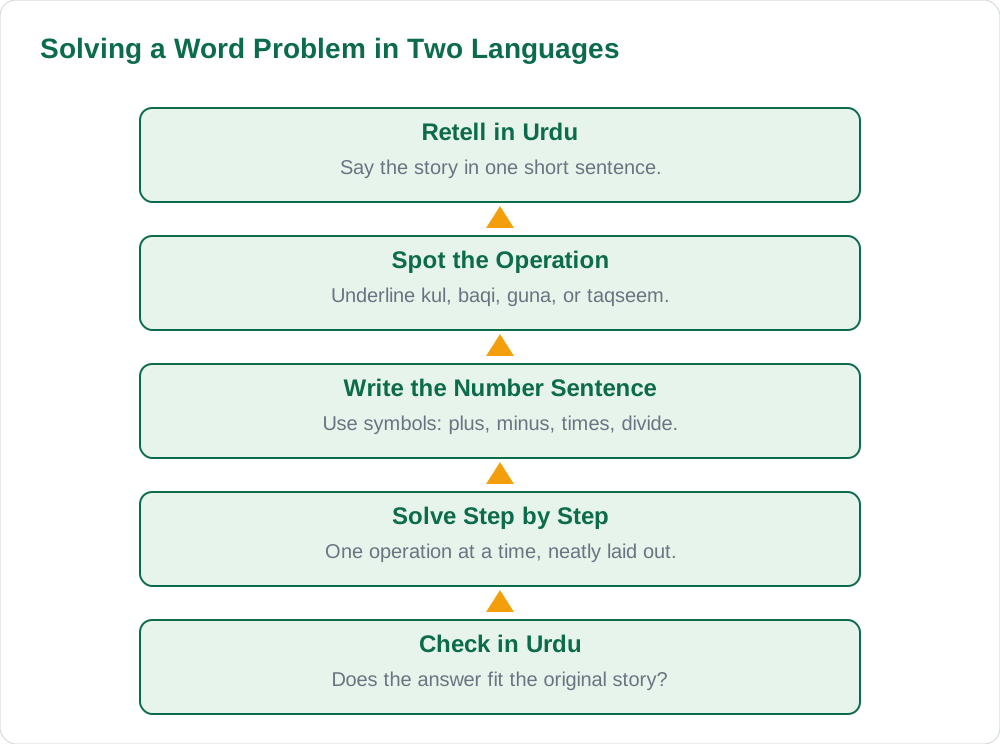
Word problems cause the most trouble because the pupil must translate the story and then do the maths. Teach a two-step habit: first retell the problem in Urdu in one sentence, then underline the numbers and the operation words. Words such as kul, baqi, guna, and taqseem point to addition, subtraction, multiplication, and division. Once the operation is clear, the pupil can set out the working in English symbols that every examiner understands, even if the thinking happened in Urdu.
Practise with short problems before long ones. A problem such as a shopkeeper has 240 pencils and packs them equally into 12 boxes becomes a simple division once the pupil spots taqseem and equal packing. Pupils who rush into numbers without retelling the story make careless errors. For a fuller method on word problems, read how to solve maths word problems.
- Retell the problem in one Urdu sentence before touching numbers.
- Underline operation words: kul, baqi, guna, taqseem, and their English twins.
- Write the number sentence in symbols, then solve step by step.
- Check the answer against the story: does it make sense in real life?
Worked Examples: Fractions, Geometry, and Algebra
Take fractions first. In the fraction 3 over 4, the Urdu pair is shumar kuninda 3 and makhraj 4. The denominator 4 says the whole is cut into four equal parts; the numerator 3 says we take three of them. A pupil who can say this in both languages will not confuse the two numbers, and will add fractions with the same denominator confidently: add the numerators, keep the denominator, then simplify if possible.
In geometry, perimeter (muheet) is the distance around a shape, while area (raqba) is the space inside it. A rectangle 6 cm by 4 cm has a perimeter of 20 cm because you walk all four sides, and an area of 24 square cm because you count the squares inside. In algebra, a variable (mutaghayyir) is a letter that stands for an unknown number, so 2x plus 3 equals 11 means two times some number, plus three, gives eleven. Solving it is unwrapping: subtract 3, then divide by 2, giving x equals 4.
- Fractions: denominator names the parts, numerator counts the parts taken.
- Geometry: perimeter walks the boundary, area counts the inside.
- Algebra: a variable is a mystery number; undo the operations in reverse order.
- After each example, say the key terms aloud in Urdu and in English.
Weekly Routine That Locks Terms In
A steady weekly routine beats last-minute cramming. Spend five minutes a day on the term bank: Monday for new terms, Tuesday for recall both ways, Wednesday for two word problems using those terms, Thursday for a quick written quiz, and Friday for correcting mistakes and re-starring weak terms. Weekend time goes to mixed revision, where old chapters return so terms do not fade. Parents can help by asking for the Urdu meaning of an English term at dinner, or vice versa, turning recall into a game rather than a test.
Teachers can support the routine by writing both terms on the board the first time a concept appears, and by accepting a correct answer explained in Urdu while the pupil learns the English label. Pupils should also keep their solved notes beside the term bank so that every worked example reinforces the vocabulary. Within a month, most pupils find that English questions stop feeling foreign, because every English term already has a familiar Urdu friend attached to it.
- Five minutes daily beats one long weekly session.
- Mix old terms with new ones so nothing fades away.
- Use the terms in real sums, not just in lists.
- Celebrate when a hard pair finally sticks; progress keeps motivation alive.
AI Help: Muse AI
Muse AI is Meta's personal AI assistant. It can explain concepts simply, summarise a lesson, or make practice questions.
Ask Muse AI to turn one maths chapter into a two-column Urdu-English term bank with a worked example for each pair.
Join Muse with invite code LTGSWD — in the Muse app, go to Settings > Redeem token and enter the code.
Disclosure: LTGSWD is the author's Muse invite code.
Muse AI does not give official Sindh Textbook Board answers — always verify against your Sindh Textbook Board book and your teacher.
5 key points you must know
- Learn every maths term as a Urdu-English pair with a plain meaning and a worked example.
- A one-page-per-chapter term bank makes daily revision fast and focused.
- Retell word problems in Urdu first, then write the working in symbols.
- Five minutes of daily recall beats long cramming sessions.
- Say terms aloud in both languages so the pair sticks in memory.
Frequently asked questions
How many new maths terms should an Urdu-medium pupil learn at once?
About five to eight per chapter is plenty. Learn each one with its Urdu twin, a plain meaning, and a worked example, then revise daily. A short list learned deeply beats a long list half-remembered.
What should I do if I understand the sum in Urdu but not the English question?
Retell the question in Urdu in one sentence, underline the numbers and operation words, then write the number sentence in symbols. The maths is the same; only the labels change, and your term bank bridges that gap.
Should pupils memorise English definitions word for word?
No. A definition in your own words, in Urdu or English, shows real understanding. Examiners reward correct working and clear meaning, not memorised sentences. Use the term bank to practise explaining, not just repeating.
How can parents help with maths terminology at home?
Ask quick two-way recall questions at a calm moment, such as what makhraj means in English, or what denominator means in Urdu. Keep it to a few minutes, praise effort, and let the pupil check the term bank rather than guessing under pressure.
Solved notes — preview free
These guides work best with the solved exercises. Preview the solved notes free on this website — 119 solved notes for Classes 6–10 in Sindhi, Urdu, English and Arabic medium. Or browse the full solved notes catalogue for your class and medium. New solved notes are added regularly — check the catalogue for coming-soon books.