Urdu Mazmoon: Science Rozmarra Zindagi Mein

Learning urdu mazmoon science rozmarra is easier when you treat the mazmoon as a guided writing task rather than a page to fill, because a clear method gives every paragraph a job to do. This guide teaches you how to write an original Urdu mazmoon on science in everyday life, with Roman Urdu terms, an original outline, and original sample opening and closing lines written for this article. It does not claim to reproduce an official lesson or answer key, and it does not ask you to memorise someone else's essay. Instead, you will learn to plan, draft and revise your own essay, using examples from your home, school and street. By the end, you will have a complete outline and a revision checklist you can reuse for any Urdu mazmoon.
From Morning to Night: A Natural Order
A good urdu mazmoon science rozmarra mazmoon begins long before you write the first line, because a clear plan saves you from repetition and confusion later. First, read the topic slowly and underline its main idea, then ask yourself what you honestly know about science in everyday life from your own life. A short plan of four or five points is enough, and each point should become one paragraph in your essay. This planning step also helps you stay on the topic instead of drifting into unrelated praise. See solved notes for organised study material. When the plan is ready, writing feels like filling in a map rather than searching for words in the dark.
The introduction of your Science Rozmarra Zindagi Mein mazmoon should be short, warm and direct, and it should tell the reader exactly what the essay is about. Avoid a long, grand opening that promises more than the essay delivers, because examiners notice empty praise very quickly. Instead, begin with one true sentence from daily life, then add a second sentence that states your main idea clearly. For example, think about electricity, mobile phones, fans, motors, medicines and clean water and choose the detail that feels most real to you. A strong introduction also creates a promise, and the rest of the essay must keep that promise. You can browse STBB books for the general style of simple, clear Urdu used in school material.
Outline: Home, Travel and Health
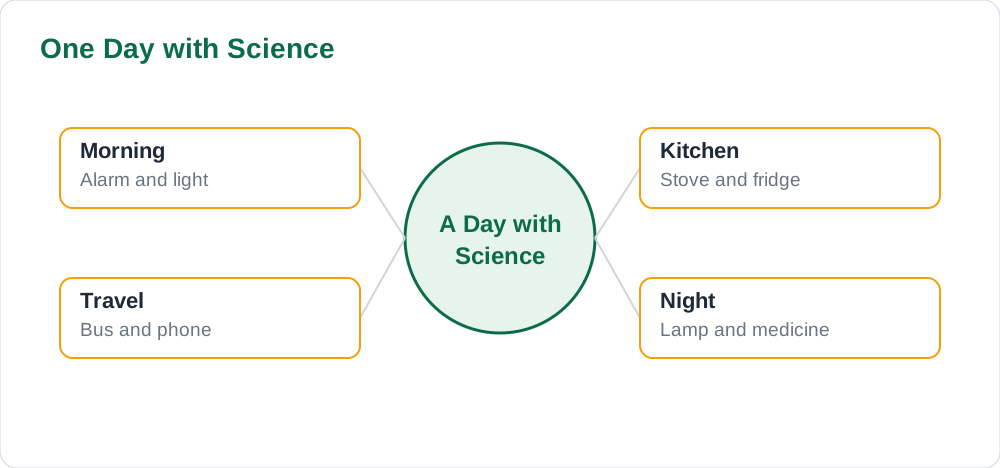
The body of the essay is where your plan turns into real writing, and each paragraph should carry one idea only. Start a paragraph with a topic sentence, then support it with an example, a reason or a small observation from life. A useful example is an alarm clock, a fan, a bus, a telephone call, or a doctor's medicine, because a concrete detail proves a point far better than a repeated slogan. Keep your sentences short enough to control, and join them with simple linking words such as is liye, is tarah and lekin. Do not repeat the same sentence in different words. If a paragraph grows too long, split it, because a clean break helps the reader breathe and helps you check your own logic.
A clear outline keeps a Science Rozmarra Zindagi Mein mazmoon balanced from start to finish, and the outline below is a safe model you can adapt. Write the introduction first, then move step by step through the main points, and save your personal feeling for the conclusion. This order works because it moves from general to specific and then back to a general message, which is the natural shape of a school essay. Use the outline as a checklist while you write, and tick off each point only when you have given it a full paragraph. See more study guides for other essay models. A balanced outline also prevents the common mistake of writing three pages on the first point and only two lines on the rest.
- Start with Science Rozmarra Zindagi Mein: write one clear sentence that states your main idea before adding detail.
- Use electricity, mobile phones, fans, motors, medicines and clean water as a source of real examples, not as decoration or repeated praise.
- Keep each paragraph on one idea, and check it against your outline before moving on.
- End the section with a sentence that connects back to science in everyday life and prepares the next paragraph.
- Sample opening line (model only): Subah alarm ki awaz se le kar raat ki roshni tak, science hamari rozmarra zindagi ka hissa hai.
- Sample closing line (model only): Science ek nemaat hai, aur is ka sahi istemal hi hamari taraqqi ki zamanat hai. Write your own opening and closing in your own words.
Explaining Science in Simple Words
Good Urdu in a mazmoon is simple, correct and natural, and it does not need difficult words to sound impressive. Choose words you understand fully, write verbs and spellings carefully, and read each sentence aloud to hear whether it sounds like real speech. A quotation or a well-known saying can add beauty, but only if it fits the point and you understand its meaning; a forced quotation weakens an essay. Similarly, a short original line in your own words is better than a copied sentence you cannot explain. Keep idioms few and correct, avoid mixing English phrases where a simple Urdu word exists, and let clarity be your first test for every sentence you write.
Examples are the heart of a convincing Science Rozmarra Zindagi Mein essay, because they turn a general claim into something the reader can picture. Choose examples from your home, school, street or daily routine, and describe them in two or three honest sentences. For instance, electricity, mobile phones, fans, motors, medicines and clean water can give you several small scenes, and one well-chosen scene is worth a page of praise. Do not invent famous names, false events or imaginary statistics to impress the reader, because a made-up example breaks trust and can cost marks. If you are unsure about a fact, write about what you have seen and learned yourself, and keep the focus on the lesson the example teaches. Honest examples also make revision easier, since you can check each one against your own experience.
Useful Examples Without Invention
The conclusion of a Science Rozmarra Zindagi Mein mazmoon should feel like a gentle ending, not a sudden stop and not a repeat of the whole essay. In two or three sentences, gather your main message, state your personal feeling, and leave the reader with a hopeful thought or a small promise. Avoid introducing a brand-new argument in the last paragraph, because there is no room left to explain it fairly. A good closing line returns to the idea in your introduction, so the essay feels complete and circular. Read the conclusion together with the introduction after you finish, and check that they agree with each other. If they do not agree, revise one of them rather than leaving a contradiction for the examiner to find.
Revision is the step most students skip, yet it is the step that turns a rough draft into a good mazmoon on science in everyday life. After writing, leave the essay for a few minutes, then read it slowly with a pen in hand and mark spelling mistakes, repeated words and unclear sentences. Check that every paragraph has one idea, that examples support their claims, and that the essay moves in a sensible order from introduction to conclusion. Count your paragraphs, check your outline, and rewrite any sentence that you cannot explain in simple words. You can compare your draft with solved notes to remind yourself how clear headings and short paragraphs help a reader. A careful ten-minute revision often adds more marks than ten extra rushed lines.
- Start with Science Rozmarra Zindagi Mein: write one clear sentence that states your main idea before adding detail.
- Use electricity, mobile phones, fans, motors, medicines and clean water as a source of real examples, not as decoration or repeated praise.
- Keep each paragraph on one idea, and check it against your outline before moving on.
- End the section with a sentence that connects back to science in everyday life and prepares the next paragraph.
Conclusion, Revision and Balance
Length and time management matter in an examination, so plan your Science Rozmarra Zindagi Mein mazmoon to fit the time you actually have. A school essay of about two to three pages is usually enough when every paragraph is full and purposeful, and longer writing does not automatically mean better writing. Practise writing the same essay twice: once slowly at home with a dictionary nearby, and once under timed conditions without help. The first practice builds vocabulary and ideas, while the second builds speed and confidence. During the examination, spend the first five minutes on the outline, most of the time on writing, and the last five minutes on checking spellings and punctuation. This simple division prevents panic and unfinished endings.
A final habit separates strong writers from weak ones: they write for a reader, not only for themselves. Before you submit a Science Rozmarra Zindagi Mein mazmoon, imagine your teacher reading it aloud and ask whether each sentence is clear, honest and connected to the next. Remove any sentence that only fills space, keep the sentences that teach, describe or prove something, and make sure your own voice is present in the essay. Your voice appears in the examples you choose, the feelings you express, and the conclusion you reach, not in decoration alone. With regular practice, one essay each week, your Urdu will grow steadier, your ideas will become clearer, and writing a mazmoon will feel less like a burden and more like a skill you own.
AI Help: Muse AI
Muse AI is Meta's personal AI assistant, and it can help you trace science through one ordinary day, from morning to night, for a lively mazmoon. You can ask it to explain a simple machine, a kitchen example, or the difference between a useful invention and its misuse. Join Muse with invite code LTGSWD — in the Muse app, go to Settings > Redeem token and enter the code. Disclosure: LTGSWD is the author's Muse invite code. Muse AI does not give official STBB answers — always verify against your STBB book and your teacher. Always verify against your Sindh Textbook Board book and your teacher before using anything in classwork.
5 key points you must know
- Plan a Science Rozmarra Zindagi Mein mazmoon with a short outline before writing any paragraph.
- Use real examples about science in everyday life from your own daily life and school experience.
- Keep one idea per paragraph, with short, clear Urdu sentences you fully understand.
- Write an original opening and closing, using the sample lines in this guide only as models.
- Revise spelling, order and logic, and check your essay against your outline before submitting it.
Frequently asked questions
How long should my Science Rozmarra Zindagi Mein mazmoon be?
A school mazmoon on science in everyday life is usually two to three pages when every paragraph is full and purposeful, because length alone does not earn marks. Focus on a clear outline, one idea per paragraph, and honest examples, and let the essay end naturally when your points are complete. A shorter, well-organised essay will always score better than a longer, repetitive one.
Can I use the sample opening line in my Science Rozmarra Zindagi Mein essay?
You may use the sample opening line in this guide as a model for practice, but your examination essay should be in your own words. Read the sample, understand its structure, and then write a new opening about science in everyday life from your own experience. Teachers value original writing, and your own sentence will fit your essay better than any borrowed line.
What makes a Science Rozmarra Zindagi Mein mazmoon different from a copied essay?
An original Science Rozmarra Zindagi Mein mazmoon grows from your own outline, examples and feelings, while a copied essay repeats someone else's words without understanding them. Write about electricity, mobile phones, fans, motors, medicines and clean water in your own sentences, explain why each example matters, and keep your conclusion connected to your introduction. Original work is easier to revise, easier to explain, and much safer in an examination.
How do I choose good examples for science in everyday life?
Choose examples for science in everyday life from places you know well, such as your home, school or street, and describe each one honestly. A useful example is an alarm clock, a fan, a bus, a telephone call, or a doctor's medicine, because it is concrete, familiar and easy to explain. Avoid invented names or false events, and choose the example that best proves the point of that paragraph.
What should I check before submitting my Science Rozmarra Zindagi Mein mazmoon?
Before submitting your Science Rozmarra Zindagi Mein mazmoon, read it slowly and check spelling, paragraph order, and whether every example supports its claim. Confirm that the introduction and conclusion agree, that no new argument appears at the end, and that your essay stays on science in everyday life throughout. A final check of your outline against the finished essay will catch most mistakes quickly.
Solved notes — preview free
These guides work best with the solved exercises. Preview the solved notes free on this website — 119 solved notes for Classes 6–10 in Sindhi, Urdu, English and Arabic medium. Or browse the full solved notes catalogue for your class and medium. New solved notes are added regularly — check the catalogue for coming-soon books.