Urdu Grammar: Zamir Ka Sahi Istemal
Urdu grammar zamir istemal is the art of using pronouns correctly, so that a paragraph flows smoothly without repeating the same names again and again. Zamir replace nouns, and when they are used well, writing feels natural and connected; when they are used badly, the reader cannot tell who is being talked about, and marks are lost. This guide also shows how respect levels change pronoun choice in real conversation. In this guide you will learn the kinds of zamir, the agreement rules they must follow, and the common pronoun errors that weaken student writing. You will also learn practical exercises for placing zamir correctly in real sentences. By the end, you will use pronouns confidently in essays, letters and exam answers.
What Is Zamir and Why Does It Matter?
Zamir is the ism that stands in place of a noun, so that a speaker or writer does not repeat the same name in every sentence, and it is essential to natural language in every culture. Imagine a paragraph that repeated a student's name in every sentence: it would sound robotic and tiring, while the same paragraph with zamir feels smooth, because words like woh, uska and unhon flow in place of the repeated name. Examiners value correct zamir use because it demonstrates control over connected writing, not merely knowledge of isolated words.
Zamir matters for marks in two ways: grammar questions test zamir identification and agreement directly, while essay and letter marking rewards the smooth, connected style that correct zamir creates. A paragraph with well-chosen zamir reads as mature writing, while a paragraph that repeats nouns endlessly reads as beginner writing, even when its ideas are good. Learning zamir is therefore not a small grammar chore but an investment in every written answer you produce. Start by noticing zamir in your textbook reading: circle each one and draw an arrow to the noun it replaces, and you will quickly see how authors use pronouns to build flowing paragraphs.
Kinds of Zamir by Person
Zamir is divided by person into first, second and third person, and each group has its own forms for singular, plural and respect, which students must learn as sets rather than single words. First-person zamir refer to the speaker, such as main and hum, second-person zamir refer to the listener, such as tum and aap, and third-person zamir refer to someone being talked about, such as woh and un. Examiners test person and respect together, often by asking which zamir fits a given situation, such as addressing a teacher versus addressing a friend.
Learning zamir by person works best through short dialogues, because pronouns live in conversation and their levels become clear when you hear who is speaking to whom. Write a three-line dialogue between a student and a teacher, then rewrite it as a dialogue between two friends, and notice which zamir change and which stay the same: the respect forms change, while the basic structure remains. Then convert a paragraph from first person to third person, changing every zamir, which trains the full set rather than isolated words. These conversion exercises mirror exam questions closely, and they also build the sensitivity to respect levels that marks mature Urdu writing.
Agreement Rules for Zamir
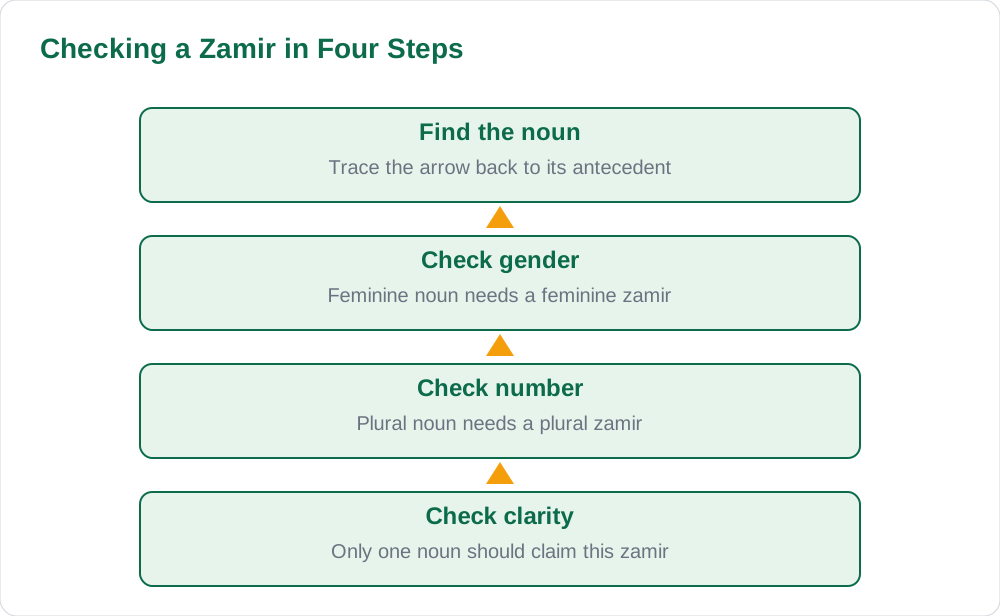
If the noun is a single feminine word, the zamir referring to it must be feminine and singular; if the noun is plural, the zamir must be plural; and if the noun is third person, the zamir must be third person too. Breaking any part of this agreement confuses the reader, because the zamir seems to point to a different noun than the one intended, and examiners mark such errors as grammar faults even when the rest of the sentence is correct. The rule sounds demanding, but it becomes natural with practice, because agreement is how the listener tracks who is who in a paragraph.
If any link fails, either the zamir is wrong or the arrow points to the wrong noun, and both problems are worth fixing, because an ambiguous arrow means the reader will also be confused. Practise the arrow test on textbook paragraphs first, where the correct answers are visible, and then on your own homework, where errors are real and fixing them teaches the most. After a few weeks of arrow practice, you will feel agreement mismatches as you write, and correct zamir will come without conscious checking, which is the goal of all grammar practice.
- Zamir must match its noun in gender, number and person.
- Respect level matters: aap for respect, tum for familiarity.
- The arrow test traces each zamir back to its noun to check agreement.
Common Zamir Mistakes in Student Writing
The commonest zamir mistake is the unclear antecedent: a zamir appears, but two nouns in the previous sentence could both claim it, leaving the reader unsure who is meant. This happens most often when a paragraph introduces two people of the same gender and number, and then uses a bare zamir that could refer to either. The cure is simple: when ambiguity is possible, repeat the noun once instead of using a zamir, because clarity matters more than economy, and examiners reward a clear sentence over a smooth-sounding but confusing one. Another frequent mistake is switching person mid-paragraph, such as starting in first person and drifting into third, which breaks the reader's sense of who is speaking.
A third common error is using a familiar zamir where respect is required, such as addressing a teacher or an elder with a familiar form, which sounds disrespectful even when the grammar is otherwise correct. A fourth is the distant zamir problem: a zamir appears many sentences after its noun, by which time the reader has forgotten the connection, so the sentence feels disconnected. Guard against all four by re-reading each paragraph after writing and asking, for each zamir, whether its noun is clear, near and correctly matched. This one-minute check catches most pronoun errors before the examiner ever sees them, and it steadily improves the connected quality of your writing.
Practising Zamir in Real Sentences
The best zamir practice uses real sentences from your lessons rather than isolated word lists, because pronouns only show their problems inside connected text. Take a paragraph from your Urdu reader, remove all its zamir, and rewrite it using only nouns: the result will feel heavy and repetitive, which teaches you why zamir exists. Then restore the zamir one by one, choosing each carefully and checking its agreement with the arrow test, until the paragraph flows again. This remove-and-restore exercise is enjoyable, takes ten minutes, and teaches both the function of zamir and the discipline of choosing them well, which is exactly the combination exam writing requires.
A second powerful exercise is person conversion: take a first-person paragraph, such as a diary entry, and rewrite it in third person, changing every zamir and every agreeing fail. The exercise forces you to handle the whole agreement system at once, and mistakes become visible immediately, because a single unchanged zamir breaks the new perspective. Do one conversion a week, and review it with the arrow test before considering it finished. Over a term, these exercises build a confident, natural command of zamir that shows in every essay and letter you write. For more grammar help, browse the blog and the solved notes page.
AI Help: Muse AI
Muse AI is Meta's personal AI assistant. It can explain zamir agreement in simple words and check the pronouns in your practice paragraphs on this topic. Join Muse with invite code LTGSWD — in the Muse app, go to Settings > Redeem token and enter the code. Disclosure: LTGSWD is the author's Muse invite code. Muse AI does not give official STBB answers — always verify against your STBB book and your teacher. Always verify against your Sindh Textbook Board book before using any explanation in classwork.
5 key points you must know
- Zamir replaces a noun to avoid repetition and to link sentences smoothly.
- First person is the speaker, second the listener, third the person talked about.
- Respect matters: aap is respectful, tum is familiar — choose by situation.
- A zamir must agree with its noun in gender, number and person.
- Use the arrow test to trace each zamir to its noun and check clarity.
Frequently asked questions
What is the arrow test for zamir?
Draw an arrow from each zamir back to the noun it replaces, then check gender, number and person along the arrow. If any link fails, the zamir is wrong or the arrow points to the wrong noun. The test also exposes unclear antecedents: if two nouns could both claim the zamir, the arrow is ambiguous and the sentence needs a repeated noun instead.
When should I repeat a noun instead of using zamir?
Repeat the noun when a zamir would be ambiguous — for example, when two people of the same gender and number appear in the previous sentence and a bare zamir could refer to either. Clarity matters more than economy, and examiners reward a clear sentence over a smooth-sounding but confusing one. One repeated noun restores clarity at once.
How do I choose between tum and aap?
Choose by respect and situation: aap is the respectful form for teachers, elders and formal situations, while tum is familiar and fits friends and peers. Using a familiar form where respect is required sounds disrespectful even when the grammar is correct, so examiners notice the choice. When in doubt in formal writing, choose aap.
Why does my paragraph drift between first and third person?
Person drift happens when you change perspective mid-paragraph without noticing, often while converting ideas from notes into full sentences. The cure is a final person check: read the paragraph and confirm that every zamir and fail belongs to the same person throughout. Person conversion exercises — rewriting a diary entry in third person — train this consistency directly.
How far can a zamir sit from its noun?
As close as possible: a zamir many sentences after its noun becomes a distant zamir, and the reader may forget the connection. If the gap grows beyond one or two sentences, repeat the noun once to refresh the connection. In exam answers, keep zamir near their nouns, especially when new people or things enter the paragraph.
Solved notes — preview free
These guides work best with the solved exercises. Preview the solved notes free on this website — 119 solved notes for Classes 6–10 in Sindhi, Urdu, English and Arabic medium. Or browse the full solved notes catalogue for your class and medium. New solved notes are added regularly — check the catalogue for coming-soon books.