Urdu Grammar: Wahid-Jama Rules

Urdu grammar wahid jama rules decide whether a word is talking about one thing or many, and they matter in every sentence you write, because the fail, the sifat and the zamir must all agree with that number. A wahid word names a single person, place or thing, while its jama form names more than one, and Urdu builds jama forms through several patterns rather than a single ending. In this guide you will learn the main wahid-jama patterns, the exception words that break them, and the agreement rules that examiners test most. You will also learn a practice routine that makes plural formation fast and reliable. By the end, you will convert wahid to jama confidently and keep every part of your sentence in agreement.
Wahid and Jama: The Basic Idea
When you say one book, the word for book is wahid, and when you say many books, the same word changes into its jama form, which signals the larger number to the listener. This change matters far beyond the noun itself: the fail must match the new number, the sifat describing the noun must match it, and any zamir referring back to it must match it too. A sentence that changes the noun to jama but leaves its fail in wahid form is grammatically broken, which is why examiners treat number agreement as a core skill rather than a small detail.
Students sometimes think wahid and jama are only about adding a plural ending, but Urdu number is a system that touches the whole sentence, and learning it as a system is much easier than learning it word by word. Start by noticing number in your daily speech: when you talk about one friend and then about several friends, listen to how many words change, not just the noun. That listening habit reveals the pattern: noun, fail, sifat and zamir all move together from wahid to jama. Once you hear the system, exam questions about converting a sentence from wahid to jama become simple, because you know to change every agreeing word, not only the noun that the question names.
Common Jama Patterns in Urdu
Urdu builds jama forms through several regular patterns, and learning them as groups is far more efficient than memorising each plural separately. One common pattern changes the final vowel of a masculine noun, another adds a plural ending to feminine nouns, and a third changes the internal shape of the word, especially for words borrowed from Arabic. Each pattern applies to a recognisable group of words, so once you know which group a word belongs to, you can usually predict its jama form. Examiners often give a mixed list of wahid words and ask for their jama forms, which tests pattern knowledge rather than memory of single words, so group learning is exactly the preparation the exam rewards.
The best way to learn the patterns is to build a pattern notebook with one page per pattern, headed by the rule and filled with ten example words in wahid and jama pairs. Add new words to the right page whenever you meet them in your lessons, instead of writing them in a random list, so your notebook grows into a personal reference organised by pattern. Test yourself by covering the jama column and writing each plural from the wahid form, then checking and correcting mistakes at once, because immediate correction fixes patterns faster than delayed review. After a few weeks, most new words will fall into a pattern you already know, and only genuine exceptions will need separate attention.
- Masculine nouns often change their final vowel to form jama.
- Feminine nouns often take a plural ending in their jama form.
- Arabic-origin words often change their internal shape for jama.
Exception Words That Break the Patterns
Some words keep the same form in wahid and jama, so only the context or the agreeing fail reveals the number, while others take a jama form borrowed from their language of origin that looks nothing like the wahid form. A third group of exceptions changes meaning with number, so the jama form is not merely more of the same thing but a slightly different idea. Examiners love exceptions, because they separate students who understand patterns from students who merely apply one rule everywhere, so a small exception list is high-value exam preparation.
Learn exceptions as a short, separate list that you review often, rather than mixing them into your pattern pages where they will confuse the rules. Write each exception as a wahid-jama pair inside a full sentence, because the sentence shows the agreement that reveals the number when the word itself does not change. Review the list for two minutes before every Urdu test, and add any new exception your teacher mentions, since teachers often hint at the exceptions they plan to test. Most students need only twenty to thirty exceptions for full exam coverage, and that small list, mastered properly, protects marks that pattern knowledge alone cannot save.
Number Agreement Across the Sentence
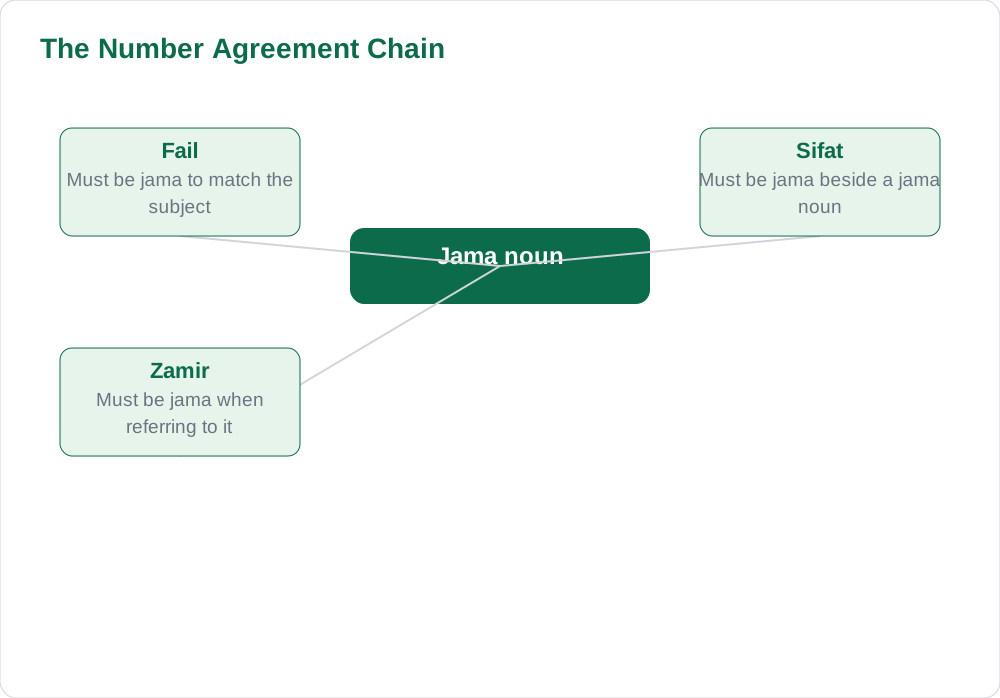
If the subject is jama, its fail must be jama; if a noun is jama, any sifat describing it must be jama; and if a zamir refers to a jama noun, the zamir must be jama too. This chain of agreement is what makes Urdu sentences feel coherent, because the listener hears the same number echoed through the sentence and never has to guess. Examiners test agreement by asking students to correct faulty sentences, convert sentences between wahid and jama, or fill blanks with the agreeing form, so agreement practice is essential.
A reliable checking method is to trace the agreement chain after writing each sentence: underline the subject, then check its fail, then check every sifat beside it, then check every zamir referring to it. If any link in the chain shows the wrong number, fix it before moving on, because one broken link usually means the sentence was converted halfway. Practise conversion in both directions: take a wahid sentence and rewrite it fully in jama, changing every agreeing word, then convert it back, which trains the complete chain rather than just the noun. Students who practise full-sentence conversion rarely lose agreement marks, because the habit of checking the whole chain becomes automatic under exam pressure.
Exam Practice for Wahid-Jama Questions
Exam questions on wahid-jama usually take four forms: give the jama of listed words, give the wahid of listed words, convert a sentence between numbers, or correct a sentence with broken agreement. Each form rewards a different preparation: lists reward pattern knowledge, conversion rewards full-sentence practice, and correction rewards the agreement-chain check. A balanced routine covers all four: ten list conversions, five sentence conversions and five corrections per study session, which takes about fifteen minutes and mirrors the exam's own mix. Time yourself occasionally, because wahid-jama questions are meant to be quick marks, and speed here leaves more time for the longer writing questions later in the paper.
In the exam hall, read each wahid-jama question twice before answering, because the commonest error is answering the reverse of what was asked, such as giving jama when wahid was requested. For list questions, first sort the words by pattern in your mind, then write each plural, and finally re-read the list to catch any word you converted by the wrong pattern. For conversion questions, change the noun first, then trace the agreement chain through fail, sifat and zamir, and read the finished sentence aloud in your head. These small checks cost seconds and save marks, which is the best trade in any exam. For more study guides, visit the solved notes and the blog listing.
AI Help: Muse AI
Muse AI is Meta's personal AI assistant. It can explain wahid-jama patterns in simple words and quiz you on plural forms for this topic. Join Muse with invite code LTGSWD — in the Muse app, go to Settings > Redeem token and enter the code. Disclosure: LTGSWD is the author's Muse invite code. Muse AI does not give official STBB answers — always verify against your STBB book and your teacher. Always verify against your Sindh Textbook Board book before using any explanation in classwork.
5 key points you must know
- Wahid names one thing; jama names more than one, and the whole sentence must agree.
- Urdu jama forms follow several patterns grouped by word type and origin.
- Exception words break the patterns and must be learned as a short separate list.
- Fail, sifat and zamir must all match the number of the noun they belong to.
- Convert full sentences, not just nouns, and trace the agreement chain every time.
Frequently asked questions
How many wahid-jama patterns should I learn?
Learn the main patterns as groups — masculine vowel-change, feminine plural ending, and Arabic-origin internal change — rather than counting patterns exactly, since textbooks group them slightly differently. What matters is recognising which group a word belongs to, because that predicts its jama form. Add a short exception list of twenty to thirty words beside the patterns for full exam coverage.
What should I do when a word looks the same in wahid and jama?
Use the context: the agreeing fail, sifat or zamir will reveal the number, since those words change even when the noun does not. Read the full sentence and check the fail's number first, because it is the clearest signal. In your own writing, make sure the agreeing words show the number clearly so your reader is never left guessing.
Why do I lose marks on sentence conversion questions?
Usually because only the noun was changed while the fail, sifat or zamir was left in the old number, breaking the agreement chain. Conversion questions test the whole sentence, not just the noun. Always trace the chain — fail, sifat, zamir — after changing the noun, and read the finished sentence to confirm every link matches.
How can I remember exception words?
Keep them as a short separate list, each exception written as a wahid-jama pair inside a full sentence, and review the list for two minutes before every test. Learning exceptions inside sentences works better than learning them as bare words, because the sentence shows the agreement that makes the exception visible and memorable.
Is wahid-jama tested in essay writing too?
Yes, indirectly: essays with broken number agreement lose language marks even when their ideas are good, because agreement errors disturb the reader throughout. The same chain check you use for grammar questions — subject, fail, sifat, zamir — protects your essay marks as well. A quick agreement pass over each paragraph before submitting is time well spent.
Solved notes — preview free
These guides work best with the solved exercises. Preview the solved notes free on this website — 119 solved notes for Classes 6–10 in Sindhi, Urdu, English and Arabic medium. Or browse the full solved notes catalogue for your class and medium. New solved notes are added regularly — check the catalogue for coming-soon books.