Urdu Grammar: Sifat and Its Kinds
Urdu grammar sifat kinds explain how describing words add colour and precision to a sentence, because a sifat tells you what kind of noun you are dealing with, how much of it there is, or how it relates to something else. Without sifat, every noun would stand bare, and writing would sound flat and vague, which is why examiners reward students who use sifat well. In this guide you will learn the main kinds of sifat — quality, quantity and relation — with plain definitions and everyday examples you can use at once. You will also learn how sifat agrees with its noun, and the common mistakes that weaken student answers. By the end, you will choose and place sifat confidently in your exam writing.
What Is a Sifat in Urdu Grammar?
In a sentence about a tall boy, the word tall is the sifat, because it describes the boy, while the boy himself is the ism being described. A sifat cannot stand alone as the subject of a sentence in the way an ism can, because its job is to qualify something else rather than to name something itself. This dependence is the key test for sifat: if a word only makes sense beside a noun it describes, it is behaving as a sifat, whatever its form may look like on its own.
Students often confuse sifat with ism-e-sifat, but the distinction is clear once you test the word's position: a quality word standing as the subject, as in honesty is precious, is an ism-e-sifat, while the same quality used beside a noun, as in an honest student, is a sifat. Examiners test this contrast regularly, so practise converting between the two forms, turning sifat phrases into ism-e-sifat sentences and back again. Another useful habit is to ask kaunsa, kaisa or kitna about the noun: the answer to those questions is usually the sifat, because those question words ask exactly for the description a sifat provides. This question test works on textbook sentences and on your own writing alike.
Sifat-e-Zaati: Adjectives of Quality
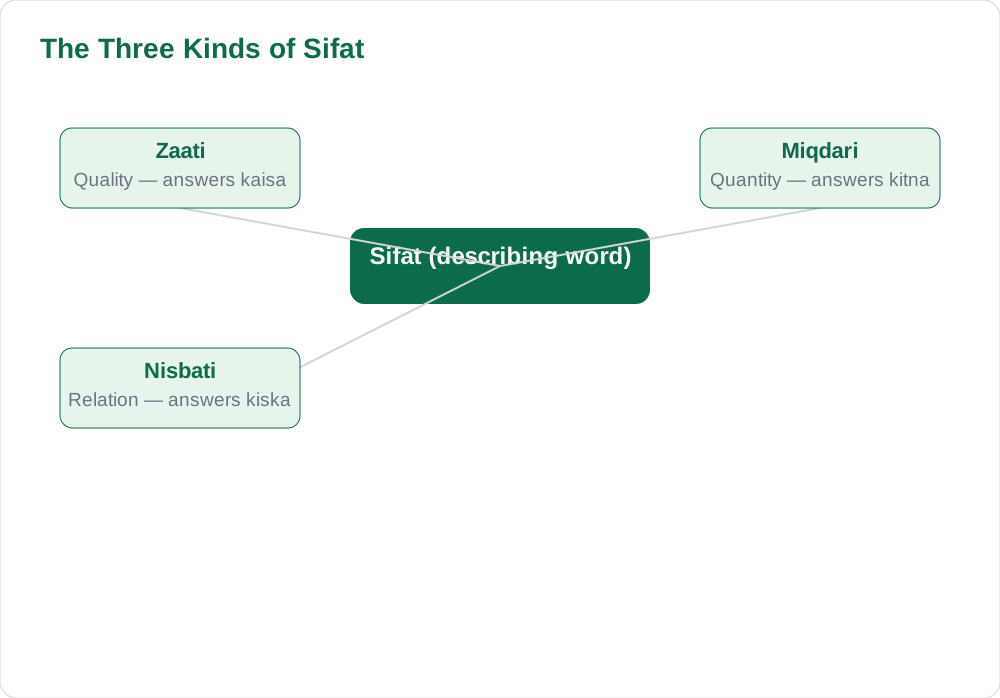
Sifat-e-zaati describes the quality, character or condition of a noun, answering the question kaisa, and it is the largest and most frequently used kind of sifat. Words for good, brave, tall, sweet, honest and hardworking all belong here, because each one paints a quality of the person or thing it describes. In a sentence about a brave student, the quality word is sifat-e-zaati, and removing it leaves a correct but colourless sentence, which shows that this sifat adds description without changing the basic structure. Examiners often ask students to underline sifat-e-zaati in a passage or to supply one for a given noun, so a rich vocabulary of quality words is direct exam preparation as well as good writing practice.
Each time you read a lesson, collect five quality sifat with the nouns they describe, and write them as pairs in your notebook, such as a brave student or a sweet fruit. Then practise using the same sifat with different nouns, which teaches you which qualities fit which nouns and prevents odd combinations in your own writing. In exams, prefer a precise quality word to a vague one: a diligent student says more than a good student, and examiners notice precision, especially in essay and letter writing where sifat carry much of the impression.
Sifat-e-Miqdari and Sifat-e-Nisbati
Sifat-e-miqdari describes quantity, answering the question kitna, and it covers both exact numbers and approximate amounts, from two books to much water and every student. Sifat-e-nisbati describes relation, showing that a noun belongs to, comes from, or is connected with something else, such as a school rule, a city road or a home task. These two kinds are tested together because students often confuse them: a quantity word counts or measures the noun, while a relation word links the noun to another idea. The question test separates them cleanly: if the word answers kitna, it is miqdari, and if it answers kiska or kis se mutalliq, it is nisbati, and applying the test takes only a second in an exam.
Quantity sifat need care with countable and uncountable nouns, because some quantity words fit countable things like books and students, while others fit uncountable things like water and time. Using a countable quantity word with an uncountable noun, or the reverse, is a common error that examiners mark, even though the sentence may still be understood. Relation sifat need care with agreement, because the relating word must match its noun in gender and number just like any other sifat. Practise both kinds by labelling sifat in a textbook paragraph, writing the question each one answers beside it, which trains the question test until it becomes automatic and protects you from the commonest classification mistakes.
- Sifat-e-miqdari answers kitna: it counts or measures the noun.
- Sifat-e-nisbati answers kiska: it links the noun to something else.
- Use the question test to classify any sifat in seconds.
Sifat Agreement with Its Noun
A masculine noun takes a masculine sifat form, a feminine noun takes a feminine form, a singular noun takes a singular form, and a plural noun takes a plural form, and the sifat changes its shape to match in each case. In a sentence about good students in plural, the describing word must show plural form, and in a sentence about a good girl, it must show feminine form, or the sentence will be marked wrong however good its ideas. Examiners test agreement through correction questions, fill-in blanks and sentence conversion, so agreement practice is essential for every student.
The safest checking habit is to read the noun-sifat pair together after writing each sentence, listening for a mismatch the way you would listen for a wrong note in music. If the pair sounds wrong, change the sifat to match the noun, never the noun to match the sifat, because the noun carries the meaning and the sifat follows it. Practise by converting sentences between masculine and feminine, and between singular and plural, changing the sifat each time, which trains agreement as a flexible skill rather than a memorised fact. Five conversions a day will make agreement automatic, and that automatic habit will protect marks in grammar questions, essays and letters alike, wherever sifat appear.
Using Sifat Well in Exam Writing
A paragraph that calls a student hardworking, honest and punctual gives a vivid picture, while a paragraph that repeats good and nice for every noun gives almost no picture at all. Variety matters too: reusing the same sifat for every noun makes writing monotonous, while a varied stock of quality, quantity and relation words keeps it lively. Build that stock from your reading, collecting sifat pairs in your notebook, and practise swapping a vague sifat for a precise one in your homework, which is the fastest way to raise the quality of your written Urdu.
Placement matters as much as choice: a sifat should sit beside the noun it describes, so the reader connects them at once, and a sifat placed far from its noun can seem to describe the wrong word. If any sifat seems to belong to two nouns, move it closer to the right one or rewrite the sentence, because ambiguity costs marks in comprehension-based marking. A final read-through of every answer with sifat placement in mind takes a minute and visibly improves the impression your writing makes. For more guides, see the blog and solved notes pages.
AI Help: Muse AI
Muse AI is Meta's personal AI assistant. It can explain sifat kinds in simple words and suggest precise describing words for your sentences on this topic. Join Muse with invite code LTGSWD — in the Muse app, go to Settings > Redeem token and enter the code. Disclosure: LTGSWD is the author's Muse invite code. Muse AI does not give official STBB answers — always verify against your STBB book and your teacher. Always verify against your Sindh Textbook Board book before using any explanation in classwork.
5 key points you must know
- A sifat describes a noun and only makes sense beside the noun it qualifies.
- Sifat-e-zaati describes quality and answers kaisa; it is the largest kind.
- Sifat-e-miqdari describes quantity and answers kitna; sifat-e-nisbati shows relation.
- A sifat must agree with its noun in gender and number, changing its form to match.
- Prefer one precise sifat to several vague ones, and place each sifat beside its noun.
Frequently asked questions
How is sifat different from ism-e-sifat?
Sifat describes a noun from beside it, as in an honest student, while ism-e-sifat names the quality as an independent idea that can stand as a subject, as in honesty is precious. Test the position: if the quality word can be the subject, it is ism-e-sifat; if it only sits beside a noun describing it, it is sifat. Examiners test this contrast regularly.
How do I classify a sifat quickly in an exam?
Use the question test: ask kaisa, kitna or kiska about the noun. Kaisa points to sifat-e-zaati, kitna to sifat-e-miqdari, and kiska or kis se mutalliq to sifat-e-nisbati. The test takes a second and works on almost every sifat in textbook sentences, so practise it until it becomes automatic.
What is the commonest sifat agreement mistake?
Leaving the sifat in its old gender or number after the noun has changed, especially in conversion questions where a sentence moves from singular to plural or masculine to feminine. Always change the sifat to match the noun, never the reverse, and read the noun-sifat pair together after writing to hear any mismatch.
How many sifat should I use in an exam paragraph?
Use enough to make the picture vivid but not so many that the paragraph becomes heavy: one precise sifat per important noun is a good rule. Prefer precise words like diligent and punctual to vague ones like good and nice, and vary your sifat instead of repeating the same word for every noun.
Can a quantity word be wrong for a noun?
Yes, when it does not fit the noun's countability: some quantity words fit countable nouns like books and students, while others fit uncountable nouns like water and time. Using a countable quantity word with an uncountable noun is a common marked error. Learn quantity words in countable and uncountable groups to avoid it.
Solved notes — preview free
These guides work best with the solved exercises. Preview the solved notes free on this website — 119 solved notes for Classes 6–10 in Sindhi, Urdu, English and Arabic medium. Or browse the full solved notes catalogue for your class and medium. New solved notes are added regularly — check the catalogue for coming-soon books.