Urdu Grammar: Muzakkar-Muannas Ki Pehchan
Urdu grammar muzakkar muannas ki pehchan is the skill of telling whether a noun is masculine or feminine, and it matters in every sentence, because the fail, sifat and zamir must all agree with the noun's gender. Unlike some languages, Urdu gender is not always obvious from meaning: a word for a strong object can be feminine, and a word for a delicate thing can be masculine, so students must learn clues rather than guess. In this guide you will learn the main gender clues, the agreement test, and the tricky words examiners love. You will also learn a practice routine that makes gender identification fast and reliable. By the end, you will name the gender of common nouns confidently and keep your sentences in agreement.
Why Gender Matters in Urdu Sentences
This gender controls the shape of the fail that follows the noun, the form of any sifat describing it, and the zamir that refers back to it, so a wrong gender choice echoes through the whole sentence. A masculine subject with a feminine fail sounds as wrong to an Urdu reader as a mismatched tense, and examiners mark agreement errors strictly because they show whether the student truly knows the noun. That is why gender identification is not a small vocabulary topic but a foundation skill that supports marks across grammar, comprehension and essay writing.
Students who struggle with gender usually struggle because they try to guess from meaning, such as assuming that large or strong things are masculine and small or gentle things are feminine. Urdu gender follows its own history and word patterns, not the size or strength of the thing named, so meaning guesses fail often. The reliable path is to learn gender together with each new noun, as part of the word itself, the way you learn its spelling. When you meet a new word in a lesson, note its gender beside it and notice the fail or sifat that agrees with it in the sentence, because that agreement is the textbook itself teaching you the gender.
Gender Clues from Word Endings
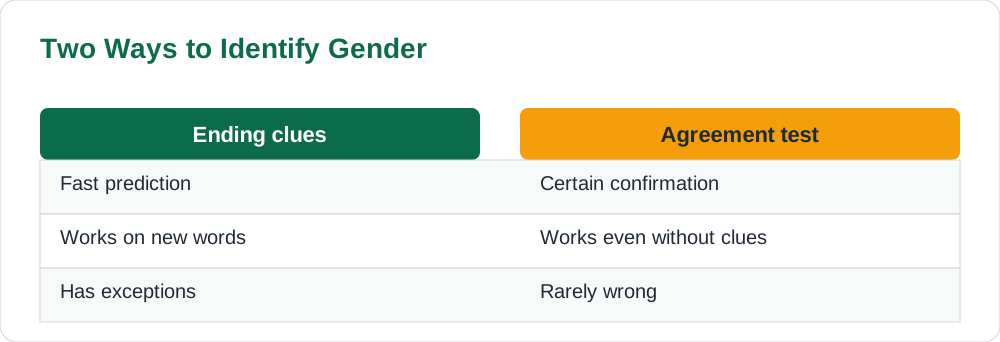
Word endings give the most useful gender clues in Urdu, because many masculine and feminine nouns follow recognisable ending patterns that hold for large groups of words. Certain endings appear mostly on muzakkar nouns, while other endings appear mostly on muannas nouns, and learning these tendencies lets you predict the gender of an unfamiliar word with good accuracy. The clues are tendencies rather than absolute rules, because every pattern has exceptions, but a tendency that is right most of the time is still valuable in an exam, especially when combined with a second clue. Examiners often test endings directly, giving words with typical endings and asking for their gender, so ending patterns are high-value preparation.
Learn endings in pairs rather than one by one: for each masculine tendency, learn the feminine ending that contrasts with it, and collect five example words for each side of the pair. Write the pairs in your notebook with the gender marked clearly, and test yourself by covering the gender column and guessing from the ending alone. When you meet an exception, move it to your tricky-words list instead of letting it weaken the pattern, because patterns plus a short exception list together cover far more words than either alone. Review the pairs before tests, and in the exam, use the ending clue first and confirm with the agreement test described below before writing your answer.
- Many muzakkar nouns share recognisable masculine endings.
- Many muannas nouns share recognisable feminine endings.
- Endings are tendencies: always confirm with agreement and exceptions.
The Agreement Test for Gender
If the noun sits comfortably with a masculine fail and a masculine sifat, it is muzakkar, and if it sits comfortably with feminine forms, it is muannas. This test works even for words whose endings give no clue, because agreement is the definition of gender in grammar: a noun's gender is exactly the agreement pattern it triggers. In exam questions that give a full sentence, the agreeing words are already there, so you only need to read them; in questions that give a bare word, you must supply the agreeing word yourself from memory.
Practise the agreement test by taking nouns from your lessons and writing each one in a short sentence with a sifat and a fail, then reading the sentence aloud to hear whether the agreement sounds natural. Your ear is a surprisingly good gender judge, because years of hearing Urdu have trained it to notice mismatches even when you cannot state the rule. If a sentence sounds wrong, try the opposite gender forms: when the feminine version suddenly sounds right, you have found the noun's true gender. Keep a notebook of the nouns you tested this way, marked with their gender, and the list will grow into a personal gender dictionary that covers your whole textbook.
Tricky Words Examiners Love to Test
Tricky gender words are the ones whose gender surprises students, either because the meaning suggests the opposite gender or because the ending follows the pattern of the other gender. These words appear in exam papers again and again, precisely because they catch students who guess from meaning or from endings alone, and a small list of them is worth many marks. Common traps include words for objects whose gender contradicts their size or character, words borrowed from other languages that kept their original gender, and pairs of similar words where one is masculine and the other feminine. Teachers often warn about these words in class, so class notes are a valuable source for your tricky list.
Build your tricky list deliberately: write each word with its gender, a sentence showing its agreement, and a short note about why it surprises you, because the surprise note is what makes it memorable. Review the list briefly before every test, and add any word that fooled you in homework or a class quiz, since a word that fooled you once is likely to appear again. Quiz yourself by covering the gender column and supplying both the gender and an agreeing sentence, which tests the full skill rather than bare recall. Twenty well-learned tricky words protect more marks than a hundred half-learned ordinary words, because tricky words are the ones examiners choose.
Keeping Gender Agreement in Your Writing
Gender agreement in writing requires the same chain check as number agreement: after writing a sentence, trace from the noun through its fail, its sifat and its zamir, confirming that every link shows the same gender. In longer essays, the risk grows, because a zamir several sentences later may drift to the wrong gender when the writer has forgotten the original noun. Re-reading each paragraph with gender in mind catches these drifts, and reading aloud helps further, because the ear notices a gender mismatch faster than the eye in a long paragraph.
Make gender checking part of your final pass over every written answer: one pass for ideas, one pass for grammar, and inside the grammar pass, one sweep for gender agreement. Mark any noun whose gender you are unsure of, and verify it against your notebook list or your textbook before submitting, rather than leaving a guess. Over time, the nouns you once marked will become certain, and your checking pass will grow faster, until gender agreement is simply part of how you write. For more grammar guides, browse the blog and the solved notes page, and check the books page for your class reader.
AI Help: Muse AI
Muse AI is Meta's personal AI assistant. It can explain muzakkar-muannas clues in simple words and quiz you on tricky gender words for this topic. Join Muse with invite code LTGSWD — in the Muse app, go to Settings > Redeem token and enter the code. Disclosure: LTGSWD is the author's Muse invite code. Muse AI does not give official STBB answers — always verify against your STBB book and your teacher. Always verify against your Sindh Textbook Board book before using any explanation in classwork.
5 key points you must know
- Every Urdu noun is muzakkar or muannas, and gender controls fail, sifat and zamir agreement.
- Word endings give useful gender tendencies, but they are not absolute rules.
- The agreement test confirms gender: pair the noun with a fail or sifat and hear which fits.
- Tricky words defy meaning and ending guesses; learn them as a short separate list.
- Trace the gender chain through fail, sifat and zamir in every written answer.
Frequently asked questions
Can I guess gender from the meaning of a word?
No, meaning guesses fail often, because Urdu gender follows word history and patterns, not the size, strength or character of the thing named. A strong object can be feminine and a delicate thing can be masculine. Use ending clues for a prediction and the agreement test for confirmation, and learn each new noun together with its gender.
What is the agreement test for gender?
Pair the noun with a fail, sifat or zamir and see which gender form fits naturally. If masculine forms fit, the noun is muzakkar; if feminine forms fit, it is muannas. This test is reliable because gender is defined by the agreement pattern a noun triggers, so it works even for words whose endings give no clue.
Why do examiners test tricky gender words so often?
Because tricky words separate students who know gender from students who guess from meaning or endings alone. Words whose gender contradicts their meaning or ending are ideal test items for that reason. A short list of twenty tricky words, learned with agreeing sentences, protects marks that pattern knowledge alone cannot save.
How should I learn the gender of new words?
Learn gender as part of the word itself, the way you learn its spelling: when you meet a new word in a lesson, note its gender beside it and notice the fail or sifat agreeing with it in the sentence. Keep a personal gender notebook that grows with your textbook, and review it briefly before every test.
How do I check gender agreement in an essay?
Make a final grammar pass over each paragraph, tracing from each noun through its fail, sifat and zamir to confirm every link shows the same gender. Reading aloud helps, because the ear catches mismatches faster than the eye in long paragraphs. Mark uncertain nouns and verify them against your notebook before submitting.
Solved notes — preview free
These guides work best with the solved exercises. Preview the solved notes free on this website — 119 solved notes for Classes 6–10 in Sindhi, Urdu, English and Arabic medium. Or browse the full solved notes catalogue for your class and medium. New solved notes are added regularly — check the catalogue for coming-soon books.