Urdu Grammar: Muhavare and Rozmarra
Urdu grammar muhavare rozmarra is the chapter where language becomes colourful, because muhavare carry wisdom in a few words and rozmarra phrases keep daily conversation natural and fluent. A muhavara says much more than its literal words suggest, while a rozmarra phrase is an everyday expression whose meaning is close to its words but polished by common use. In this guide you will learn how muhavare and rozmarra differ, how to understand a muhavara from its story, and how to use both correctly in exams and essays. You will also learn the mistakes that make idiom use sound forced or wrong. By the end, you will use idioms with the confidence of a fluent speaker.
What Is a Muhavara?
A muhavara is a fixed phrase whose meaning cannot be guessed from its individual words, because the phrase as a whole has taken on a figurative sense through long use. When someone uses a muhavara about the heart or the eyes, they are rarely talking about body parts at all: they are expressing courage, fear, love or wisdom through an image the whole language community understands. This figurative leap is what makes muhavare powerful: a single phrase can express a complex feeling or situation that would otherwise need a whole sentence. It is also what makes them difficult for learners, because translating the words literally gives nonsense, and only learning the accepted meaning unlocks the phrase.
Muhavare are fixed, which means their words cannot be freely changed or rearranged without breaking the idiom: swapping a word for a synonym usually destroys the phrase, even when the synonym means the same thing alone. This fixedness is a useful exam clue: if changing a word breaks the meaning, you are probably dealing with a muhavara rather than an ordinary phrase. Examiners test muhavare by asking for meanings, by asking students to use them in sentences, or by giving a sentence and asking which muhavara it illustrates. All three question types reward learning muhavare as whole units with their meanings, not as collections of separate words.
What Is Rozmarra?
Rozmarra means the everyday language of daily life: the common phrases, greetings, polite forms and routine expressions that fluent speakers use without thinking. Unlike a muhavara, a rozmarra phrase usually means something close to its literal words, but it is polished by habit into a standard form that sounds natural, while a word-by-word translation might sound stiff or foreign. Greetings, thanks, apologies, requests and farewells all belong to rozmarra, and mastering them is what makes a learner sound fluent rather than bookish. Examiners value rozmarra because it shows living command of Urdu, not merely grammar knowledge, and it appears in dialogue writing, letters and comprehension passages.
The best way to learn rozmarra is to listen and collect: notice the phrases your family, teachers and shopkeepers use in daily situations, and write them down with the situation they belong to. A phrase learned with its situation — a greeting for the morning, a polite request in a shop, an apology after a mistake — is remembered far better than a phrase learned from a list. Practise by using one new rozmarra phrase in real conversation each day, because a phrase used once in real life sticks better than a phrase read ten times. In exams, rozmarra knowledge shines in dialogue and letter questions, where natural phrasing earns impression marks that grammar alone cannot.
- Rozmarra phrases mean something close to their literal words.
- They are polished by daily habit into standard natural forms.
- Learn each phrase with the situation where it belongs.
Muhavare Versus Rozmarra: The Key Differences
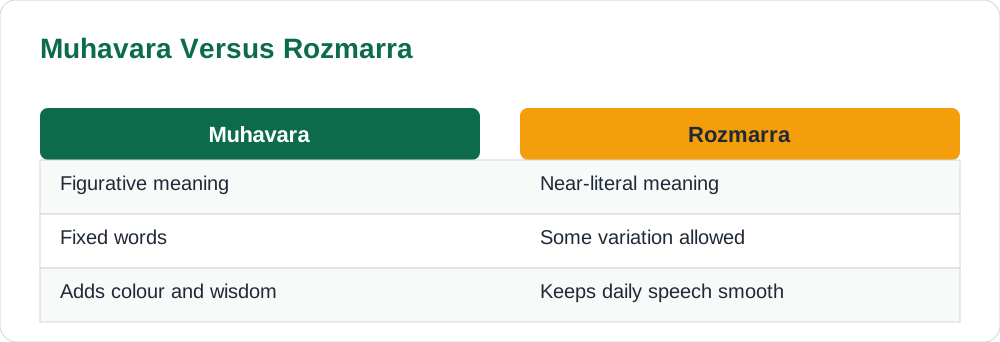
The key difference between muhavare and rozmarra is figurativeness: a muhavara means something different from its literal words, while a rozmarra phrase means roughly what its words say, in a polished everyday form. A second difference is fixedness: muhavare resist word changes, while rozmarra phrases allow some variation, since their meaning lives in the words themselves rather than in the whole phrase. A third difference is purpose: muhavare add colour, wisdom and emphasis to writing, while rozmarra keeps daily communication smooth and polite. Examiners often ask students to distinguish the two, giving a phrase and asking whether it is a muhavara or rozmarra, so the figurativeness test is the fastest answer: if the literal meaning fails, it is a muhavara.
A practical classification exercise is to take ten phrases from your lessons and sort them into two columns, testing each with the literal-meaning question. For each phrase, ask whether a stranger hearing only the words would understand it: if yes, it is probably rozmarra, and if no, it is probably a muhavara. Then check fixedness by trying a synonym swap: if the phrase breaks, that confirms muhavara, and if it survives, that confirms rozmarra. Doing this exercise weekly builds a reliable instinct for the distinction, and it also deepens your vocabulary, because each sorted phrase is learned with its meaning, its type and an example sentence at the same time.
How to Learn and Use Muhavare Correctly
Learning muhavare correctly means learning three things together: the exact words, the accepted meaning, and a sentence that shows the muhavara in action, because any one of the three alone is not enough for exam use. A student who knows the meaning but changes the words will be marked wrong, and a student who knows the words but uses the muhavara in the wrong situation will sound odd. The best notebook format has three columns — muhavara, meaning, sentence — and five new entries a week, reviewed regularly, will build a strong stock over a term. Choose muhavare from your textbook first, because examiners draw their questions from textbook idioms far more often than from rare or regional ones.
Using muhavare in essays requires restraint: one well-placed muhavara lifts a paragraph, while five crowded together make writing sound artificial, as if the student is showing off rather than communicating. Place a muhavara where its meaning genuinely fits the idea, not where it merely fills space, and check that its tone suits the paragraph: a humorous muhavara in a serious essay about a tragedy would be a serious misjudgement. In exam answers, use muhavare you are sure of, because a misused idiom loses more marks than a plain sentence would, while a correctly used one earns clear credit. Confidence comes from the three-column notebook and from using each new muhavara in homework before trusting it in an exam.
Common Idiom Mistakes to Avoid
The commonest idiom mistake is literal translation: writing a muhavara's words in another language or explaining it word by word, which destroys its figurative meaning and confuses the reader. A second mistake is word substitution, replacing one word of a muhavara with a synonym and assuming the idiom survives, when in fact the fixed phrase has been broken. A third mistake is overuse, crowding an essay with idioms until the writing sounds like a list rather than an argument, which examiners penalise as poor style. A fourth is wrong-situation use, placing a light or humorous muhavara in a serious context, which shows that the student knows the words but not the meaning's weight.
Avoid all four mistakes with a simple rule: use only muhavare you have learned as whole units with their meanings and example sentences, and use each one only where its meaning genuinely fits. Before an exam, review your three-column notebook and mark the ten muhavare you know best, because those are the ones to trust under pressure. In the exam, if you are unsure of a muhavara's exact words or meaning, write a plain sentence instead: a correct plain sentence always beats a broken idiom. This discipline — confidence with a few, caution with the rest — is what separates strong idiom users from students who lose marks showing off. For more guides, see the blog and solved notes pages.
AI Help: Muse AI
Muse AI is Meta's personal AI assistant. It can explain muhavare meanings in simple words and give example sentences for idioms on this topic. Join Muse with invite code LTGSWD — in the Muse app, go to Settings > Redeem token and enter the code. Disclosure: LTGSWD is the author's Muse invite code. Muse AI does not give official STBB answers — always verify against your STBB book and your teacher. Always verify against your Sindh Textbook Board book before using any explanation in classwork.
5 key points you must know
- A muhavara is a fixed phrase with a figurative meaning beyond its literal words.
- Rozmarra is everyday polished language: greetings, requests, thanks and farewells.
- Literal meaning test: if literal sense fails, the phrase is probably a muhavara.
- Learn each muhavara as words plus meaning plus an example sentence.
- Use idioms sparingly and only where their meaning genuinely fits the context.
Frequently asked questions
How can I tell a muhavara from an ordinary phrase?
Apply the literal-meaning test: if the phrase's words, taken literally, do not explain its meaning, it is a muhavara. Then apply the fixedness test: try swapping a word for a synonym, and if the phrase breaks, that confirms it is a muhavara. Ordinary phrases and rozmarra pass the literal test and usually survive a synonym swap.
Why must muhavara words not be changed?
Because a muhavara's meaning lives in the whole fixed phrase, not in its separate words, so changing a word breaks the unit the language community recognises. Even a synonym with the same individual meaning destroys the idiom, since listeners recognise the exact phrase, not a paraphrase of it. Always learn and use a muhavara's exact words.
How many muhavare should I use in an essay?
One well-placed muhavara per paragraph is plenty, and sometimes one per essay is enough. Overuse makes writing sound artificial, as if the student is showing off rather than communicating, and examiners penalise it as poor style. Choose muhavare that genuinely fit the idea, and prefer a plain sentence to a forced idiom.
What is the best way to memorise muhavare?
Use a three-column notebook — muhavara, meaning, example sentence — with five new entries a week, reviewed regularly. Learning the words, meaning and sentence together prepares you for all three exam question types: giving meanings, using idioms in sentences, and identifying the muhavara a sentence illustrates. Start with textbook muhavare, since examiners draw from them most.
How is rozmarra tested in exams?
Rozmarra appears mainly in dialogue writing, letters and comprehension passages, where natural phrasing earns impression marks. It is rarely tested by direct definition questions; instead, examiners reward students whose dialogues and letters sound like real Urdu rather than translated English. Collect phrases with their situations from daily life to build this skill.
Solved notes — preview free
These guides work best with the solved exercises. Preview the solved notes free on this website — 119 solved notes for Classes 6–10 in Sindhi, Urdu, English and Arabic medium. Or browse the full solved notes catalogue for your class and medium. New solved notes are added regularly — check the catalogue for coming-soon books.