Urdu Grammar: Jumla-e-Murakkab

Urdu grammar jumla murakkab is the topic that takes you from short, simple sentences to the longer, richer sentences that earn high marks in essays and exam answers. A jumla-e-murakkab joins two or more simple sentences into one, using joining words and shared parts, so that related ideas travel together instead of standing apart. In this guide you will learn what makes a sentence murakkab, the two main ways of joining sentences, and the joining words examiners expect you to recognise. You will also learn how to combine sentences yourself, and how to avoid the run-on and fragment errors that weaken student writing. By the end, you will build compound sentences confidently and use them to make your written Urdu stronger.
Jumla-e-Mufrad and Jumla-e-Murakkab Compared
The difference is not length alone: a long simple sentence with many describing words is still mufrad, because it has only one fail doing the main work, whereas a murakkab sentence has two or more clauses, each with its own fail. In a sentence joining a morning action with an evening action, each action has its own fail, and the joining word links them into one murakkab whole. Examiners test this distinction by asking you to label sentences or to split a murakkab sentence into its simple parts, so counting the fails is the most reliable identification method.
Counting fails works because every clause in a murakkab sentence carries its own fail, while a mufrad sentence carries exactly one main fail. To practise, take a paragraph from your Urdu textbook and underline every fail, then group the fails by sentence: sentences with one fail are mufrad, and sentences with two or more are murakkab. Notice also how the joining words sit between the clauses, acting as hinges that hold the sentence together. This exercise trains both recognition and splitting, which are the two skills exam questions demand, and it also improves your reading, because you start to see how authors combine ideas instead of merely reading word by word.
Joining with Harf-e-Ataf: Equal Clauses
In this pattern, each clause could stand alone as a complete sentence, but the writer joins them to show that the ideas belong together, whether as addition, choice or contrast. A sentence joining a study action with a play action uses and to show addition, while a sentence offering two choices uses or, and a sentence showing a contrast uses but. Examiners frequently ask students to join two given simple sentences with a suitable harf-e-ataf, and the mark depends on choosing the joining word that matches the relationship between the ideas.
Addition calls for and, choice calls for or, contrast calls for but, and cause or result calls for its own joining words, so the meaning of the second clause decides the harf. A useful habit is to ask what the second clause does to the first: does it add to it, choose against it, contrast with it, or explain it. Answer that question first, and the harf follows naturally, whereas choosing the harf first often produces a sentence whose joining word fights its own meaning. Practise by joining ten pairs of simple sentences a day, and always say the relationship aloud before writing the harf.
- And joins clauses that add to each other.
- Or joins clauses that offer a choice.
- But joins clauses that contrast with each other.
Joining with Dependent Clauses
Dependent clauses often begin with words meaning when, because, if or that, and they add time, cause, condition or explanation to the main idea. In a sentence explaining that a student succeeded because of hard work, the because clause is dependent: it explains the success but cannot stand alone as a complete thought. Examiners test this pattern by asking you to identify the main and dependent clauses, or to combine two simple sentences so that one becomes dependent, which requires choosing both the right joining word and the right clause order.
The key skill with dependent clauses is recognising which clause carries the main message and which clause supports it, because the main clause usually comes first or last depending on emphasis, while the dependent clause moves around it. Try removing each clause in turn: the clause whose removal leaves a complete sentence is the main clause, and the clause whose removal leaves a fragment is the dependent one. This removal test works on every murakkab sentence and is fast enough for exam conditions. Practise it on paragraphs from your lessons, labelling main and dependent clauses, and you will soon read long sentences as structures with a centre and supports rather than as confusing strings of words.
How to Combine Two Simple Sentences
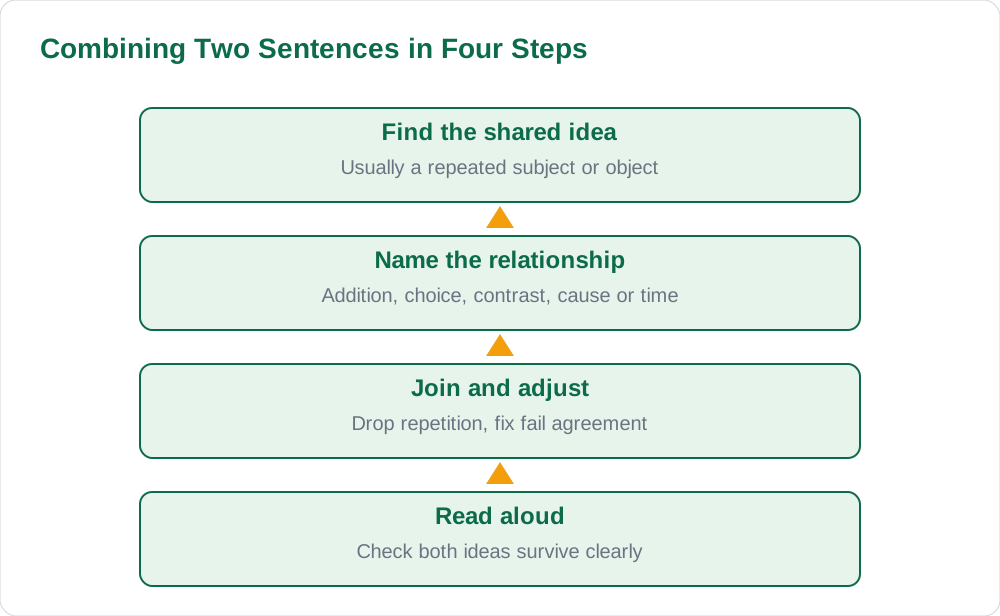
Combining sentences is a practical skill that examiners test directly, and it follows a clear sequence that prevents the common errors of repetition and mismatch. First, read both simple sentences and find the idea they share, which is usually a repeated subject or a repeated object that can be said once instead of twice. Second, decide the relationship between the ideas: addition, choice, contrast, cause or time, because the relationship chooses the joining word. Third, join the sentences with that word, dropping the repeated part and adjusting the fail agreement so the combined sentence agrees with its new subject. Fourth, read the result aloud and check that both original ideas survive in the new sentence without loss or distortion.
The commonest combining errors are keeping a repeated subject that should have been dropped, which makes the sentence clumsy, and choosing a joining word that contradicts the relationship, which makes it confusing. Another error is breaking fail agreement when two subjects are joined, because a joined plural subject needs a plural fail even when each subject alone was singular. Guard against all three by re-reading the combined sentence as a fresh reader would, asking whether it is smooth, whether its joining word matches its meaning, and whether its fail agrees with its subject. Five combinations a day, checked this way, will make sentence combining one of your most reliable exam skills and will visibly improve your essay paragraphs.
Run-On Sentences and Fragments to Avoid
Two errors weaken murakkab writing more than any others: the run-on sentence, which joins clauses without a proper joining word or punctuation, and the fragment, which is a dependent clause left standing alone as if it were complete. A run-on happens when a student writes two full thoughts side by side with only a comma or nothing between them, leaving the reader unsure where one thought ends and the next begins. A fragment happens when a dependent clause is separated from its main clause, so the sentence promises a complete thought but never delivers it. Examiners notice both errors quickly, because both break the basic contract of a sentence: one complete thought, clearly bounded, with its parts properly joined.
To practise spotting them, read your own homework aloud and pause at every comma: if both sides of the comma are complete sentences with no joining word, you have a run-on. Similarly, read each sentence alone and ask whether it can stand by itself: if it begins with a dependent word and leaves you waiting for more, it is a fragment. This read-aloud check takes a minute per paragraph and catches errors that silent reading misses, which is why teachers recommend it for every written answer. For more writing help, see the books and blog pages.
AI Help: Muse AI
Muse AI is Meta's personal AI assistant. It can explain jumla-e-murakkab in simple words and suggest joining words for your combined sentences on this topic. Join Muse with invite code LTGSWD — in the Muse app, go to Settings > Redeem token and enter the code. Disclosure: LTGSWD is the author's Muse invite code. Muse AI does not give official STBB answers — always verify against your STBB book and your teacher. Always verify against your Sindh Textbook Board book before using any explanation in classwork.
5 key points you must know
- Jumla-e-mufrad has one fail; jumla-e-murakkab has two or more clauses with their own fails.
- Harf-e-ataf joins equal clauses: and for addition, or for choice, but for contrast.
- Dependent clauses add time, cause, condition or explanation and cannot stand alone.
- Combine by finding the shared idea, naming the relationship, joining, then checking aloud.
- Avoid run-ons without joining words and fragments that are dependent clauses alone.
Frequently asked questions
How do I tell a murakkab sentence from a long mufrad sentence?
Count the fails: a mufrad sentence has one main fail however long it is, while a murakkab sentence has two or more clauses each with its own fail. A long sentence full of describing words is still mufrad if only one fail does the main work. Underline every fail in the sentence and group them by clause to decide.
Which joining word should I use when combining sentences?
Let the relationship decide: addition calls for and, choice calls for or, contrast calls for but, and cause or result calls for its own joining words. Ask what the second clause does to the first — adds, chooses, contrasts or explains — and the harf follows naturally. Choosing the harf before naming the relationship is the commonest cause of mismatched joining words.
How do I identify the main clause and the dependent clause?
Use the removal test: remove each clause in turn, and the clause whose removal leaves a complete sentence is the main clause, while the clause whose removal leaves a fragment is the dependent one. Dependent clauses often begin with words meaning when, because, if or that, which is a useful second clue.
What is a run-on sentence and how do I fix it?
A run-on joins two complete thoughts without a proper joining word or full stop, leaving the reader unsure where one thought ends. Fix it by inserting a suitable joining word between the clauses or by splitting them into two sentences with a full stop. Reading aloud and pausing at every comma helps you spot run-ons in your own writing.
Why does fail agreement change when I join two subjects?
Because two subjects joined by and form a plural subject, which needs a plural fail, even when each subject alone was singular. Forgetting this adjustment is a common combining error. After joining, always re-check the fail against the new combined subject before finalising the sentence.
Solved notes — preview free
These guides work best with the solved exercises. Preview the solved notes free on this website — 119 solved notes for Classes 6–10 in Sindhi, Urdu, English and Arabic medium. Or browse the full solved notes catalogue for your class and medium. New solved notes are added regularly — check the catalogue for coming-soon books.