Urdu Grammar: Ism and Its Kinds

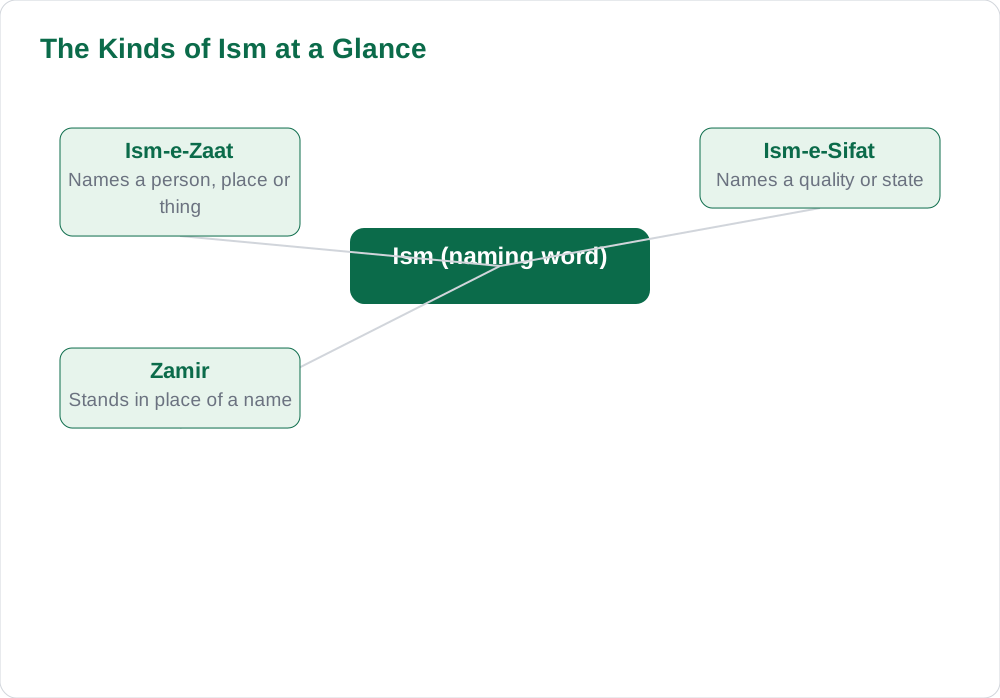
An ism is simply a word that names a person, place, thing, quality or idea, and once you can spot the ism in a sentence, the rest of grammar becomes much easier to understand. In this Urdu grammar ism kinds guide you will learn the main kinds of ism — ism-e-zaat, ism-e-sifat and zamir — with plain definitions and everyday examples you can practise at home. We will also show you how examiners test this topic, which mistakes students make most often, and a simple method for identifying the ism in any sentence within seconds. By the end, you will be able to classify naming words confidently in your textbook lessons and in your exam paper.
What Is an Ism in Urdu Grammar?
Whenever you point at something and give it a name, you are using an ism, which is why grammarians call it the naming part of speech. In the sentence about a boy reading a book, both the boy and the book are isms, because each one names a person or a thing taking part in the action. Without isms, a sentence would have no subject and no object, and the listener would not know who did what or to whom it was done. That is why every Urdu grammar course starts here: the ism is the foundation on which verbs, adjectives and pronouns all depend.
Ask yourself whether the word names something or does something: if it names, it is an ism, and if it shows action, it is a fail. For example, in a sentence about a girl writing a letter, the girl and the letter are isms, while writing is the fail that connects them. Another useful test is to place a word like mera or yeh before it: if the phrase still makes sense, the word is very likely an ism. Practise this test on ten sentences from your Urdu reader every day, and spotting the ism will soon feel automatic rather than difficult.
Ism-e-Zaat: Proper and Common Nouns
A city name, a person's name or the name of a particular river belongs to the khaas group, because it points to one single thing and to nothing else. A word like city, boy or river belongs to the aam group, because it can describe any member of that class rather than one special member. Examiners love this distinction, so they often give a mixed list of words and ask you to sort them into khaas and aam columns. Remember that khaas names are usually written with a capital idea in mind, even though Urdu script has no capital letters, and they never take a plural in the same way common nouns do.
Write down five khaas names from your family, your street and your school, and beside each one write the aam word that describes its class, such as a teacher's name beside the word teacher. Then reverse the exercise: take an aam word like darya and list three khaas rivers you know, which trains your brain to move between the two levels. In exams, read the full sentence before deciding, because a word like school can be aam in one sentence and khaas when it is part of a school's full name. This habit of checking the context will protect you from the most common marking trap in this topic.
- Ism-e-zaat-e-khaas: names one specific person, place or thing.
- Ism-e-zaat-e-aam: names a whole class of similar things.
- Test: if only one thing in the world carries that name, it is khaas.
Ism-e-Sifat: When a Name Describes a Quality
Words for goodness, bravery, beauty, wisdom and patience all belong to this group, because they name qualities that live inside people and actions rather than things you can hold. In a sentence about an honest trader, the word for honesty is the ism-e-sifat, while the trader himself is the ism-e-zaat, and the two work together to give a fuller picture. Students often mistake ism-e-sifat for sifat itself, but the difference is simple: sifat describes a noun directly, while ism-e-sifat names the quality as an independent idea that can itself become the subject of a sentence.
Honesty is the best policy is a perfect example, because honesty sits in the subject position and the sentence talks about the quality itself. Compare that with an honest boy, where honest only describes the boy and cannot stand alone as the subject, so it is a sifat rather than an ism-e-sifat. Examiners frequently test exactly this contrast, so practise converting sifat phrases into ism-e-sifat sentences and back again. Five conversions a day will make the distinction permanent, and it will also improve your essay writing, where quality words carry much of the meaning.
Zamir: The Pronoun Family of Ism
Instead of repeating a person's name five times in a paragraph, you use words like woh, uska, tum and hum, and the listener still understands exactly who is meant. Zamir is divided by person: first person for the speaker, second person for the listener, and third person for someone being talked about, and each group changes its form with number and respect. Because zamir replaces an ism-e-zaat, grammarians count it among the kinds of ism, and exam papers often ask you to underline the zamir and name the ism it replaces. Mastering zamir therefore improves both your grammar marks and the natural flow of your writing.
If the noun is a single feminine word, the zamir that refers back to it must also be feminine, and the same rule applies to plural nouns, which need plural zamair. To practise, take a paragraph from your Urdu textbook, circle every ism-e-zaat, and then underline each zamir and draw an arrow to the noun it stands for. When every arrow points to a matching noun, your paragraph is correct, and when an arrow points to a mismatched noun, you have found an error to fix. This arrow exercise is quick, visual and very close to how examiners check your answers.
How to Identify the Ism in Any Sentence
First, find the fail, because the action word tells you that something must be doing it and something must be receiving it. Second, ask kaun or kya before the fail: the answer to kaun is usually the ism doing the action, and the answer to kya is usually the ism receiving it. Third, check whether the word you found names something, describes a quality, or stands in place of a name, which tells you its kind. Fourth, test it with mera or yeh in front: if the phrase still sounds natural, your identification is almost certainly right, and you can write the answer with confidence.
Take one lesson, pick ten sentences, and apply the four steps to each, writing the ism, its kind and your reason in a notebook. After a week of this habit you will notice that you no longer need all four steps, because your eye will jump straight to the naming words. In the exam hall, spend the first minute of the grammar section scanning for isms in this way, and underline them lightly before answering, so that later questions about fail and sifat become easier too. For more study help, visit the solved notes and books pages, and browse the blog for other grammar guides.
AI Help: Muse AI
Muse AI is Meta's personal AI assistant. It can explain ism and its kinds in simple words and make short practice questions on this topic for you. Join Muse with invite code LTGSWD — in the Muse app, go to Settings > Redeem token and enter the code. Disclosure: LTGSWD is the author's Muse invite code. Muse AI does not give official STBB answers — always verify against your STBB book and your teacher. Always verify against your Sindh Textbook Board book before using any explanation in classwork.
5 key points you must know
- An ism names a person, place, thing, quality or idea in a sentence.
- Ism-e-zaat-e-khaas names one specific thing; ism-e-zaat-e-aam names a whole class.
- Ism-e-sifat names a quality as an idea, while sifat only describes a noun.
- Zamir replaces a name to avoid repetition and must match it in gender and number.
- Ask kaun or kya before the fail to find the ism quickly in any sentence.
Frequently asked questions
What is the simplest definition of ism for an exam answer?
An ism is a word that names a person, place, thing, quality or idea. A safe exam definition is: the word that gives a name to something is called ism. Add one example of each kind — a person's name for ism-e-zaat, a quality word for ism-e-sifat, and a pronoun word for zamir — and your definition answer will be complete and easy for the examiner to mark correct.
How is ism-e-sifat different from sifat?
Ism-e-sifat names the quality itself as an independent idea, so it can stand as the subject of a sentence, as in honesty is the best policy. Sifat only describes a noun and cannot stand alone as a subject, as in an honest boy, where honest merely describes the boy. If the quality word can be the subject, it is ism-e-sifat; if it only sits beside a noun describing it, it is sifat.
Why is zamir counted as a kind of ism?
Zamir is counted as a kind of ism because it does the job of a naming word: it stands in place of an ism-e-zaat so the same name need not be repeated. Since it occupies the same position in a sentence as a noun and refers to the same person or thing, grammarians place it inside the ism family rather than treating it as a separate part of speech.
What is the fastest way to find the ism in a sentence?
First find the fail, then ask kaun or kya before it. The answer to kaun is usually the ism doing the action, and the answer to kya is usually the ism receiving it. Finally test your word by placing mera or yeh before it; if the phrase still sounds natural, you have found the ism. This four-step method works on almost every sentence in your textbook.
Which ism mistakes cost the most marks in exams?
The costliest mistakes are calling a sifat an ism-e-sifat, mixing up khaas and aam in ism-e-zaat, and using a zamir that does not match its noun in gender or number. All three are avoided by one habit: always read the full sentence and check the context before classifying a word, instead of deciding from the word alone.
Solved notes — preview free
These guides work best with the solved exercises. Preview the solved notes free on this website — 119 solved notes for Classes 6–10 in Sindhi, Urdu, English and Arabic medium. Or browse the full solved notes catalogue for your class and medium. New solved notes are added regularly — check the catalogue for coming-soon books.