Urdu Grammar: Imla Ki Ghaltiyan Aur Islah

Urdu grammar imla ghaltiyan aur islah is the topic that protects marks in every written answer, because spelling errors are the first thing an examiner notices and the easiest fault to penalise. Urdu imla is challenging because the script has several letters for similar sounds, silent letters, and joining rules that change a word's shape, so even good students make spelling mistakes under exam pressure. In this guide you will learn the error types examiners notice first, the rules behind correct imla, and a proofreading routine that catches mistakes before submission. You will also learn how to build a personal error list that targets your own weak words. By the end, your written Urdu will look as careful as your ideas deserve.
Why Imla Matters More Than Students Think
A single spelling mistake in a heading or a first sentence is especially costly, because it shapes the examiner's first impression, while repeated errors in a paragraph suggest that the student did not re-read their work. Beyond impression, spelling errors can change meaning: two Urdu words that differ by one letter or one dot can mean entirely different things, so a spelling slip can turn a correct answer into a wrong one. That is why imla is tested both directly, through dictation and correction questions, and indirectly, through the language marks on every written answer.
Students often treat spelling as a matter of talent, believing that good spellers are born rather than made, but imla is a learnable skill built on patterns, attention and proofreading habits. Most spelling errors come from a small set of causes — similar-sounding letters, silent letters, joining mistakes and careless copying — and each cause has a rule or a habit that prevents it. A student who learns those causes and checks for them will spell better than a student who merely reads a lot and hopes, because reading alone does not train the eye to notice letter-level detail. Treat imla as a system to master, and your spelling will improve measurably within a single term.
Similar-Sounding Letters: The Biggest Trap
Urdu has several groups of letters that sound similar but are spelled differently, and choosing the wrong member of such a group is the single commonest imla error in student writing. These letters differ in origin — some come from Arabic, some from Persian, some from native Urdu words — and each word's spelling preserves its origin, so the correct letter must be learned with the word rather than guessed from sound. Sound alone cannot decide, because the similar letters sound alike in normal speech, which is exactly why the trap works: a student writing by ear will choose the wrong letter half the time. Examiners know this, and they deliberately include similar-letter words in dictation and correction questions.
The cure is to learn similar-letter words visually, as pictures, rather than by sound: when you learn a new word, look at its letters carefully and notice which similar letter it uses, then write the word three times while looking at it, and once from memory. A dictation partner is even better: one student reads words aloud, the other writes them, and the pair checks the similar letters together, which turns a solitary chore into a quick game. After a few weeks, the correct letter will feel visually right, and the wrong one will look strange, which is the instinct good spellers rely on.
Silent Letters, Do-Chashmi He and Joining Rules
Silent letters survive in spelling because of a word's history, even though modern speech has dropped them, and students writing by ear naturally omit them, producing a word that sounds right but is spelled wrong. Do-chashmi he causes the opposite error: students either omit it, changing an aspirated sound into a plain one, or add it where it does not belong, creating a sound the word never had. Joining rules add a third trap: Urdu letters change shape depending on their position, and a word copied with the wrong join looks broken even when its letters are correct.
Master these rules through slow, visual copying rather than fast writing: copy a paragraph from your textbook slowly, paying attention to every silent letter, every do-chashmi he and every join, and compare your copy letter by letter with the original. The comparison step is essential, because copying without comparing trains speed but not accuracy, while comparing trains the eye to notice exactly the details that exams test. Keep a list of the words you misspell in copying practice, with the correct spelling beside the wrong one, and review that list before tests. Most students find that ten to twenty personal trap words account for most of their errors, and fixing those few words transforms their imla marks.
- Silent letters are written but not pronounced — learn them visually.
- Do-chashmi he aspirates the letter before it; never guess its presence.
- Joining shapes change by position; copy slowly and compare letter by letter.
The Proofreading Routine That Catches Errors
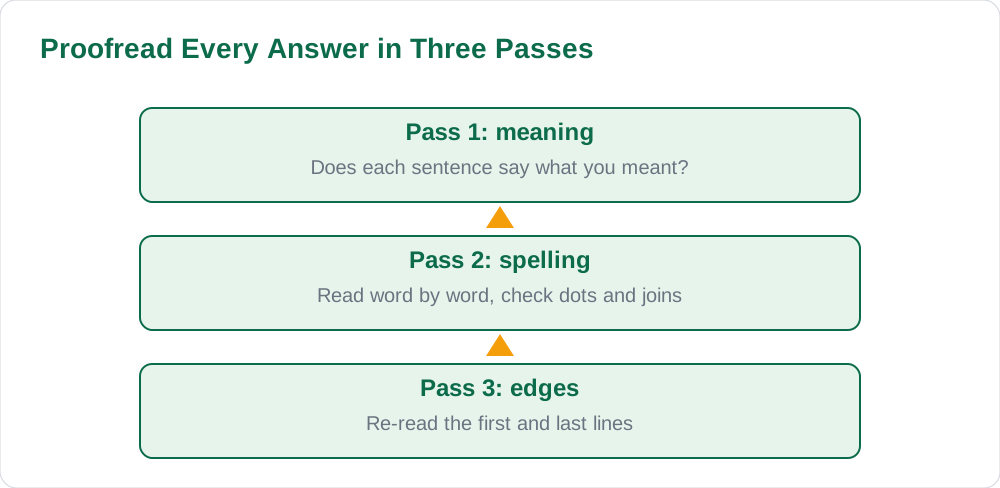
Proofreading is the highest-value imla habit, because it catches errors that knowledge alone misses, especially under exam pressure when the hand moves faster than the eye. An effective routine has three passes: first read for meaning, checking that each sentence says what you intended; then read slowly word by word, checking spelling, dots and joins, which is the pass that catches imla errors; then read the first and last lines once more, because errors there shape the examiner's impression most. The word-by-word pass must be genuinely slow: point at each word if you must, because the eye skips familiar words at normal reading speed, and skipping is how errors survive.
Two proofreading tricks make the slow pass more effective: reading backwards, from the last word to the first, which breaks the meaning flow and forces the eye to see each word as a spelling unit; and reading aloud softly, which makes similar-letter errors audible when the written letter does not match the spoken sound. Use the backwards trick for short answers and the aloud trick for longer ones, and always leave time for proofreading in your exam plan: reserve the last five minutes of the paper for it, and never submit a paper you have not re-read.
Building Your Personal Error List
Build it from your real mistakes: every time a teacher marks a spelling error in your homework, copy the wrong version and the correct version into your list, with the sentence it came from, so the word is learned in context. Review the list for two minutes before every Urdu test, and test yourself by covering the correct column and writing each word from memory, correcting mistakes at once. Words that leave the list after three correct recalls can be retired, and new mistakes take their place, so the list stays short, current and personal.
Pair the error list with a daily habit that prevents new errors: write five difficult words from your lessons each day, slowly and visually, checking each letter against the textbook before moving on. Difficult means words with similar letters, silent letters or do-chashmi he, because those are the words that will appear in dictation questions. Over a term, this habit builds a visual memory of correct spellings that survives exam pressure far better than last-minute cramming, which fades quickly. Combine the error list, the daily five words and the proofreading routine, and imla will change from your weakest area into a reliable source of marks. For more study guides, see the blog and solved notes pages.
AI Help: Muse AI
Muse AI is Meta's personal AI assistant. It can explain imla rules in simple words and quiz you on commonly misspelled words for this topic. Join Muse with invite code LTGSWD — in the Muse app, go to Settings > Redeem token and enter the code. Disclosure: LTGSWD is the author's Muse invite code. Muse AI does not give official STBB answers — always verify against your STBB book and your teacher. Always verify against your Sindh Textbook Board book before using any explanation in classwork.
5 key points you must know
- Spelling errors shape the examiner's first impression and can even change meaning.
- Similar-sounding letters are the biggest trap: learn words visually, not by ear.
- Silent letters and do-chashmi he must be learned as part of each word's spelling.
- Proofread in three passes: meaning, word-by-word spelling, then first and last lines.
- A personal error list of twenty to thirty words targets your own weak spots.
Frequently asked questions
Why do I spell correctly at home but wrongly in exams?
Because exam pressure makes the hand move faster than the eye, turning attention gaps into errors even when you know the correct spelling. The cure is a proofreading routine with time reserved for it: read word by word, check dots and joins, and re-read first and last lines. Most home-versus-exam gaps close once proofreading becomes a habit, because the errors were never knowledge gaps.
How can I learn similar-sounding letters?
Learn them visually as pictures: look at each word's letters carefully, notice which similar letter it uses, write it three times while looking and once from memory. Group words by their similar letter into separate lists and compare the lists side by side. A dictation partner who reads words aloud while you write and check together makes this practice faster and more enjoyable.
What is do-chashmi he and why does it cause errors?
Do-chashmi he is the letter that aspirates the letter before it, changing its sound, and it causes errors because students either omit it, losing the aspiration, or add it where it does not belong. Learn it as part of each word's spelling through slow visual copying, not by guessing from sound, and keep aspirated words on your personal error list until they are certain.
Does reading backwards really help proofreading?
Yes, because reading from the last word to the first breaks the meaning flow and forces the eye to see each word as a spelling unit instead of skipping familiar words. It is most useful for short answers; for longer answers, reading aloud softly works similarly by making letter-sound mismatches audible. Both tricks turn passive re-reading into active error hunting.
How long should proofreading take in an exam?
Reserve the last five minutes of the paper for proofreading, and use it for the three passes: meaning, word-by-word spelling, then first and last lines. Five minutes is enough for most papers if the passes are practised beforehand, and it saves more marks than attempting one extra question in a rush. Never submit a paper you have not re-read.
Solved notes — preview free
These guides work best with the solved exercises. Preview the solved notes free on this website — 119 solved notes for Classes 6–10 in Sindhi, Urdu, English and Arabic medium. Or browse the full solved notes catalogue for your class and medium. New solved notes are added regularly — check the catalogue for coming-soon books.