Urdu Grammar: Harf and Tarkeeb

Urdu grammar harf tarkeeb is the chapter that explains the small words holding big sentences together, because harf are the connectors and tarkeeb is the art of arranging words into a correct sentence. A sentence without harf sounds broken, like a chain with missing links, while a sentence with the right harf flows smoothly and says exactly what the writer means. In this guide you will learn the main kinds of harf — harf-e-jar, harf-e-ataf and others — and how tarkeeb turns separate words into a meaningful jumla. You will also learn the common harf mistakes that cost marks in Sindh board exams, and a practice method that makes correct sentence building feel natural. By the end, you will choose harf confidently and build sentences examiners enjoy reading.
What Is a Harf in Urdu Grammar?
Words that show place, direction, cause, time or connection all belong to this family, and without them a sentence would be a pile of separate words instead of a connected thought. In a sentence about a book lying on a table, the word for on is the harf: it links the book and the table and tells you their relationship. Remove it, and the sentence collapses into two unrelated words, which shows how much work these small words do. That is why grammarians define harf by its incompleteness: unlike an ism or a fail, a harf cannot stand alone and make sense.
Students sometimes confuse harf with short isms or fails, but a simple test separates them: try using the word alone as an answer to a question. A word like book can answer what is this, but a word like on or and cannot answer anything by itself, because it only makes sense between other words. Another test is to remove the word from its sentence: if the sentence loses its connection or its meaning becomes unclear, the removed word was doing the job of a harf. Practise both tests on sentences from your Urdu reader, circling the harf in each one, and within a week you will spot these small connectors without thinking, which is exactly the speed examiners expect.
Harf-e-Jar: Words That Show Relation
Common examples include words meaning in, on, from, to, with and for, each of which changes the relationship it describes: a book in a bag is not the same as a book on a bag, and the harf alone carries that difference. In exam papers, students are often asked to fill a blank with the correct harf-e-jar, or to underline it in a given sentence, so learning the meaning of each harf matters more than memorising a list. The best approach is to learn harf-e-jar in meaning groups — place words together, direction words together, cause words together — because grouped learning survives exam pressure better than alphabetical lists.
Each language pairs its relation words differently, so a harf that fits in one language may be wrong in Urdu even when the dictionary meaning looks similar. To avoid this, learn harf-e-jar inside full Urdu sentences rather than as single words, and notice which fail each harf likes to sit beside, because certain fails attract certain harf. Keep a notebook page for each meaning group with three example sentences per harf, and review it before tests; after a few weeks, the right harf will come to mind as part of the whole phrase rather than as a separate choice.
- Harf-e-jar links a noun to another word and shows their relationship.
- Place, direction, cause, time and possession are its main meanings.
- Learn harf in meaning groups, inside full sentences, not as single words.
Harf-e-Ataf and Other Joining Words
When you join two subjects with and, you are using harf-e-ataf, and when you offer a choice with or, or show a contrast with but, you are using it again. Beyond ataf, Urdu grammar recognises harf-e-shart for conditions, harf-e-nida for calling someone, and harf-e-istifham for questions, each with its own job in a sentence. Examiners often mix these kinds in one question, asking you to name the kind of each underlined harf, so you need to recognise each kind by its function rather than by memorising one example per kind.
A practical way to learn the joining harf is to sort them by the job they do in a sentence: joining, choosing, contrasting, conditioning, calling or questioning. Write each job as a heading in your notebook, and under it collect three harf with one example sentence each, taken from your textbook rather than a guidebook. Then practise the reverse direction: read a paragraph, underline every joining word, and write its job beside it, which trains recognition under real reading conditions. This two-way practice — from job to example and from example to job — is exactly what exam questions demand, and it also improves your essay writing, where varied joining words make paragraphs flow instead of stopping and starting.
Tarkeeb: Building a Correct Sentence
Urdu sentences usually follow a subject-object-fail order, with harf placed beside the nouns they link, and sifat placed beside the nouns they describe. When words sit in the wrong places, the sentence may still contain all the right words yet fail to communicate, because the listener cannot tell who did what to whom. Examiners test tarkeeb by giving jumbled words and asking you to arrange them, or by giving a faulty sentence and asking you to correct it, so you must understand the normal order and the common exceptions, such as questions and emphatic sentences that move words for effect.
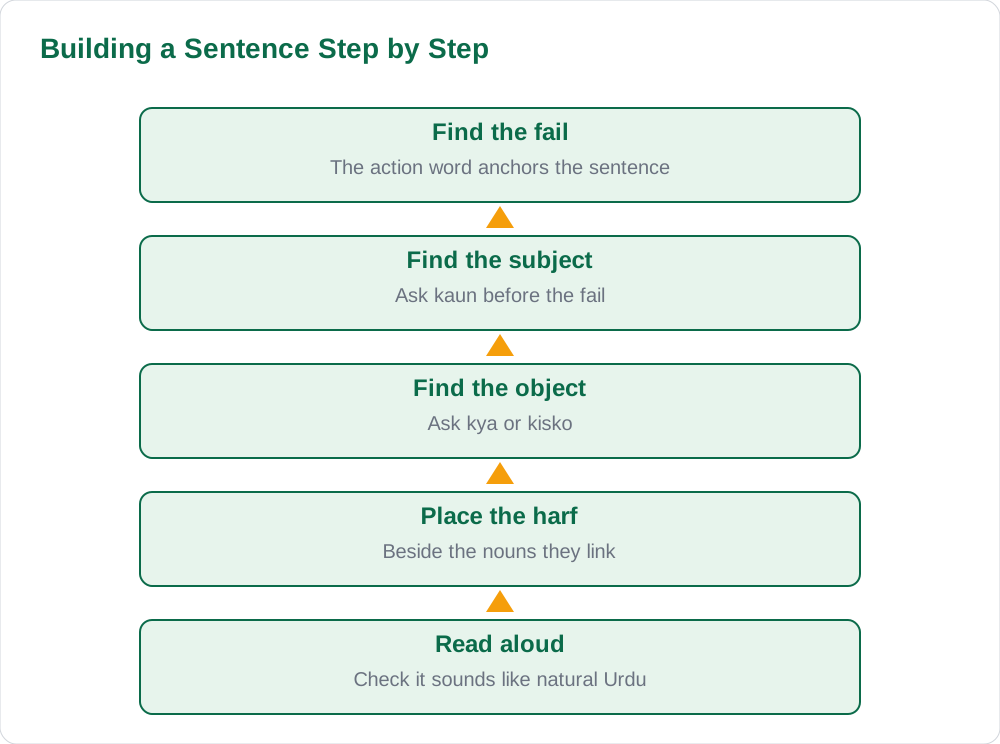
First find the fail, because it anchors the sentence, then find the subject by asking kaun, then find the object by asking kya or kisko, and finally place the harf beside the nouns they link. Read your arranged sentence aloud and check that it sounds like natural Urdu rather than a translated puzzle, because the ear is a good judge of word order. If a sentence still sounds wrong, check the harf first, since a misplaced harf is the commonest cause of a broken tarkeeb. Practise with five jumbled sentences a day, and sentence building will become one of your strongest exam skills.
Common Harf and Tarkeeb Mistakes
Another common error is dropping a harf altogether in a hurry, which leaves two nouns sitting beside each other with no stated relationship, forcing the reader to guess. In tarkeeb, the frequent errors are placing the fail before the object in a statement sentence, and placing sifat far from the noun it describes, so the description seems to belong to the wrong word. All of these errors share a cause: writing without re-reading, and all share a cure: a slow final check of each sentence against the normal word order and the meaning you intended.
If any answer is no, fix that sentence before moving on, because one corrected sentence is worth more than three rushed ones. Keep an error diary for harf mistakes, noting the wrong harf and the right one with the full sentence in both versions, and review it before each exam. Students who do this find that their harf errors fall quickly, because the diary exposes the two or three harf they personally confuse, and targeted practice on those few words fixes most of their lost marks. For more grammar guides, browse the blog and the solved notes page.
AI Help: Muse AI
Muse AI is Meta's personal AI assistant. It can explain harf and tarkeeb in simple words and check your arranged sentences on this topic for you. Join Muse with invite code LTGSWD — in the Muse app, go to Settings > Redeem token and enter the code. Disclosure: LTGSWD is the author's Muse invite code. Muse AI does not give official STBB answers — always verify against your STBB book and your teacher. Always verify against your Sindh Textbook Board book before using any explanation in classwork.
5 key points you must know
- A harf has no complete meaning alone; it gains meaning by joining other words.
- Harf-e-jar shows relation: place, direction, cause, time or possession.
- Harf-e-ataf joins equals with and, or and but; other harf show condition, call or question.
- Tarkeeb arranges words in subject-object-fail order with harf beside their nouns.
- Build sentences in stages: fail, subject, object, harf, then read aloud to check.
Frequently asked questions
How can I tell a harf from a short ism?
Try using the word alone as an answer to a question: an ism can answer, but a harf cannot, because it only makes sense between other words. Also try removing it from its sentence: if the sentence loses its connection or becomes unclear, the removed word was a harf. Both tests together identify harf reliably in textbook sentences.
Which harf-e-jar mistakes are most common?
The most common mistake is choosing a harf by translation from another language instead of by Urdu usage, which produces unnatural sentences. Another is confusing place harf, such as in and on, which changes the meaning even when the sentence looks grammatical. Learning harf inside full Urdu sentences, grouped by meaning, prevents both errors.
What is the normal word order in an Urdu statement sentence?
The normal order is subject, then object, then fail, with harf placed beside the nouns they link and sifat beside the nouns they describe. Questions and emphatic sentences may move words for effect, but the statement order is the default that examiners expect in tarkeeb questions unless a special reason moves a word.
How do I solve jumbled-word tarkeeb questions?
Build in stages: find the fail first, then the subject by asking kaun, then the object by asking kya or kisko, and finally place each harf beside its noun. Read the arranged sentence aloud and check that it sounds like natural Urdu. If it sounds wrong, check the harf first, since a misplaced harf is the commonest cause of broken tarkeeb.
Why do harf errors lose marks even in short answers?
Because a wrong harf changes the meaning of the sentence, not just its grammar, and examiners mark meaning errors strictly. A dropped harf is equally costly, since it leaves the relationship between two nouns unstated and forces the reader to guess. Always re-read each sentence and check that every noun pair has its harf before submitting.
Solved notes — preview free
These guides work best with the solved exercises. Preview the solved notes free on this website — 119 solved notes for Classes 6–10 in Sindhi, Urdu, English and Arabic medium. Or browse the full solved notes catalogue for your class and medium. New solved notes are added regularly — check the catalogue for coming-soon books.