Urdu Grammar: Fail and Zamane (Tenses)

Urdu grammar fail zamane is the chapter that turns a list of action words into real communication, because the fail tells you what happened and the zamana tells you when it happened. Every Urdu sentence has a fail at its heart, and changing the zamana changes the whole meaning: the same action can belong to yesterday, to today, or to tomorrow. In this guide you will learn the three zamane — maazi, haal and mustaqbil — with their forms, their helping words and the signals that reveal them in a sentence. You will also learn the common tense mistakes that Sindh board students make, and a practice routine that makes tense identification fast and reliable. By the end, you will read any Urdu sentence and name its zamana with confidence.
What Is a Fail in Urdu Grammar?
In a sentence about a student reading a book, reading is the fail: it tells you what the student is doing, while the student and the book are the isms that take part in the action. A fail always carries information about time as well, which is why grammar joins fail and zamana together as one topic. The same root action can appear in many shapes, and each shape places the action in the past, the present or the future. Learning fail therefore means learning both the action and its time, and students who study the two together progress much faster than those who memorise verb lists alone.
You can find the fail by asking kya karta hai, kya kiya or kya karega about the subject of the sentence, because the answer to those questions is always the action word. In a sentence about rain falling on a roof, asking what the rain does gives you the fail at once, while the roof and the rain itself are isms. Another useful habit is to look for the word that changes when you change the time of the sentence: shift a sentence from yesterday to tomorrow and watch which word changes its form. That changing word is the fail, and noticing it trains your eye for the tense questions that examiners set from textbook passages every year.
Zamana-e-Maazi: Talking About the Past
Its common forms include maazi mutlaq for a simple completed action, maazi qareeb for an action completed recently, and maazi baeed for an action completed long before another past event. In a sentence about a student who finished homework yesterday, the fail sits in maazi mutlaq, and the word yesterday acts as a clear time signal. Examiners often test maazi by giving a sentence without a time word and asking you to identify the tense from the fail's form alone, so you must learn the endings and helping words that mark each maazi form rather than relying only on time signals.
The most reliable way to master maazi is to convert the same sentence through its forms and say each version aloud, because the ear learns tense patterns faster than the eye. Take a simple sentence about going to school, and rewrite it as a simple past action, a recently completed action and an action completed long ago, noticing how the helping words change each time. Then practise in reverse: read a paragraph from a story lesson and underline every maazi fail, naming its form beside it. Story lessons are full of maazi, so they are the best practice material, and after a week of this exercise you will recognise past forms instantly, even in long and unfamiliar passages.
Zamana-e-Haal: The Present Tense
Its forms include haal mutlaq for a habitual or general action and haal jaari for an action in progress at this very moment, and the difference between them is one of the favourite exam questions in this chapter. A sentence about a student who studies every day uses haal mutlaq, because the action repeats as a habit, while a sentence about a student who is studying right now uses haal jaari, because the action is in progress. Learning the helping words that mark each form — the words that sit beside the fail and signal present time — is the key to telling them apart quickly.
The cure is to ask whether the action is a routine or a moment: routines and general truths belong to haal mutlaq, while an action caught in the middle belongs to haal jaari. Try this test on sentences from your own day: brushing teeth every morning is a routine, while brushing teeth at this moment is an action in progress. Write ten such pairs in your notebook, label each one, and read them aloud, because speaking the difference fixes it in memory far better than silent reading. In exams, look for the helping words first, then confirm with the routine-or-moment test before writing your answer.
Zamana-e-Mustaqbil: Looking to the Future
Its forms are simpler than maazi, because the future is usually marked by a clear change in the fail's ending together with a helping word that points forward in time. A sentence about a student who will take an exam next week uses mustaqbil, and the time word next week confirms what the fail's form already shows. Examiners test mustaqbil by asking you to convert a present or past sentence into the future, or by giving a future sentence and asking you to name its form, so you need both directions of practice: recognition and conversion.
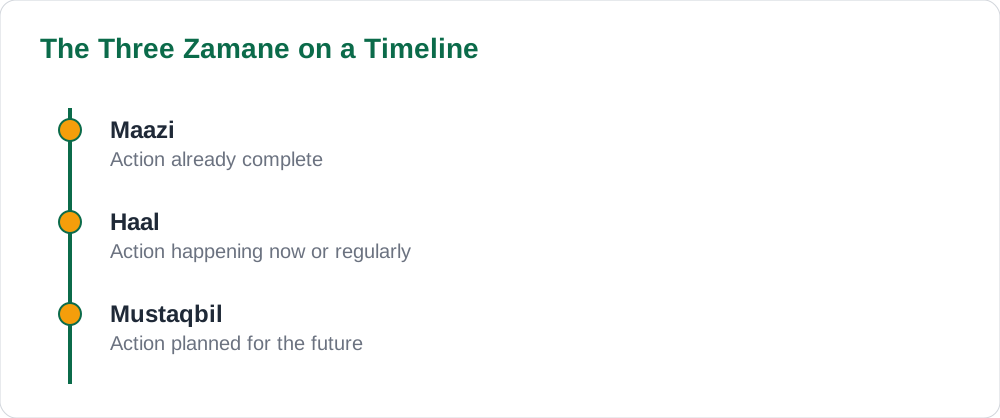
When the three versions sit together on the page, the pattern of endings and helping words becomes visible, and your brain starts to treat tense as a system instead of a list of separate facts. Add a time word to each version — yesterday, today and tomorrow — and the system becomes even clearer, because time words and fail forms always agree in a correct sentence. Practise with actions from your daily routine, since familiar actions let you focus on the tense pattern instead of struggling with new vocabulary at the same time.
Common Tense Mistakes and How to Fix Them
Another frequent error is using haal jaari for a routine action, or haal mutlaq for an action happening at this moment, which confuses the two present forms. A third mistake is forgetting that the fail must agree with its subject in gender and number as well as in tense, so a correct tense with a wrong agreement still loses marks. All three mistakes share one cause: writing the answer too quickly without checking the sentence as a whole, and all three share one cure: a slow final reading of each sentence before moving on.
Then read it aloud if you can, because the ear catches tense errors that the eye misses, especially in longer sentences where the fail sits far from its time word. Keep a small error diary in which you record every tense mistake you make in homework, with the wrong version and the corrected version side by side, and review it before each test. Students who keep such a diary report that their repeated mistakes vanish within a few weeks, because the diary turns vague embarrassment into a visible pattern they can fix. For more grammar help, see the solved notes and the blog listing.
AI Help: Muse AI
Muse AI is Meta's personal AI assistant. It can explain maazi, haal and mustaqbil in simple words and make tense-conversion practice sentences on this topic for you. Join Muse with invite code LTGSWD — in the Muse app, go to Settings > Redeem token and enter the code. Disclosure: LTGSWD is the author's Muse invite code. Muse AI does not give official STBB answers — always verify against your STBB book and your teacher. Always verify against your Sindh Textbook Board book before using any explanation in classwork.
5 key points you must know
- A fail shows an action or state and always carries information about time.
- Maazi covers completed past actions, from simple past to distant past forms.
- Haal covers present actions: habitual in haal mutlaq, in progress in haal jaari.
- Mustaqbil covers future plans, promises and predictions with clear forward markers.
- Check time word, routine-or-moment sense and subject agreement before finalising an answer.
Frequently asked questions
How do I find the fail in a long sentence?
Ask kya karta hai, kya kiya or kya karega about the subject, and the answer is the fail. Another method is to change the time of the sentence from yesterday to tomorrow and watch which word changes its form; that changing word is the fail. Both methods work even in long sentences, because the fail is the one word that must change when the time changes.
What is the difference between haal mutlaq and haal jaari?
Haal mutlaq describes a habitual or general action, such as studying every day, while haal jaari describes an action in progress at this moment, such as studying right now. Ask whether the action is a routine or a moment: routines belong to haal mutlaq and moments belong to haal jaari. The helping words beside the fail also differ, so learn them as a pair.
Which maazi form is used for a recently completed action?
Maazi qareeb is used for an action completed recently, while maazi mutlaq is the simple completed past and maazi baeed is for an action completed long before another past event. Examiners test the difference by giving sentences with time hints like just now or long ago, so practise matching each form to its time hint until the pairing feels natural.
How can I practise tense conversion effectively?
Take one action and write it in maazi, haal and mustaqbil side by side, adding yesterday, today and tomorrow as time words. Seeing the three versions together reveals the pattern of endings and helping words as a system. Do five such sets a day with familiar daily actions, and read each version aloud to fix the patterns in your ear as well as your eye.
Why do tense answers lose marks even when the tense is right?
Because the fail must also agree with its subject in gender and number, and because the time word must match the fail's tense. A correct tense with a wrong agreement, or a present fail beside a past time word, still loses marks. Always re-read your sentence once for time agreement and once for subject agreement before moving to the next question.
Solved notes — preview free
These guides work best with the solved exercises. Preview the solved notes free on this website — 119 solved notes for Classes 6–10 in Sindhi, Urdu, English and Arabic medium. Or browse the full solved notes catalogue for your class and medium. New solved notes are added regularly — check the catalogue for coming-soon books.