Oral Assessment That Builds Speaking Confidence
Many pupils understand a topic well but freeze when asked to speak about it, because oral assessment often feels like a high-pressure performance in front of the whole class. When speaking is only tested in rare, formal moments, fear grows and the assessment measures courage more than knowledge. Oral assessment that builds speaking confidence works differently: it uses short, low-stakes tasks, practised often, with clear rubrics pupils understand in advance. This article shows teachers how to design oral tasks that feel safe, assess speaking fairly, and grow confidence step by step. When pupils speak a little, often, and without fear, they gradually speak more, better, and with pride in their own voice.
Why Pupils Fear Speaking, and How to Lower the Stakes
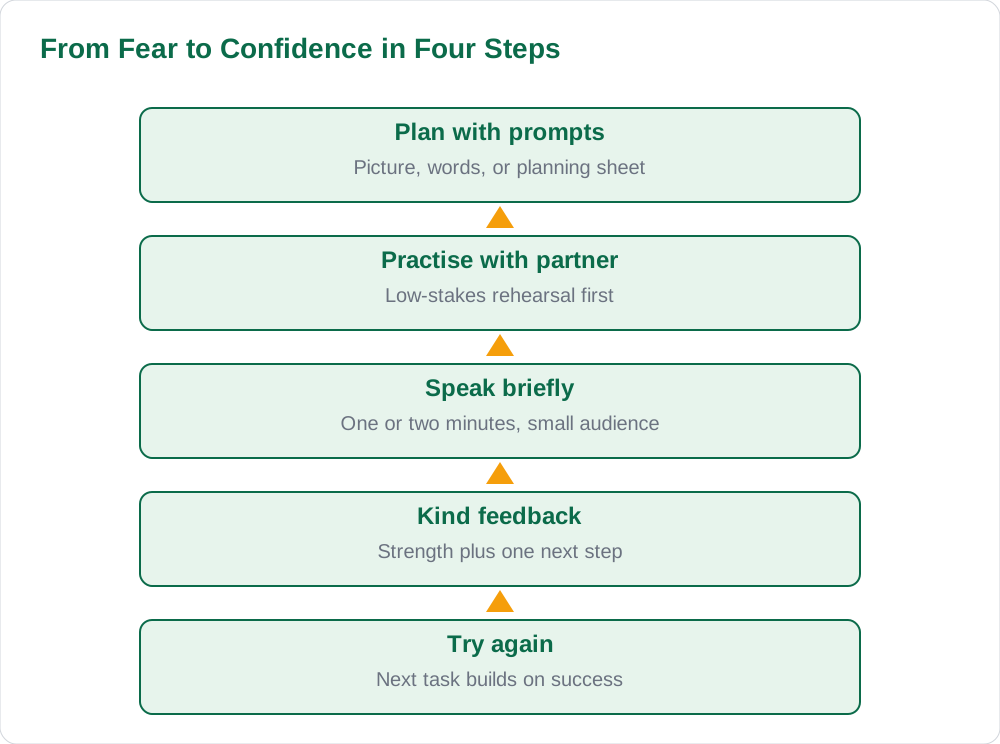
Pupils fear speaking for understandable reasons: they worry about mistakes, about classmates laughing, and about being judged in front of everyone. A single formal speech in front of fifty classmates can feel terrifying, especially for a pupil speaking in a second language or about a new topic. Low-stakes assessment removes much of this fear by making speaking frequent, short, and normal, so it stops feeling like a special test. When pupils speak for one minute to a partner every week, the act of speaking becomes routine, and routine dissolves fear far better than any pep talk.
Lower the stakes further by separating practice from grading: let pupils practise a task, receive feedback, and improve before any mark is given. Make early oral tasks ungraded or worth only a small part of a mark, and focus feedback on content and effort rather than perfect grammar or accent. Create a class agreement that listeners show respect, never laugh at mistakes, and applaud effort, and model that respect yourself by responding warmly to every attempt. A classroom where mistakes are treated as learning steps, not embarrassments, is one where pupils dare to speak. The solved notes offer topics pupils can use for short speaking practice.
Short Tasks That Practise Real Speaking Skills
The best oral tasks are short, clear, and close to real communication, rather than long memorised speeches. Useful tasks include describing a picture for one minute, explaining how to solve a problem in three steps, retelling a short story, or giving an opinion with one reason. These tasks test real skills: organising ideas, speaking clearly, and using topic vocabulary, without requiring pupils to memorise paragraphs they do not understand. Vary the tasks across the term so pupils practise describing, explaining, persuading, and discussing, and keep each task to one or two minutes so many pupils can take part in one lesson.
Give pupils preparation time and support, such as a few prompt words, a picture, or a short planning sheet, because a pupil who has planned speaks far more confidently than one surprised by a question. Allow pupils to use notes, and let them practise first with a partner before speaking to a group or the class, so the assessed performance is their second, better attempt. Record the task clearly on the board, including the time limit and what a good answer includes, so pupils are not guessing what the teacher wants. Short, supported tasks show you what pupils really know, while building the habit of speaking. The book collection provides topics for oral tasks across subjects.
Clear Rubrics Pupils Understand Before They Speak
A rubric is a simple guide showing what good speaking looks like, and it builds confidence because pupils know exactly how they will be judged. Share the rubric before the task, using plain language and only three or four criteria, such as content, organisation, clarity, and vocabulary. Explain each criterion with an example, such as content means answering the question with two ideas, and clarity means speaking loudly enough and pausing between ideas. When pupils understand the rubric, they can prepare with purpose, self-check before speaking, and understand their feedback afterwards instead of wondering why they lost marks.
Use the rubric during feedback too, by pointing to the exact criterion a pupil did well and the one to improve next time. Keep feedback short and specific, such as your ideas were clear, now work on speaking a little louder, rather than a long list of corrections. Let pupils use the rubric to assess a partner or themselves occasionally, since judging others' speaking sharpens their own awareness of good speaking. A rubric shared in advance turns assessment from a mystery into a fair, visible target, and pupils who can see the target aim for it with confidence. More assessment ideas appear on the blog.
Assess Fairly in Large and Mixed-Ability Classes
Fair oral assessment in a large class needs organisation, because you cannot listen to fifty long speeches in one lesson. Assess in rotation, listening to a few pupils each lesson while others practise in pairs, so every pupil is assessed several times across the term without losing teaching time. Use pair and group speaking tasks for practice, and reserve individual assessment for short tasks that fit the rotation, recording marks on a simple sheet as you listen. This approach gives you a fairer picture than one big speech, because it samples speaking over time and across different tasks.
Adapt tasks fairly for different learners without lowering expectations, by offering prompt cards, extra preparation time, or the choice to speak to a small group rather than the whole class. Judge pupils against the rubric and their own progress, not against the most confident speaker in the class, and note improvement over time as part of your judgement. Keep records brief but regular, noting one strength and one next step per assessment, so you can show pupils and parents clear evidence of growth. Fair, frequent, short assessments measure speaking far better than rare, frightening ones. The [home page](/) links to resources supporting classroom assessment.
Celebrate Growth and Keep Speaking Enjoyable
Confidence grows when progress is noticed and celebrated, so mark speaking growth visibly and warmly. Praise specific improvements, such as you spoke louder today, or your explanation had two clear reasons, and let pupils hear their own progress by comparing an early attempt with a later one. Create enjoyable speaking routines, such as a weekly show-and-tell, a class discussion on a fun question, or pupils presenting a group result, so speaking is linked with pleasure as well as assessment. When speaking is enjoyable, pupils volunteer more, and volunteering is itself the best practice.
Finally, keep your own response to speaking calm and encouraging, especially when a pupil struggles, because your reaction sets the class tone. Thank every speaker, avoid correcting every error in public, and follow a struggling attempt with a supportive question the pupil can answer. Over a term of short tasks, clear rubrics, and kind feedback, even shy pupils begin to speak with confidence, and that confidence transfers to other subjects and to life beyond school. Oral assessment done well does not just measure speaking; it teaches it. For questions, visit the contact page.
AI Help: Muse AI
Muse AI is Meta's personal AI assistant, and it can help teachers create short oral task prompts, write a simple speaking rubric, or suggest discussion questions matched to a lesson topic. Ask it for five one-minute speaking tasks on your topic, then choose the ones that fit your class.
Join Muse with invite code LTGSWD — in the Muse app, go to Settings > Redeem token and enter the code.
Disclosure: LTGSWD is the author's Muse invite code.
Muse AI does not give official STBB answers — always verify against your Sindh Textbook Board book and your teacher.
5 key points you must know
- Make speaking frequent, short, and low-stakes so it becomes routine, not frightening.
- Use one-to-two-minute tasks such as describing, explaining, and retelling.
- Share a simple three-or-four-criterion rubric before pupils speak.
- Assess in rotation across the term for a fairer picture in large classes.
- Celebrate specific improvements and keep speaking routines enjoyable.
Frequently asked questions
How long should an oral assessment task be?
One or two minutes is enough for most classroom tasks. Short tasks let many pupils participate, reduce fear, and still reveal content, organisation, clarity, and vocabulary.
Should pupils memorise speeches for oral assessment?
No. Memorised speeches test memory, not speaking. Use prompt words, pictures, or planning sheets so pupils speak naturally about ideas they understand.
How do I assess speaking fairly in a large class?
Assess in rotation, a few pupils per lesson, while others practise in pairs. Several short assessments across the term give a fairer picture than one long speech.
What if a pupil freezes during an oral task?
Stay calm, offer a prompt or an easier question, and let them try again later. Never force a struggling pupil to continue in front of the class, and praise the attempt.
Solved notes — preview free
These guides work best with the solved exercises. Preview the solved notes free on this website — 119 solved notes for Classes 6–10 in Sindhi, Urdu, English and Arabic medium. Or browse the full solved notes catalogue for your class and medium. New solved notes are added regularly — check the catalogue for coming-soon books.