An Inclusive Classroom for Different Learners
Every classroom contains different learners: fast readers and slow readers, confident speakers and quiet thinkers, pupils who grasp numbers quickly and pupils who need more time. An inclusive classroom does not pretend these differences away or teach only to the middle; it plans so every pupil can learn, contribute, and feel they belong. This article explains how differentiation, varied tasks, extra time, and peer support help mixed-ability classes learn together. Inclusion is not about lowering standards or creating thirty separate lessons, but about offering different routes to the same goal, so a struggling pupil and an advanced pupil both make progress in the same lesson. When teachers plan for difference from the start, fewer pupils fall behind, and the whole class becomes kinder and more confident.
Know Your Learners Before You Plan
Inclusive teaching starts with knowing who is in the room, because you cannot differentiate for pupils you do not understand. In the first weeks, observe how pupils read, write, speak, and solve problems, and note who needs support, who finishes quickly, and who learns best by seeing, hearing, or doing. Talk to pupils about what helps them learn, and check previous teachers' notes where available, so your picture is based on evidence rather than first impressions. Keep a simple class profile on your desk, updated through the term, that reminds you of reading levels, language needs, and pupils who benefit from seating near the front or extra time.
Remember that needs change across subjects and topics, so avoid labelling a pupil as weak or strong for all time. A pupil who struggles in reading may shine in practical science, and a quiet pupil may write beautifully, so look for strengths in every child as well as needs. Share useful information with colleagues respectfully, and speak to parents about what helps their child, since families often know strategies that work at home. Knowing your learners is not extra work on top of teaching; it is the foundation that makes every later decision about tasks, groups, and support sensible. The solved notes provide material you can adapt to different levels.
Differentiate by Task, Support, and Outcome
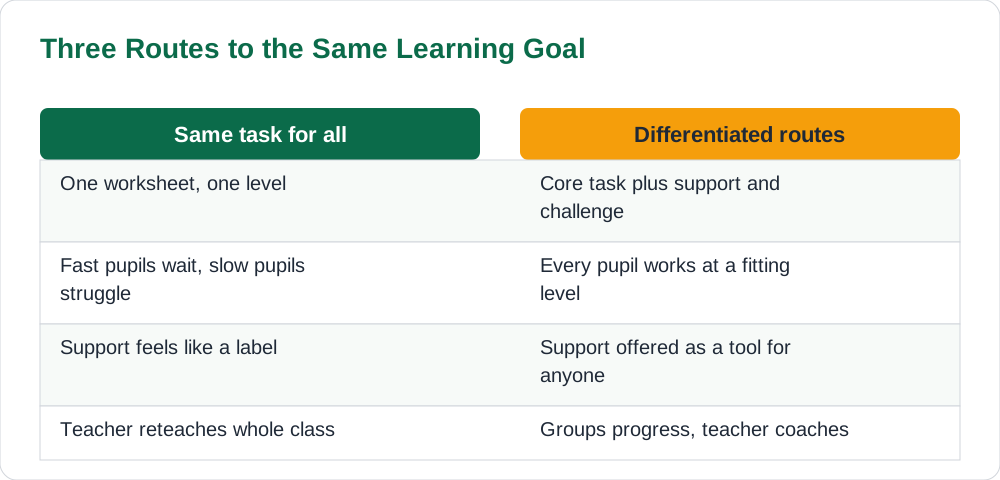
Differentiation means offering varied routes to the same learning goal, and it can be done through task, support, or outcome. By task, give groups different versions of an activity, such as a shorter text with picture support for some pupils and a longer text with extension questions for others, all teaching the same topic. By support, keep the task the same but vary the help, such as word banks, worked examples, or partner support for pupils who need it, while confident pupils work independently. By outcome, set one open task that allows different levels of response, such as explain in your own words, where every pupil can succeed and strong pupils can go further.
Keep differentiation manageable by varying only one element at a time, rather than preparing three completely different lessons. A single worksheet with a core section everyone completes, plus a support box and a challenge question, serves a mixed class with one sheet. Make support normal and stigma-free by offering it to anyone who wants it, so using a word bank or extra time feels like a tool, not a label. Pupils notice fairness more than sameness: they accept different tasks when everyone is learning and everyone is challenged. The book collection lists topics you can differentiate across your classes.
Extra Time and Flexible Pacing Without Chaos
Extra time is one of the simplest and fairest forms of support, because many pupils do not lack ability but need longer to read, think, or write. Build flexibility into lessons by giving early finishers meaningful extension tasks, such as a challenge question or helping a peer, instead of more of the same work, so fast pupils are stretched rather than bored. For pupils who need longer, allow them to complete a task over two sessions or to show understanding orally instead of in a long written answer. Flexible pacing keeps the class moving together while respecting different speeds, and it reduces the anxiety that comes from constant rushing.
Use visible structures to manage different paces, such as a task board showing must, should, and could activities, so pupils always know what to do next without waiting for the teacher. Check progress during activities and move pupils on or support them based on what you see, rather than forcing everyone to turn the page at the same second. Be transparent about why pacing differs, explaining that everyone learns at their own speed and the goal is understanding, not finishing first. When extra time and flexible pacing are normal classroom routines, pupils stop comparing speeds and start focusing on their own progress. More inclusive strategies appear on the blog.
Peer Support: Learning Together, Not Just Sitting Together
Peer support is one of the most powerful inclusive strategies, because pupils often explain ideas to each other in language classmates understand. Pair pupils thoughtfully, mixing strengths so each partner has something to offer, and train pairs in how to help: explain, don't just give answers, and check that your partner understands. Use structured roles, such as reader and checker, or explainer and questioner, so both partners contribute and neither simply copies. Peer support benefits the helper too, since explaining an idea deepens the helper's own understanding and builds confidence.
Guard against peer support becoming one-sided by rotating partners regularly and by praising good helping, not just correct answers. Monitor pairs during activities, stepping in when a partner dominates or when help turns into copying, and teach pupils to ask for teacher help when both partners are stuck. Group work with clear roles, such as writer, presenter, and timekeeper, gives every pupil a valued contribution regardless of ability. An inclusive classroom is one where pupils see each other as resources, and that culture, built daily, does more for belonging than any single lesson plan. The [home page](/) offers an overview of resources for inclusive teaching.
A Welcoming Room Where Every Pupil Belongs
Inclusion is also about belonging, so build a room where every pupil's work, language, and culture are visible and valued. Display work from pupils of all levels, not only the neatest books, and celebrate different kinds of success, such as improved effort, good teamwork, or a brave question. Use pupils' names correctly, learn a few words of home languages where appropriate, and challenge teasing firmly and kindly, so no pupil feels lesser for learning differently. Seating, routines, and classroom jobs should give every pupil a place and a role, because a pupil who feels they belong tries harder and behaves better.
Finally, reflect regularly on who is thriving and who is quiet, struggling, or overlooked, and adjust your plans accordingly. Ask pupils what helps them learn, and act on their answers visibly, so they see that their voice shapes the classroom. Speak to parents and colleagues when a pupil needs more support than classroom differentiation can provide, since inclusion sometimes means extra help beyond the lesson, not instead of it. An inclusive classroom is never finished; it grows as teachers keep noticing, adjusting, and welcoming every learner. For questions, visit the contact page.
AI Help: Muse AI
Muse AI is Meta's personal AI assistant, and it can help teachers create differentiated tasks, simplify a text for struggling readers, or write extension questions for fast finishers on the same topic. Ask it for three versions of one task at different levels, then adapt them to your pupils.
Join Muse with invite code LTGSWD — in the Muse app, go to Settings > Redeem token and enter the code.
Disclosure: LTGSWD is the author's Muse invite code.
Muse AI does not give official STBB answers — always verify against your Sindh Textbook Board book and your teacher.
5 key points you must know
- Know your learners through observation, pupil voice, and a simple class profile.
- Differentiate by task, support, or outcome, varying one element at a time.
- Offer extra time and flexible pacing with meaningful extension tasks.
- Use structured peer support with trained roles so both partners learn.
- Build belonging by displaying all pupils' work and valuing every contribution.
Frequently asked questions
Does differentiation mean preparing many different lessons?
No. Vary one element, such as support or a challenge question, within a single lesson. One worksheet with a core section, a support box, and a challenge task serves a mixed class well.
Will other pupils think differentiation is unfair?
Pupils accept different tasks when everyone is learning and challenged. Explain that fairness means everyone getting what they need to learn, not everyone doing identical work.
How do I support fast finishers without extra marking?
Give meaningful extensions such as a challenge question, creating an example, or helping a peer. These stretch learning without creating a second pile of marking.
What if a pupil needs more help than I can give in class?
Use peer support and flexible tasks first, then speak to parents and colleagues about extra help. Inclusion sometimes means additional support beyond the lesson, arranged through the school.
Solved notes — preview free
These guides work best with the solved exercises. Preview the solved notes free on this website — 119 solved notes for Classes 6–10 in Sindhi, Urdu, English and Arabic medium. Or browse the full solved notes catalogue for your class and medium. New solved notes are added regularly — check the catalogue for coming-soon books.