Surah Al-Qadr: Hifz and Meaning for Class 6

Surah Al-Qadr hifz meaning class 6 is a beautiful task because this short Surah links memorisation with one of the most honoured nights in Islam. Pupils who learn it phrase by phrase often remember it faster and with more love for its message. The Surah speaks about the Night of Decree, when the Quran was revealed, and describes that night as better than a thousand months. In this guide, you will memorise Surah Al-Qadr in small parts, learn its meaning in simple words, and revise it with a calm daily routine. Always read from your own mushaf or STBB book.
Why Surah Al-Qadr Is Special
Surah Al-Qadr tells us that the Quran was sent down on Laylat-ul-Qadr, the Night of Decree. Angels descend on that night, and peace fills it until dawn. For a young pupil, the message is that the Quran is a great gift, and the night of its revelation carries special honour and blessing.
Before you begin hifz, read a simple translation with your teacher and talk about what Laylat-ul-Qadr means. Ask why the Quran is described as a guide and a mercy. When you connect the Surah to gratitude for the Quran, each phrase becomes easier to remember. You can also explore more study help in the solved notes and on the books page.
Memorising in Short Phrases
Surah Al-Qadr is short, but its phrases deserve slow, careful practice. Divide the Surah into four or five short phrases. Read the first phrase aloud from your mushaf five times, then try to say it from memory three times. If you make a mistake, look again and repeat.
Keep your voice slow and clear. Pay attention to each word and to the natural pause at the end of a phrase. Short practice sessions of about ten minutes are best. If you feel tired, stop and return later.
Understanding Each Phrase
Meaning helps memory. After learning each phrase, say its simple meaning in your own words. For example, connect the first phrases to the revelation of the Quran, the middle phrases to the honour of the Night of Decree, and the closing phrases to angels, peace, and dawn.
Write one short meaning line for each phrase in a notebook. Do not copy Arabic text from memory; write the meaning in Urdu or English. Read these lines before each revision. Over time, the meaning lines will remind you of the order of the phrases even when you feel unsure.
- Link the opening phrases to the revelation of the Quran.
- Link the middle phrases to the honour of Laylat-ul-Qadr.
- Link the closing phrases to angels, peace, and dawn.
- Say each meaning in your own words after reciting the phrase.
Practising With a Listener
A listener makes hifz stronger. Ask a parent, elder, or classmate to follow along in a mushaf while you recite. They can point out a missed word or a wrong order at once, before the mistake becomes a habit. Recite slowly so the listener can follow every word.
You can also practise in pairs with a classmate who is learning the same Surah. Take turns reciting and listening. Pair practice keeps hifz friendly and regular, and it teaches both pupils to listen carefully. Praise effort, correct gently, and always check doubtful words in the mushaf.
Keeping Surah Al-Qadr Fresh
After you can recite Surah Al-Qadr without looking, keep it fresh with short revision. Recite it once in the morning and once in the evening for a week. Then recite it twice a week, for example on two fixed days.
Link revision to a daily habit, such as after Fajr or before homework, so you do not forget. For a similar phrase method, see the Surah Ash-Sharh guide and browse the blog for more hifz methods.
- Revise twice daily for one week after memorising the Surah.
- Then revise twice a week on fixed days to keep it strong.
- Give weak phrases one extra day of focused practice.
- Recite to a listener once a week to check accuracy.
AI Help: Muse AI
Muse AI is Meta's personal AI assistant, and it can help you explain the honour of Laylat-ul-Qadr and the revelation of the Quran in simple words for Class 6. Muse AI does not give official STBB answers — always verify against your STBB book and your teacher. Always check any explanation against your Sindh Textbook Board book and ask your teacher if anything is unclear.
Join Muse with invite code LTGSWD — in the Muse app, go to Settings > Redeem token and enter the code.
Disclosure: LTGSWD is the author's Muse invite code.
5 key points you must know
- Surah Al-Qadr describes the revelation of the Quran on the Night of Decree.
- Memorise in four or five short phrases, joining each new phrase to the last.
- Learn one simple meaning idea for every phrase.
- Practise with a listener who follows along in a mushaf.
- Revise twice daily for a week, then twice a week.
Frequently asked questions
How long does it take to memorise Surah Al-Qadr?
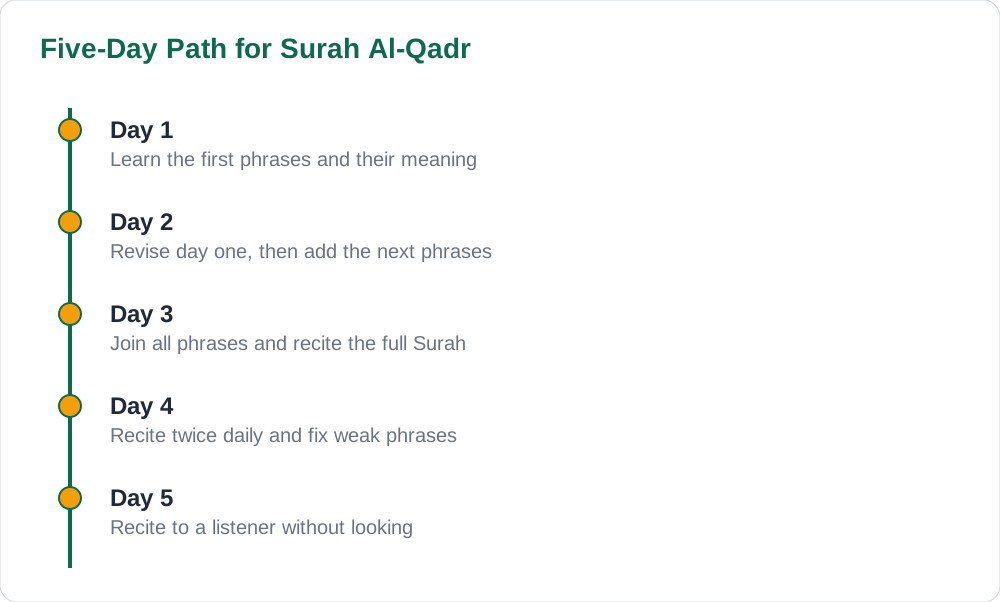
Most Class 6 pupils can memorise it in about five days with ten minutes of daily practice. The key is to learn one phrase at a time and revise earlier phrases every day.
What is Laylat-ul-Qadr in simple words?
Laylat-ul-Qadr is the Night of Decree, the honoured night on which the Quran was revealed. The Surah describes it as better than a thousand months and full of peace until dawn.
Should I memorise Surah Al-Qadr with meaning?
Yes. Learning a simple meaning for each phrase helps you remember the order and keeps your recitation thoughtful. Read the translation from your STBB book or with your teacher.
How do I keep Surah Al-Qadr fresh after memorising it?
Recite it twice daily for a week, then twice a week on fixed days. Recite to a listener once a week, and give any weak phrase an extra day of focused practice.
Solved notes — preview free
These guides work best with the solved exercises. Preview the solved notes free on this website — 119 solved notes for Classes 6–10 in Sindhi, Urdu, English and Arabic medium. Or browse the full solved notes catalogue for your class and medium. New solved notes are added regularly — check the catalogue for coming-soon books.