A Weekend Catch-Up Planner Without Burnout

The weekend is a pupil's best chance to catch up, and also the easiest time to burn out. Some pupils study all weekend as if it were a school day, arrive at Monday exhausted, and learn less in the new week than they gained over the weekend. Others avoid study entirely, so Monday begins with a pile of unfinished work and forgotten lessons. A weekend catch-up planner avoids both extremes: Saturday for honest review, Sunday for light practice, and real rest protected in both days. This guide shows how to plan a weekend that genuinely recovers gaps — missed lessons, weak topics, unfinished homework — without turning rest days into punishment. All timings here are examples to adapt, not official schedules.
Start Saturday by listing what actually needs catching up
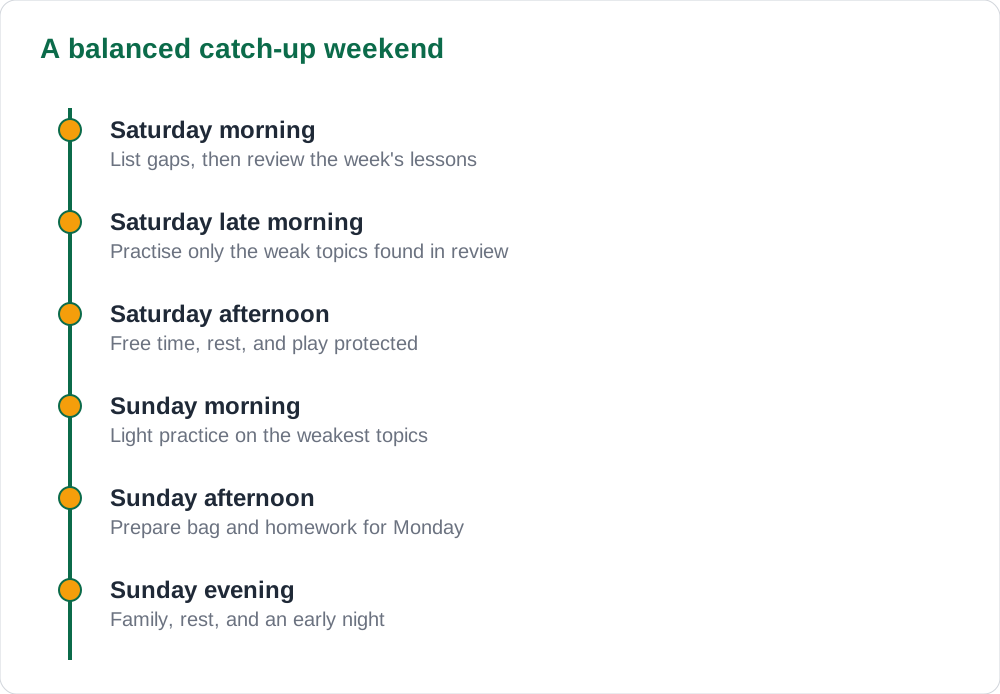
A catch-up weekend fails when it starts with a vague feeling of being behind rather than a concrete list. Spend fifteen minutes on Saturday morning writing down exactly what is incomplete: homework not finished, lessons missed or not understood, chapters never revised, and questions you got wrong during the week. Limit the list to what is genuinely unfinished, not everything you have ever studied, or the weekend will feel hopeless before it begins.
Then rank the list by urgency and importance together. Work due on Monday comes first, then topics that the next week's lessons will build on, then older revision. This ranking stops the common mistake of spending Saturday on easy, comfortable revision while urgent Monday homework waits until Sunday night. A short, honest list with a clear order turns anxiety into a workable plan, and crossing items off gives visible proof that the weekend is working.
Saturday: review the week, then practise the gaps
Saturday works best in two parts. In the morning, review the week's lessons subject by subject, spending a few minutes recalling what each lesson covered and marking anything still unclear. This review is not re-reading everything: it is a quick scan that finds the gaps. In the second part, practise only those gaps: redo problems, rewrite notes in your own words, or answer questions on the weak topics you found.
Keep Saturday sessions in blocks with real breaks, and stop at a planned time rather than studying until you drop. A useful example is two morning blocks with a long break between them, then free time in the afternoon. Protecting Saturday afternoon matters: rest and play restore the energy that Monday's lessons will need. Pupils who study all Saturday often report that Sunday feels wasted too, because exhaustion from Saturday makes any Sunday work slow and miserable.
Sunday: light practice and preparation, not a second Saturday
Sunday should feel different from Saturday: lighter, shorter, and forward-looking. Use it for gentle practice on the week's weakest topics, such as a few questions, a short summary, or reading a lesson that will be taught on Monday. This light touch keeps material warm without draining the rest that Sunday is meant to provide. Sunday is also the right day to prepare for the week: pack your bag, check homework is complete, and write Monday's study pair if you use a two-subject planner.
A common Sunday mistake is leaving everything until the evening, which turns Sunday night into a stressful rush and ruins sleep before Monday. Finish Sunday's light practice by the afternoon when possible, and keep the evening for family, rest, and an early night. If Sunday's list is not finished, carry only the most urgent item to Monday's plan and let the rest wait for next weekend's review. Protecting Sunday evening is protecting Monday morning, and Monday morning sets the tone for the whole week.
Avoiding burnout: the signs and the fixes
Burnout in pupils rarely announces itself clearly; it shows up as dreading study, reading the same page repeatedly, feeling tired despite sleeping, or getting upset over small mistakes. When these signs appear during a catch-up weekend, the answer is not to push harder but to stop, rest, and shorten the plan. A weekend that ends with you hating study has failed even if every item was crossed off, because it damages next week's motivation.
Build burnout prevention into the plan itself: fixed finish times, a genuinely free afternoon, and at least one enjoyable activity each day. If a task takes far longer than planned, split it across two weekends rather than forcing it into one. Talk to a parent or teacher if the backlog keeps growing despite weekend work, because a growing backlog usually signals a subject difficulty that needs teaching help, not simply more hours. For guidance on balancing study with the rest of life, see Parent Screen Time Study Balance for ideas the whole family can use.
When the backlog is too big for one weekend
Sometimes one weekend cannot fix the backlog, especially after illness or a very busy school period. In that case, do not try to cover everything: choose the most urgent and most foundational items, and let the rest wait in an orderly list. Covering half the backlog properly beats rushing through all of it badly, because rushed work must often be redone anyway. Write the remaining items into next weekend's plan so nothing is lost or forgotten.
Also ask for help early. Teachers would far rather hear that you are behind and need guidance on what matters most than discover it at test time. Show them your list and ask which topics to prioritise; that conversation alone often halves the workload, because teachers know which topics carry the most weight and which can wait. A catch-up weekend works best as part of a longer recovery over two or three weeks, with steady progress each weekend, rather than a single heroic effort that leaves you exhausted. Check books to confirm which chapters your class has actually covered before planning what to catch up, and use solved notes for guided practice on those chapters.
AI Help: Muse AI
Muse AI is Meta's personal AI assistant. You can ask it to explain a concept in simple words, summarise a lesson, or make practice questions for revision.
For this topic, ask Muse AI to explain a lesson you missed in simple steps, so your Saturday review starts with understanding rather than confusion.
Join Muse with invite code LTGSWD — in the Muse app, go to Settings > Redeem token and enter the code.
Disclosure: LTGSWD is the author's Muse invite code.
Muse AI does not give official STBB answers — always verify against your Sindh Textbook Board book and your teacher.
5 key points you must know
- Start Saturday with a short, ranked list of what is genuinely unfinished.
- Use Saturday morning for review, then practise only the gaps you found.
- Keep Sunday light: gentle practice, Monday preparation, and an early night.
- Watch for burnout signs and shorten the plan instead of pushing harder.
- If the backlog is too big, prioritise with your teacher and spread recovery over weeks.
Frequently asked questions
How many hours should I study on a catch-up weekend?
It depends on the backlog, but a useful example is about three focused hours on Saturday and one to two light hours on Sunday. More than that often reduces learning rather than increasing it, because tired minds retain less. If the backlog genuinely needs more, spread it over two weekends instead of cramming it into one.
Should I catch up on homework or revision first at the weekend?
Homework due on Monday comes first, because it has a real deadline. After that, revise the topics that next week's lessons will build on, since falling behind there creates new gaps. Older revision can wait for a later weekend if time runs short.
What if I missed school for a whole week?
Ask your teacher which lessons matter most and borrow notes from a classmate for the rest. Work through the priority lessons over two weekends, not one, and do not try to complete every exercise immediately. Understanding the key lessons first matters more than finishing every question.
Is it okay to take a weekend completely off study?
Yes, sometimes. If you are exhausted or unwell, a full rest weekend can restore more learning than forced study. Just note what will wait for next weekend, and return to the plan on Monday. Occasional full rest is healthy; every weekend off is a different problem.
How do I stop Sunday night homework panic?
Finish Sunday's light practice by the afternoon and check homework completeness then, not at night. Keeping Sunday evening free for rest means Monday starts calmly. If homework is regularly left until Sunday night, move it to Saturday morning in your weekend plan.
Solved notes — preview free
These guides work best with the solved exercises. Preview the solved notes free on this website — 119 solved notes for Classes 6–10 in Sindhi, Urdu, English and Arabic medium. Or browse the full solved notes catalogue for your class and medium. New solved notes are added regularly — check the catalogue for coming-soon books.