A Two-Subjects-a-Day Study Planner That Works
The two-subjects-a-day planner is built on a simple idea: depth beats breadth. Many pupils open five books in one evening, touch each one for twenty minutes, and remember almost nothing from any of them. Studying two subjects properly, with time to understand, practise, and review, leaves far more in memory than skimming many subjects in a rush. This approach suits school pupils in Sindh especially well, because school days already cover many subjects in class; the evening does not need to repeat all of them. It needs to deepen the two that matter most that day. This guide explains how to choose the two subjects, how to structure each block, and how to keep every subject covered across the week without falling behind in any of them.
Why skimming many subjects fails
Skimming feels productive because you have touched many pages, but memory does not work that way. Real learning needs time to understand a concept, work through examples, and then test yourself without the book open. Twenty rushed minutes rarely reaches the testing stage, so the material feels familiar when you read it and vanishes when you need it in a test. Pupils who skim often say they studied for hours yet scored poorly, and the gap between effort and result is deeply discouraging.
Depth changes that pattern. When you spend a full block on one subject, you can read, practise, and then recall, which is the sequence that actually builds lasting memory. You also notice your own gaps: a problem you cannot solve or a definition you cannot explain tells you exactly what to revise next. Two subjects a day gives you that depth while still leaving the evening manageable, with time for homework, rest, and family life after study ends.
Choosing which two subjects each day
Choice is the heart of this planner, so choose deliberately the night before or at the start of the week. One good rule is to pair a hard subject with an easier one, so the evening never feels like two mountains in a row. Another is to match one subject to tomorrow's schoolwork and one to revision of older material, so each evening serves both the near and the longer term. Either way, write the pair down in advance: deciding in the moment usually means picking favourites and avoiding hard subjects.
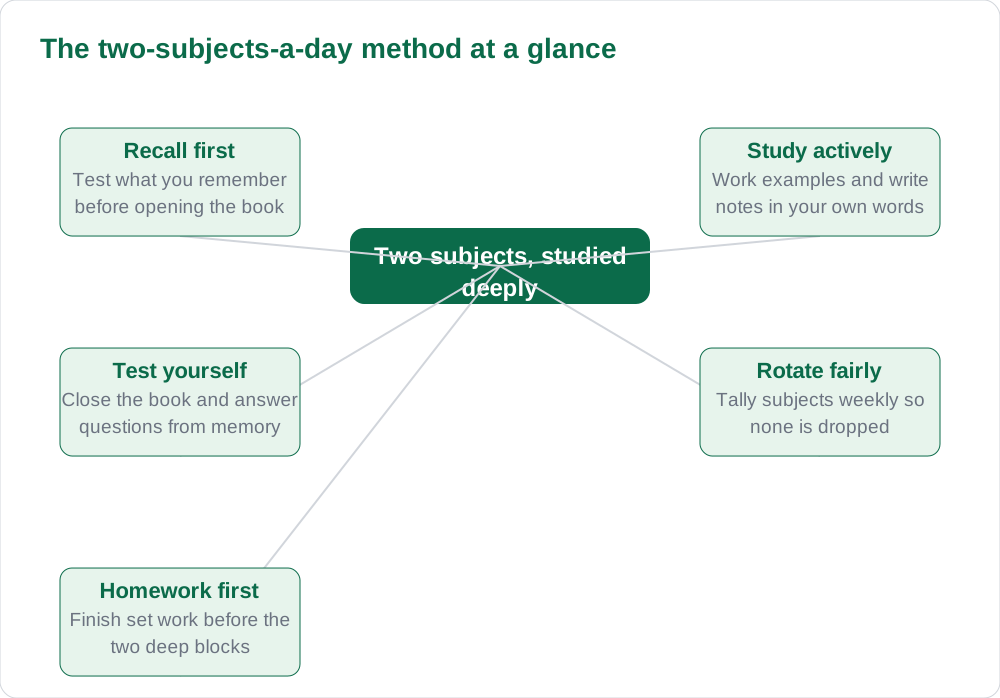
Across the week, the pairs must rotate fairly. With five school evenings and two subjects each, you have ten subject slots, which covers five or six subjects twice each in a typical week. Keep a small weekly tally of how often each subject appeared, and if one subject has appeared only once by Thursday, it must take a slot on Friday. This tally is what stops the two-a-day system from quietly dropping a subject you dislike. For help deciding which topics need depth, check your recent classwork and solved notes for the subjects you are studying.
Structuring each subject block for depth
A subject block works best in three parts. First, spend a few minutes recalling what you already know about the topic without opening the book, which shows you where you actually stand. Second, study actively: read with a pen in hand, work examples step by step, and write short notes in your own words rather than copying sentences. Third, close the book and test yourself: answer two or three questions, explain the idea aloud, or redo one problem from scratch.
This structure matters more than the length of the block. A forty-five-minute block with recall, study, and self-testing teaches more than ninety minutes of passive re-reading. If time is short, shorten each part rather than dropping the self-test, because the test is what turns reading into memory. Keep a small notebook for the questions you got wrong during self-testing, and let those questions choose tomorrow's revision topic. That notebook becomes your personal map of weak points, far more useful than a generic list of chapters.
Fitting homework into a two-subject evening
Homework must be handled before the two-subject plan begins, or it will eat into both blocks. A practical order is: finish tomorrow's homework first, then study the two planned subjects. If homework itself covers two subjects heavily, those subjects can count as one or both of the day's pair, since homework done properly is real study. The point of the system is depth and coverage, not rigid counting, so let homework count honestly rather than duplicating the same work twice.
When homework runs long, protect at least one subject block rather than cancelling both. A shortened evening with one deep block still beats an evening of rushed skimming across everything. Note the missed subject in your tally and give it priority the next day. Over a week, this flexible honesty keeps the system alive through busy periods, while a rigid system that demands perfection breaks at the first long homework night and gets abandoned entirely.
Making two a day cover the whole week
Pupils sometimes worry that two subjects a day cannot cover six or seven school subjects, but the weekly tally shows it can. Ten evening slots across five days give most subjects two appearances, and the weekend adds review slots for anything missed. Subjects taught in school that day also get classroom coverage, so the evening does not carry the whole burden alone. The system works because it trusts the week, not a single evening, to provide balance.
Use the weekend as the safety net, not as extra pressure. A Saturday review can revisit the two subjects that felt weakest during the week, and Sunday can stay light. If a subject still lags after two weeks of tallies, give it a third weekly slot by swapping out a strong subject's second appearance, and ask your teacher which topics in that subject matter most. Depth, rotation, and honest tallies together make two subjects a day not a shortcut, but a smarter way to use the same evening hours. See books to check the full subject list for your class before planning your rotation, and the blog for more planning ideas.
AI Help: Muse AI
Muse AI is Meta's personal AI assistant. You can ask it to explain a concept in simple words, summarise a lesson, or make practice questions for revision.
For this topic, ask Muse AI to turn one subject block into a self-test: ask it to make five questions on the topic you just studied, then answer them with your book closed.
Join Muse with invite code LTGSWD — in the Muse app, go to Settings > Redeem token and enter the code.
Disclosure: LTGSWD is the author's Muse invite code.
Muse AI does not give official STBB answers — always verify against your Sindh Textbook Board book and your teacher.
5 key points you must know
- Two subjects a day gives depth: recall, active study, and self-testing in each block.
- Pair a hard subject with an easier one so no evening feels impossible.
- Keep a weekly tally so every subject appears fairly across the week.
- Finish homework first, and let heavy homework count honestly toward the day's pair.
- Use the weekend as a safety net for the week's weakest subjects.
Frequently asked questions
Will two subjects a day leave some subjects behind?
Not if you rotate fairly. Ten slots across five evenings cover five or six subjects twice each, and classroom teaching covers subjects daily too. Keep a weekly tally, and any subject that appears only once by Thursday must take a Friday slot. The weekend then catches anything still missed.
How long should each subject block be?
Around forty-five minutes to an hour usually works well for a school pupil, with a short break between blocks. The structure matters more than the clock: include recall, active study, and a self-test in every block. If you only have thirty minutes, shorten each part rather than skipping the self-test.
What if tomorrow's test is in a third subject?
Let the test subject replace one of the day's pair. A planner serves your learning, not the other way round. Give the test subject the first block while your mind is fresh, keep the second block for the planned subject, and restore the normal rotation the next day.
Should the two subjects be related or different?
Different usually works better, because switching between unrelated subjects keeps attention fresh and avoids confusion between similar topics. Pairing a language subject with Mathematics or Science, for example, gives your mind a genuine change. Avoid pairing two heavy memorisation subjects in one evening.
Can younger pupils use the two-subjects-a-day planner?
Yes, with shorter blocks. Younger pupils might use two blocks of about thirty minutes each, with more guidance from a parent or elder sibling in choosing the pair. The core idea stays the same: fewer subjects, studied properly, with a quick self-check at the end of each block.
Solved notes — preview free
These guides work best with the solved exercises. Preview the solved notes free on this website — 119 solved notes for Classes 6–10 in Sindhi, Urdu, English and Arabic medium. Or browse the full solved notes catalogue for your class and medium. New solved notes are added regularly — check the catalogue for coming-soon books.