Using Short Breaks and Focus Blocks in a Study Planner
Long, unbroken study sessions look hard-working but often waste the second half, because attention fades, reading becomes staring, and mistakes creep in. Short focus blocks with real breaks solve this by working with attention instead of against it: study hard for a set time, rest properly, then return fresh for the next block. This timer method, often called the Pomodoro technique, adapts easily to school pupils in Sindh for homework, revision, and practice. This guide explains how to run focus blocks, how long breaks should be, what to do during breaks, and how to fit the method into a daily planner without turning study into clock-watching.
How focus blocks work and why they help
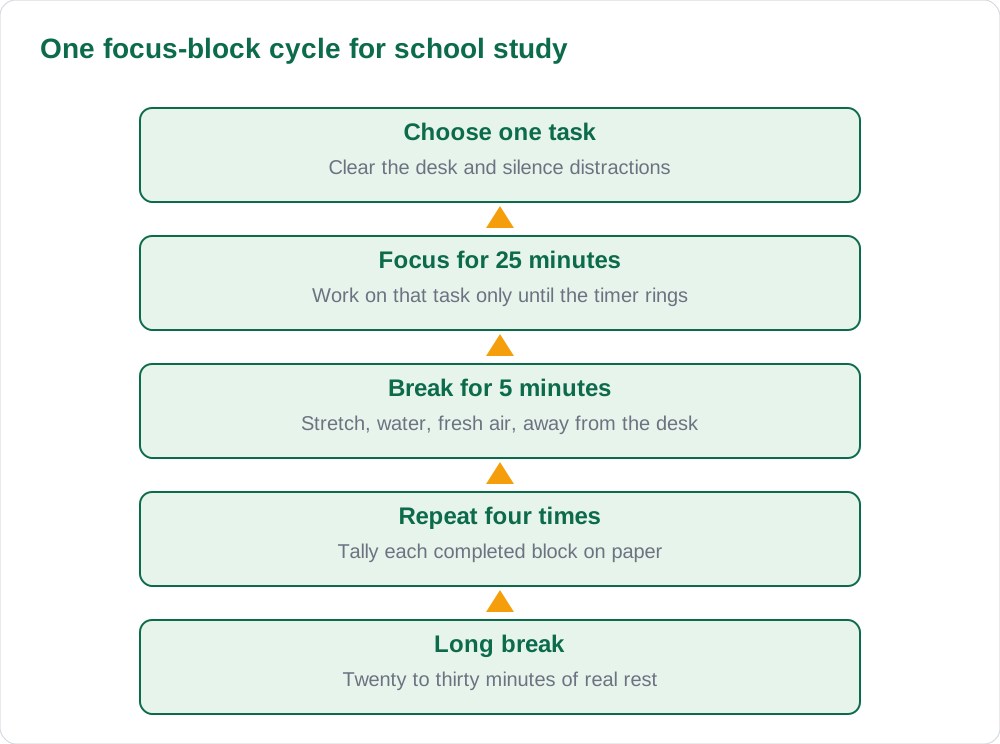
A focus block is a short period, often about twenty-five minutes for pupils, during which you work on one task with full attention and no distractions. When the timer ends, you stop, even mid-task, and take a short break of about five minutes. After several blocks, you take a longer break of fifteen to thirty minutes. The timer creates a clear start and finish, which helps pupils begin promptly instead of delaying, and helps them persist, because the end is always near and the break is earned.
The method helps for three reasons. First, it limits distraction: knowing the block is short makes it easier to ignore the phone or television until the break. Second, it protects energy: regular breaks prevent the slow exhaustion that makes long sessions unproductive. Third, it makes progress visible: counting completed blocks shows real work done, which motivates far more than vague hours spent at a desk. Pupils who use focus blocks often report studying for less total time but learning more, because the time is genuinely focused.
Setting up your first focus-block session
Start simply: choose one task, set a timer for twenty-five minutes, and work until it rings. Put your phone out of reach, close unrelated books, and keep only the materials for that task on the desk. When the timer rings, stop and take a five-minute break away from the desk: stretch, drink water, look out of the window, or walk around the room. Do not use the break to start another task, or the break stops being rest and becomes extra work in disguise.
After four blocks, take a longer break of twenty to thirty minutes, and use it for a snack, fresh air, or play. Then begin a new set of blocks, either continuing the same subject or switching to the next planned subject. Keep a small tally of completed blocks on paper, because the tally turns invisible effort into visible progress. For the first week, use the method for homework only, so it becomes familiar before you apply it to revision and longer study sessions. See Class 1-4 Homework Without Stress for homework routines younger pupils can pair with short blocks.
Choosing block lengths for different tasks and ages
Twenty-five minutes suits many school pupils, but it is a starting point, not a law. Younger pupils may work better with fifteen-minute blocks and five-minute breaks, while older pupils may manage forty-five-minute blocks for writing or problem practice. Memorisation often suits shorter blocks with frequent self-testing, while essay writing or long problems suit longer blocks that allow deep thinking without interruption. Adjust block length to the task and your age, and keep the break proportional: longer blocks earn longer breaks.
Watch for two warning signs that block length is wrong. If you constantly watch the clock, the block may be too long for that task, so shorten it. If you feel interrupted just as you begin to think deeply, the block may be too short, so lengthen it slightly. The method should feel like support, not surveillance. Over time, you will learn which tasks need short blocks and which need long ones, and your planner can record those preferences so future sessions start with the right settings.
What to do, and not do, during breaks
Breaks work only when they genuinely rest the mind, so choose break activities that differ from study. Movement helps: stretching, walking, or playing briefly restores energy far better than sitting in the same chair. Water and fresh air help too, especially in warm weather. A short conversation with family can refresh the mind, provided it ends when the break ends and does not drift into a long discussion that swallows the next block.
Screens are the most common break trap. A five-minute break spent on videos or games rarely stays five minutes, and even when it does, the fast stimulation makes returning to study feel dull and difficult. Keep the phone out of reach during both blocks and breaks until the longer break, when a brief check is less harmful. If screens keep breaking your sessions, tell a parent and ask them to hold the phone during study; that is not a punishment, it is a practical support for a habit you are trying to build.
Fitting focus blocks into a daily planner
Focus blocks fit naturally into a daily planner by replacing vague time labels with block counts. Instead of writing study from four to six, write four focus blocks: two for homework, two for revision, with breaks between them. This change makes the evening concrete and achievable: four blocks is a clear goal, while two hours is a vague stretch that invites drifting. It also makes missed time easy to handle: if one block is lost, the remaining blocks still form a useful evening.
Track block counts weekly to learn about your own study patterns. If homework regularly takes six blocks, the workload or difficulty needs attention, not simply more hours. If revision blocks keep shrinking, the planner needs a protected revision slot. Over a term, focus blocks teach pupils something valuable beyond any subject: that attention is a limited resource to be spent carefully, with rest as part of work rather than a reward for finishing it. That lesson serves every subject and every future study challenge. Browse solved notes for practice material to use inside your focus blocks, and books to confirm your class subjects.
AI Help: Muse AI
Muse AI is Meta's personal AI assistant. You can ask it to explain a concept in simple words, summarise a lesson, or make practice questions for revision.
For this topic, ask Muse AI to make a five-question self-test you can use at the end of a focus block, so each block closes with recall instead of just reading.
Join Muse with invite code LTGSWD — in the Muse app, go to Settings > Redeem token and enter the code.
Disclosure: LTGSWD is the author's Muse invite code.
Muse AI does not give official STBB answers — always verify against your Sindh Textbook Board book and your teacher.
5 key points you must know
- Study in short focus blocks of about twenty-five minutes, with five-minute breaks.
- After four blocks, take a longer break of twenty to thirty minutes.
- One task per block, phone out of reach, and a paper tally of completed blocks.
- Use breaks for movement, water, and fresh air, not screens that swallow the next block.
- Plan evenings in block counts, not vague hours, so progress stays visible.
Frequently asked questions
What if the timer rings in the middle of a good thought?
Finish the sentence or step you are on, then take the break. The rule is to stop promptly, not mid-word, but not to continue for another ten minutes either. A brief pause rarely loses a good thought, and returning fresh often improves it. Note the thought down before the break if you fear losing it.
Can I skip breaks to finish faster?
Skipping breaks usually makes finishing slower, because attention fades and mistakes increase. Short breaks protect the quality of later blocks, so a session with breaks often finishes sooner in real learning terms than a longer unbroken session. Keep breaks short and genuine, and the total time stays efficient.
How many focus blocks should I do each evening?
Four to six blocks suit many school pupils, depending on homework load and age. Start with four and add blocks only if they stay focused. More blocks done poorly teach less than fewer blocks done well, so judge by focus and recall, not by the block count alone.
Should younger pupils use shorter blocks?
Yes. Younger pupils often work best with fifteen-minute blocks and five-minute breaks, with a parent nearby to help start and end blocks. The core idea stays the same: one short, focused task, then real rest. Lengthen blocks gradually as concentration grows.
What if I get distracted during a block?
Note the distraction on paper and return to the task without starting a new activity. If the same distraction returns repeatedly, remove it before the next block: put the phone in another room or close the unrelated book. Occasional distraction is normal; a pattern of distraction needs a change in setup, not self-blame.
Solved notes — preview free
These guides work best with the solved exercises. Preview the solved notes free on this website — 119 solved notes for Classes 6–10 in Sindhi, Urdu, English and Arabic medium. Or browse the full solved notes catalogue for your class and medium. New solved notes are added regularly — check the catalogue for coming-soon books.