STBB 195 Titles: How to Use Your Textbook With Solved Notes
November is a strong month to rebuild your study method, because examinations and revision are close enough to feel real but far enough away to allow steady work. The Sindh Textbook Board publishes 195 textbook titles from Early Childhood to Grade 10, in Sindhi, Urdu, and English, and those books, not shortcuts or summaries alone, remain the foundation of your learning. Solved notes help most when they sit beside the book, not instead of it. This guide explains a simple, honest method for using your STBB textbook together with solved notes, so every revision session teaches you something real and leaves you ready for classwork and examinations. Read this guide once through, note the steps that apply to your own papers, and then make a short personal plan, because a plan written down is far easier to follow than a plan kept only in your head.
Start From the Book, Not From the Notes
Your STBB textbook is the official source for your class: it sets the chapters, the exercises, and the language your teacher uses in class. Solved notes are a study aid built around that book, and they work best after you have read the lesson itself. Begin each session by reading the textbook lesson slowly, marking key ideas, and trying the exercise questions yourself before you look at any solved answer. That first attempt, even when imperfect, shows you what you already understand and what still needs work. Keep this point in mind as you plan your week, because a calm, organised, and steady approach usually protects both your time and your marks across every paper.
When you then check the solved notes, compare your attempt with the solution instead of merely copying it. Ask why each step appears, what idea it uses, and where your own attempt differed. If a solution confuses you, return to the textbook explanation and to your teacher, because the book and the teacher together outrank any aid. The textbooks and the solved notes are most useful in this order: book first, attempt second, notes third, teacher whenever anything stays unclear. Use this idea in your own plan, and check it against your own date sheet and admit card, so that nothing important is left to guesswork on the day itself.
- Read the textbook lesson first and mark key ideas
- Try exercise questions yourself before checking solved notes
- Compare, do not copy: ask why each step appears
A November Revision Method That Fits Real Days
November revision works best as a daily routine, not as occasional long sessions. Choose two or three subjects per day, give each a focused block of study, and end each block with a short recall: close the book and write down what you learned. Rotate subjects across the week so no subject is ignored for long, and keep one block each week for older chapters, because revision that only covers recent lessons leaves early chapters to fade. A written weekly plan, kept simple, helps you actually follow this routine. Remember this as you move to the next step, because steady preparation, clear documents, and enough rest together make a real difference on examination day.
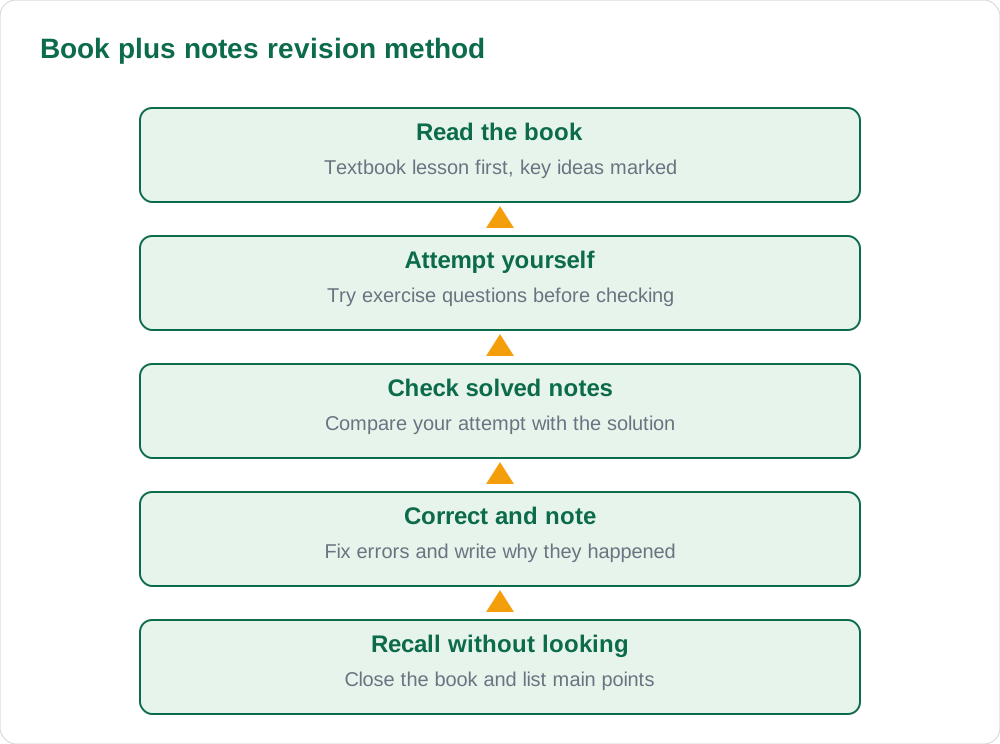
Within each block, follow the same pattern: read, attempt, check, correct, and recall. First read the textbook section, then attempt its questions, then check solved notes, then correct your work in a different colour or a separate note, and finally recall the main points without looking. That pattern takes a little longer than passive reading, but it builds memory that survives until examination day. The blog offers further study guides for building steady routines across subjects. Keep this point in mind as you plan your week, because a calm, organised, and steady approach usually protects both your time and your marks across every paper.
Use the Right Medium and the Right Chapter
The 195 titles cover Early Childhood to Grade 10 in Sindhi, Urdu, and English, so your first check should always be that you hold the right book: the right class, the right subject, and the right medium. A correct chapter in the wrong medium, or a neighbouring class book, can waste a whole study session and confuse your vocabulary. Check the cover, the class, and the subject before you begin, and keep your books organised by subject so revision starts quickly instead of with a search. Use this idea in your own plan, and check it against your own date sheet and admit card, so that nothing important is left to guesswork on the day itself.
Medium matters for language as well as content. Sindhi, Urdu, and English versions use different terms for the same ideas, and examinations expect the terms of your medium. When you use solved notes, make sure they match your book's medium and chapter, and learn key terms in that medium first. If a note uses a term you do not recognise, check it in your textbook glossary or ask your teacher, rather than memorising an unfamiliar word without understanding it. Remember this as you move to the next step, because steady preparation, clear documents, and enough rest together make a real difference on examination day.
- Check class, subject, and medium before every session
- 195 titles span Early Childhood to Grade 10 in Sindhi, Urdu, and English
- Learn key terms in your own medium first
Distribution, Scale, and Why Books Matter
The scale of the STBB programme helps explain why textbooks deserve respect: 52 million sets were part of the distribution inaugurated on 19 February 2026, bringing the same series to classrooms across Sindh. That shared foundation means teachers, students, and examinations work from common books, and it means that careful textbook study connects directly to classroom teaching. A student who knows the book well is rarely surprised by classwork, because classwork grows out of the same chapters. Keep this point in mind as you plan your week, because a calm, organised, and steady approach usually protects both your time and your marks across every paper.
A revised curriculum follows from the next academic year, so current books remain your working foundation for now, and future changes will arrive through official channels when they apply to your class. Do not chase rumoured new books or abandon your current book for an unverified replacement. Study the book you actually hold, note curriculum guidance from your teacher, and keep your notes organised by chapter so any future change is easy to absorb. Steady work with a real book beats anxious searching every time. Use this idea in your own plan, and check it against your own date sheet and admit card, so that nothing important is left to guesswork on the day itself.
- 52 million sets in the distribution inaugurated on 19 February 2026
- Common books connect classroom teaching, study, and examinations
- Revised curriculum follows from the next academic year
Honest Use: Notes Help, They Do Not Replace Learning
Solved notes help most when they explain, not when they replace thinking. Copying answers without understanding may complete homework quickly, but it leaves you unprepared for examinations, where no notes are available and questions test understanding. Use notes to check, to learn methods, and to recover when you are stuck, and always return to the textbook for the idea behind the answer. Teachers can tell the difference between copied work and understood work, and so can examination papers. Remember this as you move to the next step, because steady preparation, clear documents, and enough rest together make a real difference on examination day.
Build one honest habit this November: after every solved question, write one sentence in your own words about what the question taught you. That sentence, repeated across chapters, becomes a personal summary far stronger than copied answers. Keep your textbook, your notebook, and your solved notes together, review your own sentences weekly, and ask your teacher about anything that still feels unclear. That method respects the book, respects your teacher, and respects your own future results. Keep this point in mind as you plan your week, because a calm, organised, and steady approach usually protects both your time and your marks across every paper.
- Use notes to check and learn, never merely to copy
- After each question, write one sentence in your own words
- Review your personal summaries weekly and ask about gaps
AI Help: Muse AI
Muse AI is Meta's personal AI assistant, and it can help you use your STBB textbook together with solved notes in November. You can ask it to turn a textbook chapter into short recall questions and a simple weekly revision plan. Join Muse with invite code LTGSWD — in the Muse app, go to Settings > Redeem token and enter the code. Disclosure: LTGSWD is the author's Muse invite code. Muse AI does not give official STBB answers — always verify against your STBB book and your teacher. Always verify against your Sindh Textbook Board book and your teacher before using anything in classwork.
5 key points you must know
- STBB publishes 195 titles from Early Childhood to Grade 10 in Sindhi, Urdu, and English.
- Use the book first, attempt questions yourself, then check solved notes and correct your work.
- 52 million sets were part of the distribution inaugurated on 19 February 2026.
- A revised curriculum follows from the next academic year.
- After each question, write one sentence in your own words about what it taught you.
Frequently asked questions
How many STBB textbook titles are there?
STBB publishes 195 textbook titles from Early Childhood to Grade 10, in Sindhi, Urdu, and English, under the Shaheed Mohtarma Benazir Bhutto Textbook Series. Always check that you hold the right class, subject, and medium before you begin a study session.
Should I read solved notes before the textbook?
No. Read the textbook lesson first, try the exercise questions yourself, and only then check solved notes. Compare your attempt with the solution, ask why each step appears, and return to the book or your teacher if anything stays unclear.
What is a good November revision pattern?
Follow read, attempt, check, correct, and recall for each lesson. Study two or three subjects per day in focused blocks, rotate subjects across the week, and keep a weekly block for older chapters. End each block by recalling main points without looking at the book.
What about the revised curriculum?
A revised curriculum follows from the next academic year, so your current book remains your working foundation for now. Do not abandon it for a rumoured replacement. Study the book you hold, follow teacher guidance, and keep notes organised by chapter.
How can I avoid merely copying solved notes?
After each solved question, write one sentence in your own words about what it taught you. Use notes to check and learn methods, not to complete homework without understanding. Review your personal summaries weekly and ask your teacher about remaining gaps.
Solved notes — preview free
These guides work best with the solved exercises. Preview the solved notes free on this website — 119 solved notes for Classes 6–10 in Sindhi, Urdu, English and Arabic medium. Or browse the full solved notes catalogue for your class and medium. New solved notes are added regularly — check the catalogue for coming-soon books.