Spaced Repetition for School Revision Without Apps

Every pupil knows the frustration of learning a chapter well and then forgetting it a week later. That forgetting is not a personal weakness; it is how memory naturally works. New information fades quickly unless it is revisited, but each revisit slows the fading a little more. Spaced repetition is simply a plan for revisiting material at growing intervals, so you return to a chapter just as it is about to fade, and each return makes it stick longer. You do not need any app to do this. A notebook, a calendar, and a simple day 1, day 3, day 7 schedule will give you the same benefit, and this article shows exactly how to run it.
Why Memory Fades and How Spacing Helps
When you first learn something, the memory is fresh but fragile. Without a revisit, much of it fades within a day or two, which is why a chapter studied on Monday can feel almost new again by the following Monday. Cramming fights this by repeating the material many times in one sitting, but that only creates a short-term memory that fades just as fast once the session ends. The brain treats information repeated in one burst as something needed only right now, so it does not bother storing it deeply.
Spacing works differently. When you revisit a chapter after a gap, your brain has to work a little to retrieve it, and that small effort signals that the information is still needed. Each spaced revisit therefore strengthens the memory more than a repeat inside the same session would. After a few spaced revisits, the memory becomes durable enough to survive until the exam. The schedule matters less than the principle: revisit after a gap, not immediately, and let the gaps grow as the memory gets stronger.
The Paper-Based Day 1, Day 3, Day 7 Plan
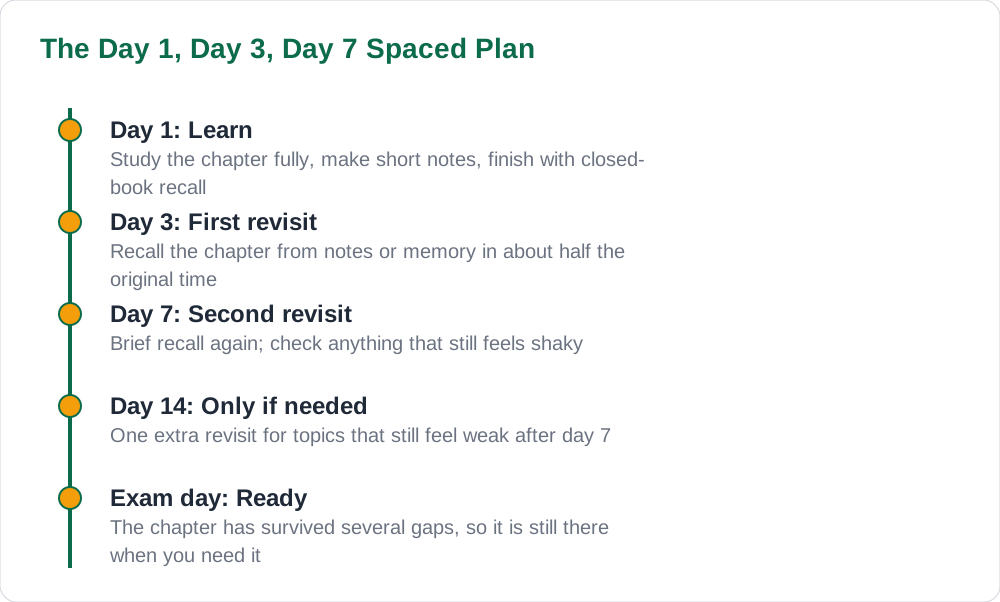
The simplest spaced plan uses three revisits. Day 1 is the day you first learn the chapter: study it properly, make short notes, and finish with a closed-book recall of the main points. Day 3 is your first revisit: two days later, recall the chapter from your notes or from memory, spending about half the time of the original study. Day 7 is the second revisit: recall it again, more briefly, and check anything that still feels shaky. If a topic still feels weak on day 7, add one more revisit on day 14, but most school chapters will be solid after the day 7 pass.
Run this plan with a simple table in the back of your notebook. Write the chapter name, the date you learned it, and the three revisit dates, then tick each revisit off as you complete it. At the start of each study session, look at today's column and revise whatever is due, before starting anything new. This takes only a few minutes of planning each week, yet it replaces the usual pattern of learning, forgetting, and relearning from scratch. The blog has more revision plans, and the solved notes are useful material for revisit sessions.
Making Flashcards from Paper and Card
Paper flashcards are the easiest tool for spaced revision, and you can make them from cut-up card or old notebooks. Write a question or a keyword on the front and the answer on the back, keeping each card to one fact: one definition, one process step, one vocabulary meaning. A card that tries to carry a whole paragraph is too big to recall quickly, so split large topics into several small cards. Number your cards or keep them in small labelled bundles by chapter, so a bundle can be picked up and reviewed in five minutes.
Use the cards inside your spaced schedule, not as a separate chore. On a revisit day, shuffle the chapter's bundle and go through it with the answer side hidden, sorting cards into two piles: known and still learning. The known pile can wait until the next revisit, while the still-learning pile gets another pass the same day or the next day. This sorting turns a dull pile of cards into a visible measure of progress, and watching the still-learning pile shrink is genuinely satisfying. Keep the cards safe in an envelope or a rubber band, because a lost bundle means rebuilding the work.
Fitting Spacing Around Homework and Class
Pupils often worry that spaced revision means extra study time, but it mostly replaces time that would otherwise be wasted. The day 3 and day 7 revisits are short, often ten to fifteen minutes, and they replace the long relearning session you would need if the chapter had been forgotten completely. The trick is to treat revisits as the first job of a study session, before homework or new topics, because a revisit left until the end of the day is the one most likely to be skipped.
Build the plan around your real week. If you learn new chapters on school days, your revisit days will naturally fall on a mix of school days and weekends, which is fine: a weekend revisit can be a little longer and can cover two chapters at once. When a test week arrives, your spaced table becomes a ready-made revision list, showing exactly which chapters are due and which are already strong. Pupils who keep the table honestly find test weeks far less frightening, because they have been revising all along in small pieces rather than facing a mountain of forgotten work. See the book collection for chapters to plan around.
- Do revisits first in a study session, before homework or new topics.
- Keep day 3 and day 7 revisits short: ten to fifteen minutes each.
- Use weekends for slightly longer revisits covering two chapters.
- Let your spaced table become your test-week revision list.
Common Spacing Mistakes to Avoid
The most common mistake is making the gaps too short. Revisiting a chapter an hour later, or even the same evening, feels productive but gives almost no spacing benefit, because the memory has not faded enough for retrieval to require effort. Give the gap at least a day or two before the first revisit. The opposite mistake is making the gaps too long: waiting a month before returning to a chapter usually means relearning it from scratch, which wastes the benefit of the first study session entirely.
Another mistake is revisiting by re-reading instead of recalling. A spaced revisit only works if you try to retrieve the material first, with the notes closed, and use the notes to check afterwards. Re-reading on day 3 and day 7 feels comfortable but adds little strength. Finally, do not abandon the plan after one missed day. A missed revisit is not a failed plan: simply do it the next day and carry on. Spaced revision rewards consistency over weeks, not perfection on any single day, so a plan followed most of the time will still transform your memory. More tips are on the [home page](/) and the blog.
AI Help: Muse AI
Muse AI is Meta's personal AI assistant. You can ask it to explain a concept in simple words, summarise a lesson, or make practice questions for revision.
For spaced revision, ask Muse AI to turn your chapter notes into a set of short questions you can reuse on day 3 and day 7, so each revisit becomes a quick recall test instead of re-reading.
Join Muse with invite code LTGSWD — in the Muse app, go to Settings > Redeem token and enter the code.
Disclosure: LTGSWD is the author's Muse invite code.
Muse AI does not give official STBB answers — always verify against your Sindh Textbook Board book and your teacher.
5 key points you must know
- Memory fades fast unless revisited; each spaced revisit makes it last longer.
- Use the day 1, day 3, day 7 pattern: learn, revisit after two days, revisit after a week.
- Track revisits in a simple table at the back of your notebook.
- Make one-fact paper flashcards and sort them into known and still-learning piles.
- Revisit by recalling with notes closed, not by re-reading, and never quit over one missed day.
Frequently asked questions
Do I need an app for spaced repetition?
No. A notebook table with chapter names and revisit dates works just as well for school revision. The benefit comes from revisiting after gaps, not from any software.
Why day 1, day 3, and day 7?
These gaps are long enough that retrieval takes real effort, which strengthens memory, but short enough that the chapter is not forgotten completely. Most school chapters become solid after the day 7 revisit.
How long should a revisit take?
A day 3 revisit takes about half the original study time, and a day 7 revisit is shorter still, often ten to fifteen minutes. Short revisits replace the long relearning session you would need if the chapter were forgotten.
What if I miss a revisit day?
Simply do the revisit the next day and carry on. Spaced revision rewards consistency over weeks, not perfection on any single day, so one missed day does not spoil the plan.
Should I re-read the chapter on revisit days?
No, try to recall it first with your notes closed, then use the notes to check. Retrieval is what strengthens memory; re-reading on revisit days adds very little.
Solved notes — preview free
These guides work best with the solved exercises. Preview the solved notes free on this website — 119 solved notes for Classes 6–10 in Sindhi, Urdu, English and Arabic medium. Or browse the full solved notes catalogue for your class and medium. New solved notes are added regularly — check the catalogue for coming-soon books.