Social Studies: Transport and Communication in Pakistan
Transport moves people and goods, while communication moves messages and ideas, and together they connect a large country such as Pakistan into one working society. A farmer in Punjab needs roads to send wheat to market, a student in Sindh needs the internet to study, a patient in a remote valley needs a road to reach a hospital, and a business in Karachi needs ports and phones to trade with the world. Without transport and communication, villages would be isolated, markets would shrink, and citizens would struggle to learn, work, and help one another. In this guide, we explain roads, railways, air and sea transport, and modern communication in simple words, showing how each system works, why it matters, and what problems it still faces.
Roads: The Backbone of Daily Travel
Roads are the most widely used form of transport in Pakistan, because they reach villages, towns, and cities that railways and airports cannot. National highways link major cities, motorways provide fast travel between large centres, and smaller rural roads connect villages to nearby markets, schools, and health centres. Buses, vans, cars, rickshaws, and trucks all use this network, carrying students to school, workers to offices, patients to hospitals, and goods to shops. A good road saves time, lowers the cost of goods, and brings services closer, which is why road building is often the first development priority in a remote area.
Roads also bring responsibilities, especially road safety, which every student should learn early. Walking on footpaths where they exist, crossing at safe points, wearing a helmet on a motorcycle, and never using a phone while driving are habits that save lives. Traffic rules, speed limits, and vehicle fitness checks exist to protect all road users, not to cause inconvenience. Students can study their own area by noting the main road, the bus stops, and the places where crossings feel unsafe, and then discussing improvements such as a footpath, a sign, or a speed breaker near a school. Such local observation makes transport a living topic, not a list of highway names.
Railways: Long Journeys and Heavy Goods
Railways are well suited to long journeys and heavy goods, because a train can carry hundreds of passengers or tonnes of freight in one trip, using less fuel per passenger than many separate cars. Pakistan Railways links major cities from Karachi in the south to Peshawar in the north, with branch lines serving smaller towns and farming areas. Trains carry students, families, workers, and goods such as coal, cement, and grain, and railway stations are busy centres of trade and employment in their towns. For many families, a train journey is also the most affordable way to travel long distances together.
Railways face challenges, including old tracks, ageing engines, and the need for faster, safer, and more punctual services. Modernisation means repairing tracks, improving signals, adding comfortable coaches, and keeping timetables reliable, so that passengers can plan with confidence. Students revising railways should learn one main line, Karachi to Peshawar, plus the idea that freight trains support industry by moving bulk goods cheaply. A comparison helps: roads are flexible and reach everywhere, while railways are efficient for long, heavy loads, so a country needs both, each doing what it does best.
Air and Sea Transport: Speed and World Trade
Air transport is the fastest way to travel, and it matters most for long distances, urgent business, medical needs, and international travel. Pakistan's main airports, including Karachi, Lahore, and Islamabad, connect the country to the Gulf, Europe, and other regions, carrying passengers, tourists, and high-value cargo such as fresh produce and documents. Air travel is more expensive than road or rail, so it is used where speed matters most, and airports also create jobs in airlines, catering, security, and tourism services. Students should remember air transport as the speed option, best for distance and urgency rather than for everyday local trips.
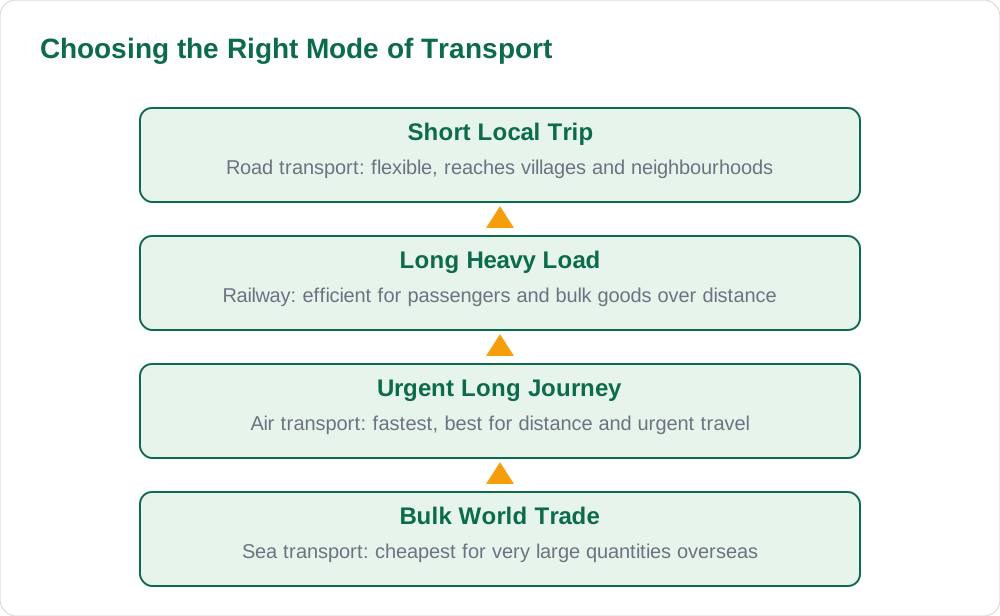
Sea transport, by contrast, is the cheapest way to move very large quantities over long distances, and it carries most of Pakistan's international trade through the ports of Karachi and Gwadar. Ships bring machinery, fuel, and consumer goods, and they carry out textiles, rice, and other exports to world markets. Ports need deep water, cranes, warehouses, and road and rail links to move goods inland quickly, which is why port cities grow into industrial and commercial centres. A simple summary for revision is: road for flexibility, rail for heavy long loads, air for speed, and sea for bulk world trade, with each mode supporting the others.
Communication: From Letters to the Internet
Communication has changed dramatically from letters and landline telephones to mobile phones, television, radio, and the internet, and each change has made Pakistan smaller and more connected. Radio and television bring news, education, and entertainment to homes across the country, including areas where newspapers arrive late. Mobile phones let farmers check market prices, families stay in touch across distances, and students access lessons and information instantly. The internet adds email, video calls, online learning, and digital banking, so a student in a small town can now learn from teachers and libraries far away, provided they have a connection and a device.
Modern communication also requires responsibility, which is an important lesson for young users. Students should check news before sharing it, protect personal information, speak respectfully online, and balance screen time with study, play, and family life. False news spreads quickly on social media, so a wise user asks whether a story comes from a trustworthy source before forwarding it. Schools can teach this digital citizenship alongside reading and writing, because communication skills now include judging sources, not only sending messages. A connected citizen is one who uses communication to learn, help, and build trust, not to spread rumour or harm.
How Transport and Communication Build the Country
Transport and communication build a country by linking producers to markets, patients to hospitals, students to schools, and citizens to their government. A new road can raise farm incomes by cutting transport costs, a bus route can let girls attend a distant school safely, and a mobile network can let a small shopkeeper reach customers in another city. Together, these systems reduce isolation, spread opportunity, and make national unity real, because people who can travel, trade, and talk easily feel part of one country. This is why governments invest heavily in highways, railways, ports, and digital networks, and why their maintenance matters as much as their construction.
Challenges remain, including traffic congestion in cities, road accidents, uneven internet access in remote areas, and the cost of maintaining large networks. Solutions include safer road design, better public transport, affordable internet in villages, and careful use of public money. Students can contribute by travelling safely, using communication responsibly, and suggesting local improvements politely. For more guides on transport, trade, and daily life, visit Blog, read solved notes on Solved Notes, and browse the book collection on Books. A connected Pakistan is a stronger Pakistan, and every safe journey and honest message helps build it.
AI Help: Muse AI
Muse AI is Meta's personal AI assistant, and it can help you learn transport and communication by comparing road, rail, air, and sea transport with simple examples for each journey. For example, you can ask it which mode suits a heavy load, an urgent trip, or bulk exports, or to quiz you on communication changes from letters to the internet. Muse AI does not give official STBB answers — always verify against your STBB book and your teacher. Always verify against your Sindh Textbook Board book and your teacher before using anything in classwork.
Join Muse with invite code LTGSWD — in the Muse app, go to Settings > Redeem token and enter the code. Disclosure: LTGSWD is the author's Muse invite code.
5 key points you must know
- Roads are the most flexible transport, reaching villages, towns, and cities.
- Railways suit long journeys and heavy goods efficiently and affordably.
- Air transport is fastest for distance and urgency; sea transport is cheapest for bulk world trade.
- Communication has grown from letters to radio, television, mobile phones, and the internet.
- Safe travel and responsible, checked communication build a connected and united country.
Frequently asked questions
Which mode of transport is best for heavy goods over a long distance?
Railways are usually best for heavy goods over long distances, because a train carries large loads in one trip at lower fuel cost per tonne than many trucks. Roads are more flexible and reach more places, while sea transport is cheapest for overseas bulk trade. The best choice depends on distance, load, cost, and how quickly the goods must arrive.
Why are roads called the backbone of transport?
Roads are called the backbone because they reach almost every village, town, and city, and they connect homes, farms, schools, markets, and railway stations. Buses, trucks, and vans use roads for daily travel and for carrying goods over short and medium distances. Without roads, other transport modes could not collect or deliver passengers and goods to their final destinations.
How do ports help Pakistan's trade?
Ports such as Karachi and Gwadar let large ships load and unload goods for world trade, carrying out exports such as textiles and rice and bringing in machinery, fuel, and consumer goods. Ports create jobs in shipping, warehousing, and industry, and they link sea routes to roads and railways inland. Efficient ports lower trade costs and help the whole economy grow.
How has the internet changed communication in Pakistan?
The internet lets people send messages instantly, make video calls, study online, bank digitally, and access news and libraries from distant places. A student in a small town can now learn from resources far away, and a shopkeeper can reach customers in another city. The benefits depend on connection, devices, and the skill to judge trustworthy sources.
What is digital citizenship for students?
Digital citizenship means using phones and the internet safely, honestly, and kindly: checking news before sharing, protecting personal information, speaking respectfully, and balancing screen time with study and family life. It also means not spreading false rumours or harmful content. These habits protect students themselves and help keep online spaces trustworthy for everyone.
Solved notes — preview free
These guides work best with the solved exercises. Preview the solved notes free on this website — 119 solved notes for Classes 6–10 in Sindhi, Urdu, English and Arabic medium. Or browse the full solved notes catalogue for your class and medium. New solved notes are added regularly — check the catalogue for coming-soon books.