Social Studies: Pakistan and Its Neighbours
Pakistan shares borders with four countries and a coastline that opens to the wider world, so its neighbours matter greatly for trade, travel, security, and culture. To the west lie Iran and Afghanistan, to the north-east lies China, and to the east lies India, while the Arabian Sea lies to the south and connects Pakistan to sea trade routes. Each neighbour has its own language, history, and economy, and each relationship has its own story of cooperation and difficulty. For Social Studies students, learning about neighbours is not about memorising border lines alone; it is about understanding why friendly relations, fair trade, and peaceful settlement of disputes help ordinary people on both sides live better lives. This guide explains each neighbour in simple words and shows why good neighbourliness is a practical policy, not just a polite phrase.
Why Neighbours Matter So Much
Neighbours matter because geography cannot be changed: countries must live beside the same neighbours for generations, so the quality of those relationships shapes daily life for decades. Trade with neighbours is often cheaper and faster than trade with distant countries, because goods travel shorter distances overland. Shared rivers, roads, and border markets connect farming communities, traders, and families across frontiers, and shared cultures, languages, and faiths often link border regions closely. When neighbours cooperate, border areas gain jobs, markets, and stability, and when they quarrel, the same areas suffer first from closed crossings, disrupted trade, and insecurity.
Good relations also matter for peace and development, because a country that feels secure on its borders can spend more attention and resources on schools, hospitals, and jobs instead of on constant tension. Diplomacy, which means peaceful negotiation between governments, exists to solve disagreements through talks, agreements, and international law rather than through conflict. Students should understand that being a good neighbour does not mean agreeing on everything; it means disagreeing peacefully, keeping promises, respecting sovereignty, and looking for shared interests such as trade, water management, and protection against common dangers like disease and natural disaster.
China: A Northern Neighbour and Partner
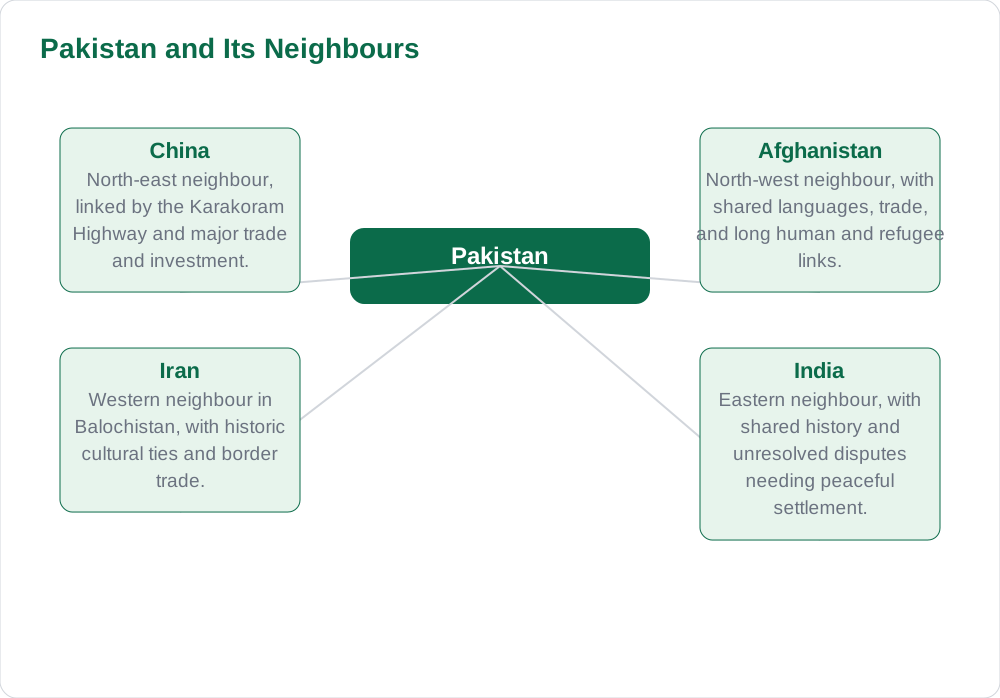
China lies to the north-east of Pakistan, connected by the Karakoram Highway through high mountain passes, and the two countries describe their relationship as a long-standing friendship. Trade, infrastructure, and investment form a large part of this partnership, including road, energy, and port projects that link western China to the Arabian Sea through Pakistan. Cultural and educational exchanges also matter, with students, traders, and visitors travelling in both directions. For students, the key point is geographic: the mountain border is remote and difficult, yet modern roads and cooperation have turned a hard frontier into a working route for trade and friendship.
The partnership with China also teaches a lesson about mutual benefit. China gains a shorter route to the sea, while Pakistan gains investment, jobs, and infrastructure that support its own development. At the same time, wise policy requires care for local communities, fair terms, and protection of the environment in mountain areas, so that large projects benefit ordinary people and not only distant planners. Students can revise this topic by marking the Karakoram route on a map, noting the port of Gwadar on the coast, and explaining in one paragraph why both countries value the connection. That map-plus-reason method works for every neighbour.
Afghanistan and Iran: Western Neighbours
Afghanistan lies to the north-west of Pakistan, and the two countries share a long border, many languages and tribal links, and centuries of trade and migration. Families, traders, and students have crossed this frontier for generations, and Pakistan has hosted large numbers of Afghan refugees during wars in Afghanistan. Peace and stability in Afghanistan therefore matter directly for Pakistan's border provinces, for trade routes to Central Asia, and for the safety of communities on both sides. Students should remember this relationship as close and human, shaped by shared culture and by the hardships of conflict, not only by official agreements.
Iran lies to the west and south-west of Pakistan, sharing a border in Balochistan and a coastline on the Arabian Sea and the Gulf region. The two countries share historical and cultural links, including the Persian influence on language, poetry, and art in South Asia, and they trade goods across their land border. Energy, border security, and cooperation against smuggling and militancy are regular topics between them. A useful revision habit is to compare the two western neighbours: Afghanistan links Pakistan to Central Asia by land, while Iran links it to the Gulf and to western Asia, and both relationships affect Balochistan and Khyber Pakhtunkhwa most directly.
India: The Eastern Neighbour
India lies to the east of Pakistan, and the two countries share the longest and most complex relationship among Pakistan's neighbours. They share history, languages, food, music, and family links from before partition, yet they have also faced wars and long-standing disputes, most notably over Kashmir. Trade between them has been limited by political tension, even though ordinary people on both sides could benefit from open markets, shared culture, and easier travel. Students should learn this topic with balance: acknowledging shared heritage and human ties, while understanding honestly that disputes remain and that peaceful dialogue is the only lasting way to settle them.
For class answers, students should avoid slogans and focus on principles: respect for sovereignty, peaceful settlement of disputes, protection of minorities and human rights on both sides, and the benefits of trade and cultural exchange for ordinary families. They can also note that sports, films, and music sometimes build bridges where politics struggles, showing that people-to-people contact matters alongside official talks. A mature answer does not pretend that problems do not exist, nor does it treat neighbours as enemies by nature; it explains the history briefly, names the disputes honestly, and argues for patience, dialogue, and fairness as the path forward.
The Sea, Trade, and Good Neighbourliness
To the south, the Arabian Sea gives Pakistan ports, fishing, and sea trade routes that connect it to the Gulf, Africa, and beyond, and this coastline is itself a kind of neighbourhood. Ports such as Karachi and Gwadar handle ships carrying goods to and from many countries, and coastal communities depend on fishing, shipping, and port jobs. Sea trade reminds students that neighbours are not only land neighbours: a country's prosperity also depends on open seas, fair shipping rules, and friendly relations with trading partners across the water. Protecting the coast from pollution and overfishing is therefore part of good stewardship as well as good economics.
Good neighbourliness, in the end, is a daily practice of states, not only a slogan for speeches. It means honouring agreements, settling disputes by talks, trading fairly, helping in disasters, and respecting each neighbour's independence and dignity. Students can practise the same values at a smaller scale by being fair neighbours at school and at home. For more guides on Pakistan's geography and neighbours, visit Blog, read solved notes on Solved Notes, and browse the book collection on Books. Countries, like people, live better when they treat their neighbours with patience, honesty, and respect.
AI Help: Muse AI
Muse AI is Meta's personal AI assistant, and it can help you learn about Pakistan's neighbours by quizzing you on directions, borders, and one key fact for each neighbour. For example, you can ask it to describe a trade route on a map, to explain why good relations help border communities, or to make simple comparison questions for revision. Muse AI does not give official STBB answers — always verify against your STBB book and your teacher. Always verify against your Sindh Textbook Board book and your teacher before using anything in classwork.
Join Muse with invite code LTGSWD — in the Muse app, go to Settings > Redeem token and enter the code. Disclosure: LTGSWD is the author's Muse invite code.
5 key points you must know
- Pakistan's land neighbours are China, Afghanistan, Iran, and India, with the Arabian Sea to the south.
- Neighbourly relations affect trade, travel, security, and border communities directly.
- China is linked by the Karakoram Highway and major trade and investment cooperation.
- Afghanistan and Iran share deep cultural, trade, and border links with Pakistan's west.
- Peaceful dialogue, fair trade, and respect for sovereignty are the path to good neighbourliness.
Frequently asked questions
Which countries share a land border with Pakistan?
Pakistan shares land borders with China to the north-east, Afghanistan to the north-west, Iran to the west, and India to the east. To the south lies the Arabian Sea, which connects Pakistan to sea trade routes. Learning neighbours by direction, north-east, north-west, west, and east, makes the map much easier to remember.
Why is trade with neighbours important?
Trade with neighbours is often cheaper and faster because goods travel shorter distances overland instead of across oceans. Border markets and crossings create jobs for traders, drivers, and shopkeepers in border areas. When neighbours trade fairly, ordinary families on both sides gain cheaper goods, wider choice, and steadier incomes.
What links Pakistan and China?
Pakistan and China are linked by the Karakoram Highway through high mountain passes, and by a long-standing partnership in trade, infrastructure, and investment. Road, energy, and port projects connect western China to the Arabian Sea through Pakistan. The relationship shows how geography, investment, and diplomacy can turn a remote frontier into a working trade route.
Why do relations with India matter so much?
India is Pakistan's eastern neighbour, sharing history, languages, food, and family links from before partition, alongside long-standing disputes, most notably over Kashmir. Because the two countries are large and close, their relationship affects peace, trade, and daily life across South Asia. Peaceful dialogue and respect for agreed principles offer the only lasting path to settlement.
How does the Arabian Sea help Pakistan?
The Arabian Sea gives Pakistan ports such as Karachi and Gwadar, fishing livelihoods, and sea trade routes to the Gulf, Africa, and beyond. Ports create jobs in shipping, warehousing, and industry, and they let Pakistan trade with distant countries as well as neighbours. Protecting the coast from pollution and overfishing keeps these benefits sustainable for future generations.
Solved notes — preview free
These guides work best with the solved exercises. Preview the solved notes free on this website — 119 solved notes for Classes 6–10 in Sindhi, Urdu, English and Arabic medium. Or browse the full solved notes catalogue for your class and medium. New solved notes are added regularly — check the catalogue for coming-soon books.