Social Studies: Natural Resources of Pakistan
Natural resources are the useful gifts of nature, such as water, fertile land, forests, minerals, and sources of energy, and a country's prosperity depends greatly on how wisely it uses them. Pakistan is blessed with mighty rivers, fertile plains, mountain forests, mineral deposits, and a long coastline, yet these resources are limited and can be damaged by waste, pollution, and careless use. For Social Studies students, learning natural resources means more than listing names: it means understanding where each resource is found, how people use it, what problems threaten it, and what conservation means in practice. In this guide, we explore water, land, minerals, forests, and energy in simple words, with conservation habits that every student can practise and explain.
Water: The Most Precious Resource
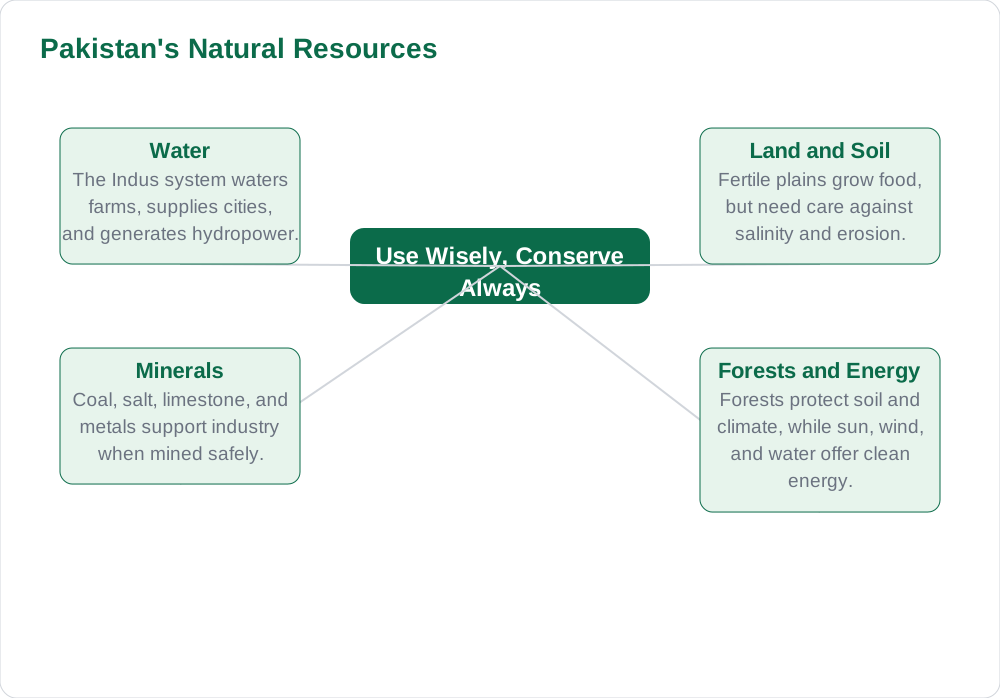
Water is Pakistan's most precious resource, because the Indus River system waters the farms that feed the country, supplies cities with drinking water, and generates hydroelectric power. The Indus and its tributaries flow from the northern mountains through Punjab and Sindh to the Arabian Sea, and a network of dams, barrages, and canals distributes this water across the plains. Farmers depend on timely water for wheat, rice, cotton, and sugarcane, while cities depend on clean supply for homes, schools, and hospitals. Without reliable water, farming fails, food prices rise, and daily life becomes difficult for millions of people.
Water also faces serious problems, including waste, pollution, and uneven distribution between seasons and regions. Leaking pipes, flood irrigation that loses water, and untreated waste entering rivers all reduce the water available for good use. Conservation means using water carefully: fixing leaks, watering crops efficiently, harvesting rain where possible, and keeping rivers clean. Students can practise conservation at home by turning off taps, reporting leaks, and avoiding waste, and they can explain in answers why water management is a national priority, not only a farming issue. Every drop saved is a drop available for another family, field, or future season.
Land and Soil: The Basis of Farming
Fertile land is the basis of Pakistan's agriculture, especially the alluvial plains of Punjab and Sindh, where river deposits have built deep, rich soil over centuries. Different regions suit different crops: irrigated plains favour wheat, rice, and cotton, while rain-fed areas and valleys support pulses, oilseeds, fruits, and livestock. Soil is a living resource that can be improved with crop rotation, organic matter, and careful use of fertilisers, but it can also be damaged by waterlogging, salinity, erosion, and overuse. When soil loses fertility, yields fall and farmers must work harder for less, which is why soil care is an economic issue as well as an environmental one.
Students should connect land use to human choices. Building houses on prime farmland reduces food production, cutting trees on slopes increases erosion, and leaving land bare in wind increases soil loss. Good land management includes terracing on slopes, planting shelter belts of trees, rotating crops, and draining waterlogged fields where needed. A simple class activity is to map land use around a town: fields, houses, roads, water, and waste land, and then discuss which changes help farming and which harm it. Such observation turns a textbook chapter into a local investigation that students remember.
Minerals and Energy Resources
Minerals are valuable materials taken from the earth, and Pakistan has deposits of coal, limestone, gypsum, salt, chromite, copper, and other minerals in different regions, including Balochistan, Khyber Pakhtunkhwa, and Sindh. Limestone supports cement factories, salt from mines such as Khewra is used at home and exported, and coal can fuel power and industry where it is mined responsibly. Mining creates jobs and income, but it must be managed carefully, because careless mining damages land, pollutes water, and endangers workers. Students should remember that mineral wealth benefits a country only when it is extracted safely, processed fairly, and shared through jobs and public revenue.
Energy resources include water power, coal, gas, oil, wind, and solar power, and Pakistan uses a mix of these to generate electricity and fuel transport and industry. Hydropower from northern rivers is clean but depends on water flow and seasons, while gas and oil provide steady fuel but must be imported in part and produce pollution. Solar and wind power are growing options, especially in sunny and coastal areas, because they are renewable and increasingly affordable. A balanced energy plan uses each source where it fits best, saves energy through efficient appliances and habits, and protects the environment. Students can explain this balance in answers by naming one advantage and one limit of each major source.
Forests, Wildlife, and the Coast
Forests cover only a small part of Pakistan, mainly in the northern mountains and parts of Khyber Pakhtunkhwa, Azad Kashmir, and northern Punjab, yet they provide timber, fuel, medicines, and homes for wildlife, and they protect soil and regulate water flow. When forests are cut faster than they regrow, slopes erode, floods worsen, and wildlife loses habitat, so tree planting and forest protection are national duties. Mangrove forests along the Sindh coast protect the shoreline, shelter fish, and support fishing communities, showing that forests matter at the sea as well as in the mountains. Students can support this cause by planting trees, caring for school gardens, and explaining why a tree is worth more standing than cut for quick profit.
Wildlife, from markhor in the mountains to Indus dolphins in the river and turtles on the coast, is also a natural resource in the wider sense, because healthy ecosystems support farming, fishing, and tourism. National parks and protected areas give wildlife safe space, and laws against hunting endangered species protect rare animals for future generations. The coast adds fishing, salt, and port trade, but overfishing and pollution threaten fish stocks and the livelihoods of fishing families. A good answer links these points: forests protect water, water supports fish, and healthy nature supports human jobs, so conservation is practical economics, not only kindness to animals.
Conservation: Using Resources for Tomorrow Too
Conservation means using resources carefully so that enough remains for future generations, and it rests on three simple habits: reduce waste, reuse what can be used again, and recycle materials such as paper, glass, and metal. At home, conservation means saving water and electricity, avoiding plastic waste, and caring for plants and soil. At school, it means switching off lights, protecting trees, and keeping grounds clean. In farming and industry, it means efficient irrigation, clean technology, and proper disposal of waste. When millions of people practise small habits, the total saving is enormous, and the environment recovers faster than any single large project could achieve alone.
Governments also play a role by making laws, building dams and water projects, planting forests, and teaching conservation in schools. Citizens support this work by obeying environmental rules, reporting pollution, and voting for leaders who take conservation seriously. Students who write about conservation should give one personal habit, one school habit, and one national measure, because this three-level structure shows complete understanding. For more guides on resources and environment, visit Blog, read solved notes on Solved Notes, and browse the book collection on Books. The resources of Pakistan are a trust, and every generation must pass them on in better condition than it found them.
AI Help: Muse AI
Muse AI is Meta's personal AI assistant, and it can help you learn natural resources by explaining one resource at a time with a simple map or everyday example. For example, you can ask it to trace the Indus from mountains to sea, to compare renewable and non-renewable energy, or to quiz you on conservation habits. Muse AI does not give official STBB answers — always verify against your STBB book and your teacher. Always verify against your Sindh Textbook Board book and your teacher before using anything in classwork.
Join Muse with invite code LTGSWD — in the Muse app, go to Settings > Redeem token and enter the code. Disclosure: LTGSWD is the author's Muse invite code.
5 key points you must know
- Water from the Indus system is Pakistan's most precious resource for farming, cities, and power.
- Fertile plains grow food, but soil needs care against waterlogging, salinity, and erosion.
- Minerals such as coal, salt, and limestone support industry when mined safely.
- Forests, wildlife, and mangroves protect soil, water, climate, and fishing livelihoods.
- Conservation means reduce, reuse, and recycle, at home, at school, and nationally.
Frequently asked questions
What are natural resources?
Natural resources are useful materials and forces provided by nature, such as water, fertile land, forests, minerals, and energy sources. People use them to grow food, build houses, make goods, and generate power. Because most resources are limited, they must be used wisely and conserved for future generations.
Why is the Indus River system so important?
The Indus and its tributaries water the farms of Punjab and Sindh, supply drinking water to cities, and generate hydroelectric power. Dams, barrages, and canals distribute this water across the plains, making large-scale farming possible. Without reliable Indus water, food production, city supply, and power generation would all suffer seriously.
What is the difference between renewable and non-renewable resources?
Renewable resources, such as sunlight, wind, water power, and forests, can regrow or replenish themselves if used carefully. Non-renewable resources, such as coal, oil, and minerals, exist in fixed amounts and run out once used. Wise policy uses renewable resources where possible and saves non-renewable resources for uses where no good alternative exists.
How does deforestation harm Pakistan?
Cutting forests faster than they regrow causes soil erosion on slopes, worsens floods, reduces rainfall retention, and destroys wildlife habitat. In mountain areas this threatens farms and villages below, while loss of coastal mangroves harms fishing and shoreline protection. Tree planting and forest protection therefore help farming, safety, and livelihoods together.
What can a student do to conserve resources?
A student can save water by turning off taps and reporting leaks, save electricity by switching off unused lights, plant and care for trees, avoid plastic waste, and reuse paper and other materials. At school they can join cleanliness and planting drives and explain conservation to classmates. Small daily habits, practised by millions, save enormous amounts of resources over time.
Solved notes — preview free
These guides work best with the solved exercises. Preview the solved notes free on this website — 119 solved notes for Classes 6–10 in Sindhi, Urdu, English and Arabic medium. Or browse the full solved notes catalogue for your class and medium. New solved notes are added regularly — check the catalogue for coming-soon books.