Social Studies: Economy Basics for Students
The economy is simply the system by which people produce, share, and use the goods and services they need to live. Every family makes economic choices each day: what food to buy, whether to save or spend, how to use time and money, and what work to do. Villages, towns, and whole countries make the same kinds of choices on a larger scale, deciding what to grow, what to build, and what to trade with others. Economics may sound like a subject for bankers and ministers, but its basic ideas are already familiar to every student who has managed pocket money or shared resources at home. In this guide, we explain needs and wants, resources, production, and trade in simple words, with examples that make the economy easy to understand and easy to explain in class.
Needs, Wants, and Choices
Needs are the things people must have to live decently, such as food, clothing, shelter, clean water, health care, and education. Wants are things people would like to have but can live without, such as a new game, a fashionable bag, or an extra sweet after a meal. Because money, time, and resources are limited, people cannot satisfy every want at once, so they must choose. A wise choice puts needs first, then selects the most useful wants from what remains. This simple rule explains most of economics: limited resources and unlimited wants force every person, family, and country to make careful choices and accept that choosing one thing means giving up another.
Students can practise this idea with pocket money, which is a small economy in miniature. If a student receives a fixed amount, they must decide how much to spend on snacks, how much to save for a book, and how much to keep for an unexpected need. Spending everything on snacks feels good for a day but leaves nothing for the book, while saving everything may miss a reasonable pleasure. Good economic thinking is not about never enjoying anything, but about ranking choices, thinking about tomorrow as well as today, and learning from the results. Families make the same decisions with salaries, and governments make them with national budgets.
Resources: Land, Labour, Capital, and Ideas
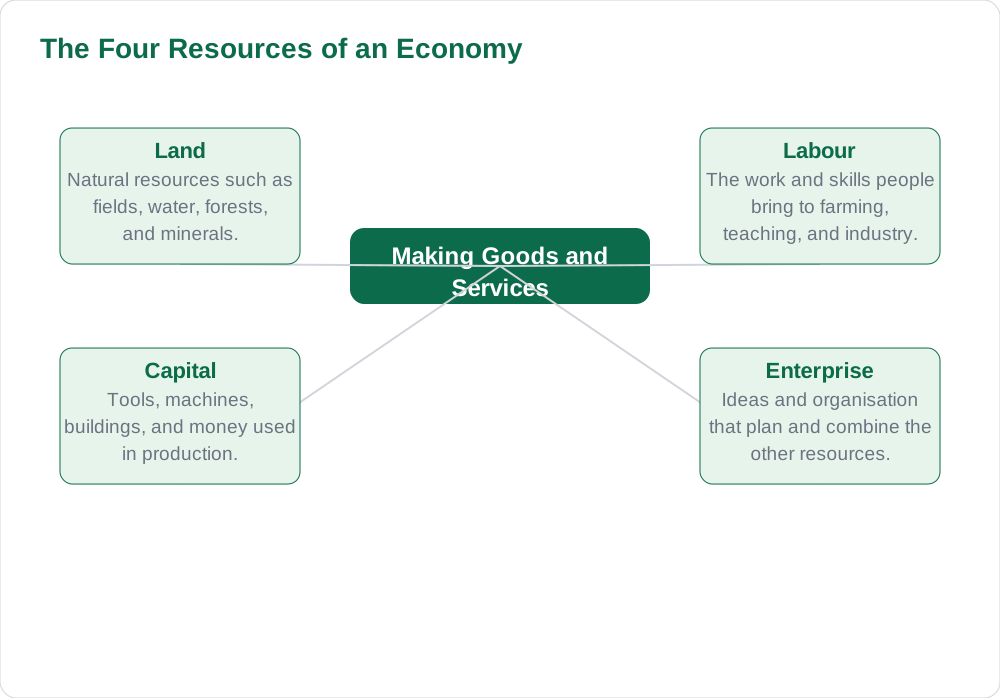
Economists group resources into land, labour, capital, and enterprise. Land means not only fields but all natural resources, such as water, forests, minerals, and climate. Labour means the work people do, from farming and teaching to driving and coding, including the skills they bring to that work. Capital means the tools, machines, buildings, and money used to produce goods, such as a tractor, a school building, or a sewing machine. Enterprise means the ideas and organisation that bring the other resources together, such as a shopkeeper who plans what to sell, a farmer who plans what to plant, or a student who plans a small project.
Pakistan's economy can be understood through these resources. Fertile land and river water support agriculture, a large and young workforce provides labour, and factories, roads, and ports provide capital for industry and trade. When any resource is scarce, choices become harder: a dry season limits land, a lack of training limits skilled labour, and poor roads limit trade. Students should remember that resources are not only physical things; knowledge, honesty, and good management are resources too. A community that educates its children and keeps its promises builds the human and social capital on which lasting prosperity depends.
Production: From Raw Material to Finished Good
Production is the process of turning resources into goods and services that people can use. A cotton plant becomes cloth through farming, ginning, spinning, weaving, and stitching, with workers, machines, and transport at every stage. A lesson becomes learning through a teacher, books, a classroom, and a student's own effort. Each stage adds value, which means the product becomes more useful and therefore worth more than the raw material alone. Students who trace one product from start to finish, such as wheat becoming bread or milk becoming yoghurt, understand production far better than students who only memorise its definition.
Production takes place in three broad sectors that students should learn to distinguish. The primary sector takes goods directly from nature, such as farming, fishing, and mining. The secondary sector makes finished goods in factories and workshops, such as textiles, cement, and furniture. The tertiary sector provides services, such as teaching, banking, transport, health care, and trade. A healthy economy needs all three: farms feed factories, factories supply shops, and services connect producers to customers. When students classify local jobs into these sectors, the economy of their own town becomes a living textbook.
Markets, Prices, and Trade
A market is any place or system where buyers and sellers meet, from a village bazaar to an online shop. Prices in a market usually rise when many buyers want a scarce good and fall when supply is plentiful or demand is low. This is why the price of a seasonal fruit falls when it is abundant and rises when it is out of season. Sellers compete by offering better quality, fair prices, and honest dealing, while buyers compare and choose. A fair market depends on trust: accurate weights, honest advertising, and respect for agreements, because cheating may bring quick profit but destroys the trust on which trade depends.
Trade extends the market idea between regions and countries. No region produces everything it needs, so Punjab may trade wheat for goods from other provinces, and Pakistan trades textiles and agricultural products for machinery, fuel, and technology from abroad. Trade benefits both sides when each specialises in what it does well and exchanges for what it lacks. Students should also learn that trade needs transport, communication, and payment systems to work, which is why roads, ports, banks, and honest business practices matter so much. A simple classroom activity is to list what a town imports and exports, and to discuss what would happen if trade stopped.
Saving, Spending, and the Role of Government
Saving means setting aside part of income for future needs, emergencies, or goals such as education or a small business. A family that saves can handle illness, repair a roof, or invest in a child's learning without borrowing at high cost. Spending wisely means comparing prices, avoiding waste, and choosing quality over show. Students can learn both habits early by keeping a small record of pocket money, noting what was spent, what was saved, and whether each purchase was a need or a want. This record, kept for a month, teaches more about economics than many textbook chapters, because it turns theory into personal experience.
Government plays an important economic role by collecting taxes, building roads and schools, providing health services, and setting rules for fair trade. It also supports the poor through programmes and protects consumers from fraud. Citizens support this work by paying taxes honestly and using public services carefully. For more study guides on everyday economics, visit Blog, explore solved notes on Solved Notes, and browse the book collection on Books. An economy, in the end, is not only about money; it is about people working together, sharing resources fairly, and building a better life for all.
AI Help: Muse AI
Muse AI is Meta's personal AI assistant, and it can help you learn economy basics by explaining needs and wants with examples from your own pocket money or family budget. For example, you can ask it to trace wheat into bread step by step, to classify local jobs into the three sectors, or to quiz you on resources and trade. Muse AI does not give official STBB answers — always verify against your STBB book and your teacher. Always verify against your Sindh Textbook Board book and your teacher before using anything in classwork.
Join Muse with invite code LTGSWD — in the Muse app, go to Settings > Redeem token and enter the code. Disclosure: LTGSWD is the author's Muse invite code.
5 key points you must know
- Needs are essentials for living; wants are desirable but not essential.
- Resources are land, labour, capital, and enterprise, and all are limited.
- Production turns raw materials into useful goods and services in three sectors.
- Markets set prices through supply and demand, and trade lets regions exchange strengths.
- Saving, wise spending, and honest taxes support families and the whole economy.
Frequently asked questions
What is the difference between a need and a want?
A need is something required for a decent life, such as food, shelter, clothing, clean water, health care, and education. A want is something a person would like but can live without, such as a new game or a fashionable item. Because resources are limited, people must satisfy needs first and then choose the most useful wants from what remains.
What are the four factors of production?
The four factors are land, meaning natural resources such as fields and water; labour, meaning people's work and skills; capital, meaning tools, machines, and buildings; and enterprise, meaning the ideas and organisation that combine the others. Every good or service, from bread to a school lesson, is produced by combining these four resources in some form.
What are the three sectors of an economy?
The primary sector takes goods from nature, such as farming, fishing, and mining. The secondary sector manufactures finished goods, such as textiles and furniture. The tertiary sector provides services, such as teaching, banking, transport, and health care. A healthy economy needs all three sectors working together.
Why do prices rise and fall in a market?
Prices usually rise when many buyers want a scarce good and fall when supply is plentiful or demand is low. For example, a seasonal fruit costs less when it is abundant and more when it is out of season. Honest competition, fair weights, and trustworthy dealing keep markets working well for both buyers and sellers.
Why is saving important for a student?
Saving teaches a student to plan for tomorrow instead of spending everything today. A small saved amount can buy a book, handle an unexpected need, or start a tiny project, and the habit of recording spending shows whether money went to needs or wants. These early habits prepare young people to manage family budgets and business income wisely as adults.
Solved notes — preview free
These guides work best with the solved exercises. Preview the solved notes free on this website — 119 solved notes for Classes 6–10 in Sindhi, Urdu, English and Arabic medium. Or browse the full solved notes catalogue for your class and medium. New solved notes are added regularly — check the catalogue for coming-soon books.