Social Studies: The Constitution in Simple Words
Every game has rules, and every country has a constitution, which is the set of basic rules that explains how the country is governed, what rights citizens have, and what duties they owe. Without a constitution, leaders could change the rules whenever they wished, citizens would not know their rights, and different institutions might clash over who has the power to decide. The constitution of Pakistan, like constitutions everywhere, sets out the structure of government, the powers of its institutions, and the fundamental rights of citizens, and it stands above ordinary laws. In this guide, we explain the constitution in simple words, show why it matters in daily life, and help students write clear answers about its purpose, features, and importance.
What a Constitution Is
A constitution is the supreme law of a country, which means that all other laws must agree with it, and any law that contradicts it can be challenged. It is usually a written document, although some countries follow unwritten customs and traditions instead. A written constitution describes the organs of government, such as the legislature that makes laws, the executive that runs the government, and the judiciary that interprets laws and settles disputes. It also states how leaders are chosen, how long they serve, and how power is shared between the central government and the provinces in a federation such as Pakistan.
Students sometimes confuse the constitution with ordinary laws, so a simple comparison helps. Ordinary laws deal with everyday matters such as traffic, trade, and school rules, and they can be changed fairly easily by the legislature. The constitution, by contrast, deals with the foundations: who governs, how they are chosen, what limits their power, and what rights no government may take away without due process. Changing a constitution is therefore deliberately harder, often requiring a special majority, because its rules protect the whole system and give citizens stability and confidence in the future.
Why Every Country Needs a Constitution
A constitution is needed first because it limits power. History shows that unchecked power can lead to unfairness, so a constitution divides power among institutions and sets checks so that no single person or body can rule without limits. It also protects citizens by listing fundamental rights, such as freedom of speech, freedom of religion, and equality before the law, and by giving citizens a way to approach the courts if those rights are violated. In this way, the constitution protects both the weak and the strong, because the same rules apply to everyone, including those in government.
A constitution also gives a country a shared identity and a stable framework for solving disputes peacefully. When elections are held, laws are debated, or provinces disagree with the centre, the constitution provides the agreed procedure for settling the matter without conflict. For students, this is a useful point for class discussion: the constitution is not just a book for lawyers, but a daily safeguard for ordinary people. It shapes how schools are run, how taxes are collected, how courts work, and how citizens can take part in public life through voting and peaceful expression of opinion.
The Main Parts of a Constitution
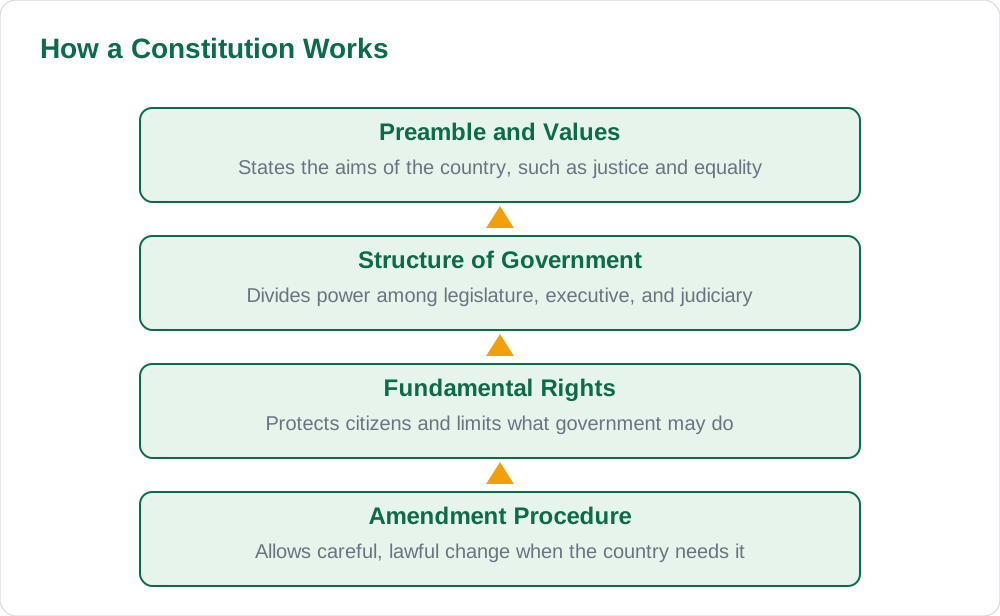
Most constitutions begin with a preamble, which is a short introduction stating the values and aims of the country, such as justice, equality, and the welfare of the people. After the preamble come the sections that describe the structure of government, the powers of the president or prime minister, the parliament, the courts, and the relationship between the centre and the provinces. Another important part lists the fundamental rights of citizens and the duties that go with them, while later parts may describe matters such as finance, elections, and the procedure for amending the constitution itself when change becomes necessary.
Students should learn to describe these parts in order, because examiners reward organised answers. A good structure is: preamble and aims, structure of government, fundamental rights, and amendment procedure. Each part can be explained with one example: the preamble states the purpose, the government sections explain who does what, the rights section protects citizens, and the amendment section shows how the constitution can be updated carefully. Practising this four-part summary aloud helps students answer both short and long questions without getting lost in detail. More study guides are available on Blog for regular revision.
Fundamental Rights: Protection for Every Citizen
Fundamental rights are the basic freedoms and protections that a constitution guarantees to every citizen, and they are called fundamental because they protect human dignity itself. They generally include equality before the law, freedom of speech and expression, freedom of religion, freedom of movement, and protection against unfair arrest and punishment. These rights do not mean that a person may do anything they wish, because rights come with reasonable limits, such as not harming others or disturbing public order. A student who understands both the right and its limit can give balanced answers instead of one-sided slogans.
Rights matter most when they are tested, so constitutions also provide a remedy: a citizen whose rights are violated can approach the courts for protection. This is why an independent judiciary is so important, because judges must be free to decide cases fairly, even when the government is involved. For classwork, students can give a simple example: freedom of speech lets a student express an opinion respectfully, but it does not allow spreading false claims that harm another person's reputation. Such examples show that rights and responsibility always travel together, which is a central lesson of constitutional study.
Living Under the Constitution in Daily Life
Students may think the constitution only matters in parliament or court, but it touches daily life in many quiet ways. When a child attends school, the right to education and the government's duty to provide schooling are at work. When a family travels freely within the country, freedom of movement is at work. When citizens vote in elections, the constitutional promise of democratic participation is at work. Even the rule that laws apply equally to rich and poor shapes everyday fairness, because it means that no one is above the law, whether they hold office or not.
Respecting the constitution also means accepting duties alongside rights, such as obeying lawful authority, paying taxes honestly, protecting public property, and respecting the rights of others. A good citizen does not demand rights while ignoring duties, and a good student practises this balance at school by following rules, respecting teachers and classmates, and caring for shared property. For solved notes and further reading, students can visit Solved Notes and explore the book collection on Books. A class that discusses the constitution with real-life examples will remember it far better than a class that only memorises definitions.
AI Help: Muse AI
Muse AI is Meta's personal AI assistant, and it can help you understand the constitution by explaining tricky ideas such as fundamental rights and separation of powers with simple everyday examples. For example, you can ask it to compare a constitution with the rules of a game, to summarise the main parts in order, or to quiz you on rights and duties. Muse AI does not give official STBB answers — always verify against your STBB book and your teacher. Always verify against your Sindh Textbook Board book and your teacher before using anything in classwork.
Join Muse with invite code LTGSWD — in the Muse app, go to Settings > Redeem token and enter the code. Disclosure: LTGSWD is the author's Muse invite code.
5 key points you must know
- A constitution is the supreme law that sets how a country is governed.
- It divides power among the legislature, executive, and judiciary to prevent misuse.
- Fundamental rights protect dignity, equality, freedom, and fair treatment.
- Rights come with reasonable limits and duties, such as respecting others.
- Citizens can approach the courts if their constitutional rights are violated.
Frequently asked questions
What is a constitution in one simple sentence?
A constitution is the basic set of rules that explains how a country is governed, what powers its institutions have, and what rights its citizens enjoy. It stands above ordinary laws, so every other law must agree with it. Without a constitution, leaders could change the rules at will and citizens would have no secure protection.
What is a preamble?
A preamble is the short introduction at the start of a constitution that states the values and aims of the country, such as justice, equality, and the welfare of the people. It does not itself create detailed laws, but it explains the spirit in which the whole constitution should be read. Students can quote its values to open an answer about the purpose of a constitution.
What are fundamental rights?
Fundamental rights are the basic freedoms and protections guaranteed by the constitution, such as equality before the law, freedom of speech, freedom of religion, and protection against unfair treatment. They are called fundamental because they protect human dignity and apply to every citizen. They come with reasonable limits, so one person's freedom does not harm another person's safety or rights.
Why is the separation of powers important?
Separation of powers divides government work among the legislature, which makes laws, the executive, which runs the government, and the judiciary, which interprets laws and settles disputes. This division prevents any single body from holding all power and allows each branch to check the others. It is one of the main safeguards against unfair rule in a constitutional system.
How can a constitution be changed?
A constitution can be changed through a special amendment procedure, which is deliberately harder than passing an ordinary law and often requires a special majority in the legislature. This careful process allows the constitution to be updated when society changes, while preventing hasty or self-serving changes. Students should remember that amendment is possible, but it must always follow the lawful procedure.
Solved notes — preview free
These guides work best with the solved exercises. Preview the solved notes free on this website — 119 solved notes for Classes 6–10 in Sindhi, Urdu, English and Arabic medium. Or browse the full solved notes catalogue for your class and medium. New solved notes are added regularly — check the catalogue for coming-soon books.