Sir Syed Ahmed Khan: Education Reformer

Sir Syed Ahmed Khan is remembered as the great education reformer of the Muslims of the subcontinent. In the 1800s, after the War of Independence in 1857, Muslims faced poverty, suspicion from rulers, and a lack of modern education. Many families feared English education and science, thinking they would harm faith. Sir Syed argued the opposite. He said that Muslims must learn modern science, English, and practical skills while keeping their faith and values. His Aligarh movement changed the future of Muslim education and prepared a generation of leaders, including those who later led the Pakistan Movement.
The Crisis After 1857
After 1857, the British blamed Muslims heavily for the uprising, and Muslim society suffered greatly. Many lost jobs, land, and influence. Traditional education alone was not enough to get government jobs or to understand modern administration, law, and science. Sir Syed saw this clearly. He believed that anger and isolation would only make the situation worse. The way forward was education, cooperation, and understanding of the modern world.
Students can learn a timeless lesson from this period. When the world changes, refusing to learn new skills does not protect you. It leaves you behind. A student who refuses to learn computers, English, or science because they feel difficult will face the same problem later. Sir Syed taught that learning new knowledge does not mean losing your identity. A Muslim student can learn science and English while remaining proud of faith, language, and culture. Knowledge belongs to everyone who works for it.
The Aligarh Movement and MAO College
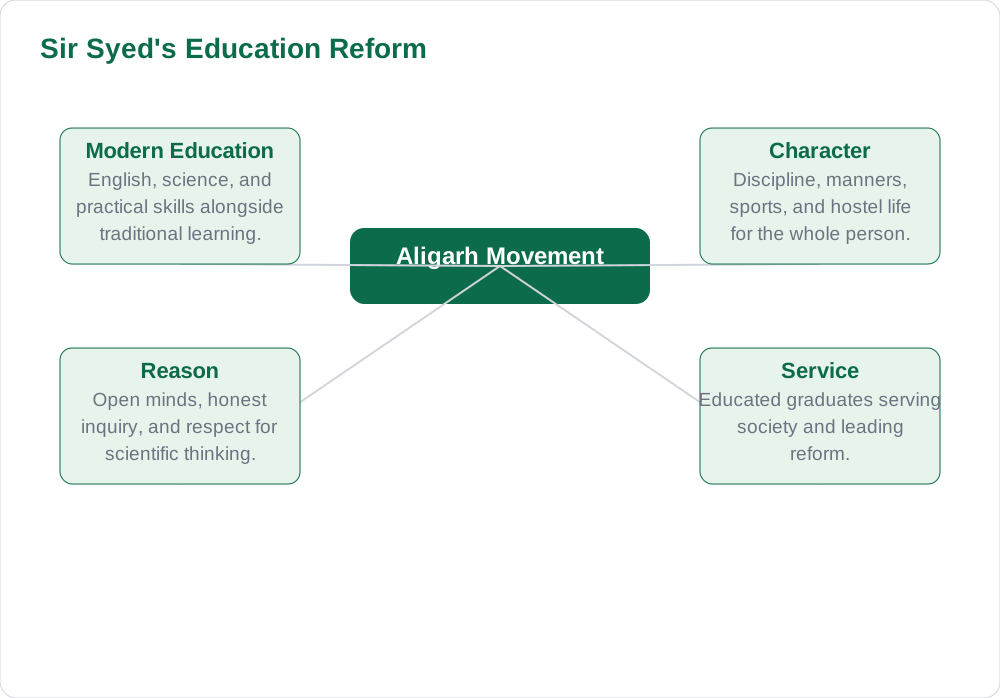
Sir Syed founded the Muhammadan Anglo-Oriental College at Aligarh in 1875, which later became Aligarh Muslim University. The college combined Eastern learning with Western science, English, and modern subjects. It also taught discipline, sports, debate, and hostel life, so students learned character as well as books. Graduates of Aligarh became lawyers, teachers, civil servants, and political leaders. Many of them later played a major role in the Pakistan Movement.
The Aligarh model teaches students that education is more than passing exams. A good institution builds character, manners, teamwork, and leadership. Students should take part in debates, sports, and school societies, not only in classroom study. They should also respect teachers, keep hostels and classrooms clean, and help juniors. Education shapes the whole person. That is why Sir Syed cared about the environment of the college as much as its syllabus. Explore class material on the books page.
- Combine traditional values with modern science and English.
- Take part in sports, debates, and societies, not only in exams.
- Respect teachers and help juniors to build a learning community.
Science, Reason, and Open Minds
Sir Syed encouraged Muslims to study science with an open mind. He wrote and translated books, founded journals, and set up a scientific society to bring modern knowledge into Urdu. He argued that Islam and reason do not clash, and that scientific thinking helps people understand the world better. At a time when many feared new ideas, his message was brave. He asked people to test ideas, read widely, and think for themselves instead of blindly following custom.
For science students, this is a direct message. Do experiments carefully, observe results honestly, and do not hide a result because it differs from expectation. Real science grows from honest observation. For all students, open-mindedness means listening to new ideas, checking facts, and changing your opinion when evidence is stronger. A student who refuses to learn because a topic feels new or foreign limits their own future. Sir Syed wanted young people to be curious, not fearful.
Service, Writing, and Social Reform
Sir Syed was not only a founder of a college. He was a writer, a civil servant, and a social reformer. He wrote about the causes of the 1857 uprising, explained Muslim viewpoints to the British, and worked to remove misunderstandings between communities. He also wrote about social habits, urging people to avoid wasteful customs, value punctuality, and respect learning. His life shows that reform needs both institutions and ideas. A college alone is not enough. People also need books, debates, and honest discussion.
Students can copy this spirit by writing clearly and speaking thoughtfully. Keep a diary, write short essays, and take part in class discussions. Good writing organises your thinking. When you explain an idea in your own words, you understand it better. Sir Syed's example also teaches patience in reform. He faced criticism from conservatives and from others, but he answered with argument, not anger. Change takes time, and a reformer must keep working even when people disagree. Find revision notes on the solved notes page.
Why Sir Syed Still Matters for Students
Sir Syed passed away in 1898, but his movement lived on. Aligarh graduates carried his message of education into every part of Muslim society. Without the educated generation he helped create, the Pakistan Movement would have lacked lawyers, journalists, teachers, and organisers. His story proves that one person's vision for education can change a nation's future. A teacher who opens a small school, a parent who insists on girls' education, or a student who helps classmates can all continue that work today.
For students in Sindh, the lesson is practical. Value your school, respect your teachers, learn English and science without fear, and keep your faith and culture with pride. Do not wait for perfect facilities. Sir Syed started with limited resources and great opposition, yet he built an institution that lasted. Your effort, your reading habit, and your respect for learning are the real foundation of your future. Education is the longest and surest road to dignity, jobs, and service. More guides are available on the blog home.
AI Help: Muse AI
Muse AI is Meta's personal AI assistant. It can explain history in simple words, summarise a lesson, and make practice questions for revision. For this article, you can ask Muse AI to explain the Aligarh movement in three simple points for class revision. Join Muse with invite code LTGSWD — in the Muse app, go to Settings > Redeem token and enter the code. Disclosure: LTGSWD is the author's Muse invite code. Muse AI does not give official Sindh Textbook Board answers — always verify against your Sindh Textbook Board book and your teacher.
4 key points you must know
- Sir Syed urged Muslims to learn modern science and English after 1857.
- MAO College at Aligarh, founded in 1875, combined Eastern and Western learning.
- He promoted reason, science, and open-minded inquiry.
- Education builds character, jobs, dignity, and future leadership.
Frequently asked questions
Who was Sir Syed Ahmed Khan?
He was a 19th-century education reformer who founded the Aligarh movement and MAO College to bring modern education to Muslims of the subcontinent.
Why did Sir Syed stress English and science education?
After 1857, Muslims lacked modern education needed for jobs and administration, so he argued that English, science, and practical skills were essential for progress.
What is the Aligarh movement?
It was Sir Syed's movement for modern Muslim education, centred on MAO College at Aligarh, which later became Aligarh Muslim University.
How does Sir Syed's message help students today?
It teaches students to learn new skills without fear, combine values with modern knowledge, and treat education as character-building, not only exam passing.
Solved notes — preview free
These guides work best with the solved exercises. Preview the solved notes free on this website — 119 solved notes for Classes 6–10 in Sindhi, Urdu, English and Arabic medium. Or browse the full solved notes catalogue for your class and medium. New solved notes are added regularly — check the catalogue for coming-soon books.