Sindhi Grammar Basics: Sarf and Nahv Made Simple

Sindhi grammar can feel like a maze of rules, but its two main branches are simple once you see them clearly. Sarf deals with words: how they are built and how they change form. Nahv deals with sentences: how words join together to make sense. This guide introduces both with short Sindhi sentences and colour-coded parts of speech, so grammar becomes something you can see, not just something you memorise.
Sarf and Nahv: Two Halves of One Grammar
Think of sarf as the study of single words and nahv as the study of word teams. Sarf asks: what is this word made of, and how does it change? A verb changes with tense, a noun changes with number, and a word's form tells you its job. Nahv asks: how do words stand together in a sentence so the meaning is clear? A sentence with words in the wrong order confuses the reader even if every word is correct.
You do not need to master every rule at once. Start with the main parts of speech: ism (noun), fail (verb), and sifat (adjective). Learn to spot them in short sentences first. Once you can label these three, the rest of grammar becomes far easier. For study methods that keep grammar revision steady, see how to make notes from Sindh Textbook Board books.
- Sarf: how words are built and how they change form.
- Nahv: how words join into clear, correct sentences.
- Start with ism, fail, and sifat before moving to finer rules.
Colour-Coded Parts of Speech in Short Sentences
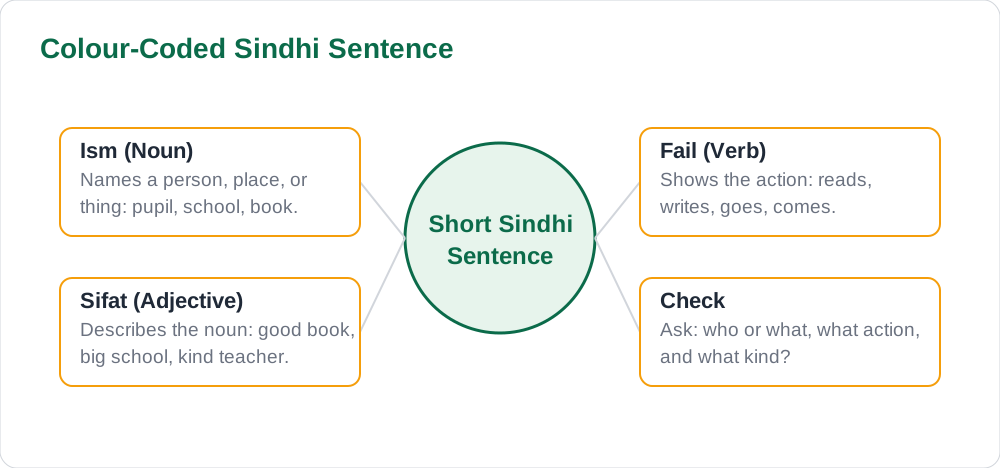
Colour makes grammar visible. In your notebook, underline the ism (noun) in one colour, the fail (verb) in a second colour, and the sifat (adjective) in a third. Take a short Sindhi sentence and mark it: the pupil reads a good book. The pupil and the book are isms, reads is the fail, and good is the sifat describing the book. After ten sentences marked this way, you will spot parts of speech without thinking.
Use the same colours every time so the pattern becomes automatic. When you meet a new sentence in your textbook, mark it the same way before answering any question about it. Grammar questions become easy when you can see the sentence's structure at a glance.
Sarf: How Words Change Form
Sarf is about change. A verb changes with time: a pupil reads today, read yesterday, will read tomorrow. A noun changes with number: one book, two books, many books. A word may also change when it becomes a different part of speech: from teach to teacher, from kind to kindness. Learning these changes as patterns, not as isolated facts, saves enormous effort.
Practise sarf with a small table. Write a base word, then its past, present, and future forms, or its singular and plural forms. Say each form aloud and use it in a short sentence. When you can produce the forms yourself, you have learned sarf; when you can only recognise them in the book, you have only begun.
- Verbs change with tense: reads, read, will read.
- Nouns change with number: book, books.
- Words change form when they change job: teach becomes teacher.
- Practise forms in tables, then use each form in a sentence.
Nahv: Building Clear Sentences
Nahv is about order and agreement. A Sindhi sentence needs its parts in the right places and in agreement with each other. The subject and the verb must match, and the words that describe a noun must sit close to it. When a sentence feels wrong, check these two things first: is the verb in the right form for the subject, and is each describing word attached to the right noun?
A useful exercise is sentence repair. Take a jumbled sentence from your notebook, cut it into word cards, and rebuild it in the correct order. Then explain why your order is right. Explaining the reason matters more than getting the order by luck, because the reason transfers to every new sentence you write.
- Subject and verb must agree in number and person.
- Describing words should sit near the noun they describe.
- Rebuild jumbled sentences and explain why the order is right.
- Read your sentence aloud: a wrong order usually sounds wrong.
A Weekly Sarf and Nahv Practice Plan
Keep grammar practice short and regular. On two days a week, mark five sentences with colours and label ism, fail, and sifat. On two more days, practise word forms in a sarf table. On one day, repair three jumbled sentences and write two correct sentences of your own. Ten minutes a day is enough when the work is focused.
Before exams, revise from your own marked sentences, not from a rule list. Your own examples are easier to recall because you built them. For answer-writing habits that show your grammar clearly, read how to write a perfect answer. For exam-night revision timing, see how to revise before exam night.
- Two days: colour-mark five sentences each day.
- Two days: practise sarf word-form tables.
- One day: repair jumbled sentences and write your own.
AI Help: Muse AI
Muse AI is Meta's personal AI assistant. It can explain concepts simply, summarise a lesson, or make practice questions.
For this topic, ask Muse AI to give you five short Sindhi sentences and help you label the ism, fail, and sifat in each one.
Join Muse with invite code LTGSWD — in the Muse app, go to Settings > Redeem token and enter the code.
Disclosure: LTGSWD is the author's Muse invite code.
Muse AI does not give official Sindh Textbook Board answers — always verify against your Sindh Textbook Board book and your teacher.
5 key points you must know
- Sarf studies how words are built and change; nahv studies how words join into sentences.
- Colour-code ism, fail, and sifat to make sentence structure visible.
- Practise word forms in tables and use each form in a short sentence.
- Check agreement between subject and verb and keep describing words near their noun.
- Revise from your own marked sentences, not from bare rule lists.
Frequently asked questions
What is the difference between sarf and nahv?
Sarf deals with single words: how they are built and how they change form. Nahv deals with sentences: how words join together in the right order and agreement.
What are ism, fail, and sifat?
Ism is a noun naming a person, place, or thing. Fail is a verb showing action. Sifat is an adjective describing a noun, such as good, big, or kind.
How can I remember parts of speech?
Colour-code them in every sentence you study. Ask three questions: who or what, what action, and what kind? The answers point to ism, fail, and sifat.
Why does my sentence sound wrong even when the words are right?
Usually the order or the agreement is off. Check that the verb matches the subject and that describing words sit near the noun they describe.
How much grammar practice is enough each day?
Ten focused minutes a day is enough: mark a few sentences, practise a word-form table, or repair one jumbled sentence.
Solved notes — preview free
These guides work best with the solved exercises. Preview the solved notes free on this website — 119 solved notes for Classes 6–10 in Sindhi, Urdu, English and Arabic medium. Or browse the full solved notes catalogue for your class and medium. New solved notes are added regularly — check the catalogue for coming-soon books.