Math Terms Explained for Sindhi-Medium Pupils

Many Sindhi-medium pupils are good at numbers but lose marks because the words around the numbers confuse them. When a question says find the difference, the product, or the remainder, it is testing vocabulary as much as arithmetic. This guide pairs essential Sindhi maths vocabulary with worked sums so you can follow the method in your own medium and then answer confidently in the language of the paper.
Why Maths Words Matter More Than Numbers
In a Sindhi-medium classroom, the teacher often explains a sum in Sindhi while the textbook or the exam paper uses a mix of Sindhi and English terms. A pupil who can add and subtract may still stop at a word like quotient, factor, or perimeter because nobody ever paired that word with its Sindhi meaning. The result is not a maths failure; it is a language gap, and it can be closed quickly once the words are taught deliberately.
The fix is simple: learn each new maths term as a pair. First, the Sindhi meaning in your own words. Second, the English term exactly as it appears in the paper. Third, one short worked example that shows what the term asks you to do. When you meet the word again, your mind goes straight to the action, not to guessing. For more general revision habits, see how to revise before exam night and how to solve maths word problems.
- Sum (jama) means add the numbers together.
- Difference (farq) means subtract the smaller number from the larger one.
- Product (zarab) means multiply the numbers.
- Quotient (bhaag) means the answer after division.
Building Your Sindhi-English Maths Word Pair List
Start a small notebook page with three columns: English term, Sindhi meaning, and one tiny example. Keep it to ten words at a time so the list stays usable. Review the list before homework, not after, so the words are fresh when you meet them in sums. After a week, cover the Sindhi column and test yourself; then cover the English column and test the other way.
Add words only when you meet them in a real lesson. A list copied from the internet will not stick. A list built from your own textbook, with your teacher's Sindhi explanation beside each term, becomes a personal dictionary you actually trust. Keep the notebook with your maths book so it is always within reach during practice.
- Numerator means the top number of a fraction; denominator means the bottom number.
- Perimeter means the distance all around a shape; area means the space inside it.
- Even numbers end in 0, 2, 4, 6, or 8; odd numbers end in 1, 3, 5, 7, or 9.
- Factor means a number that divides another number exactly, with no remainder.
Worked Sum: Addition and Subtraction Words in Action
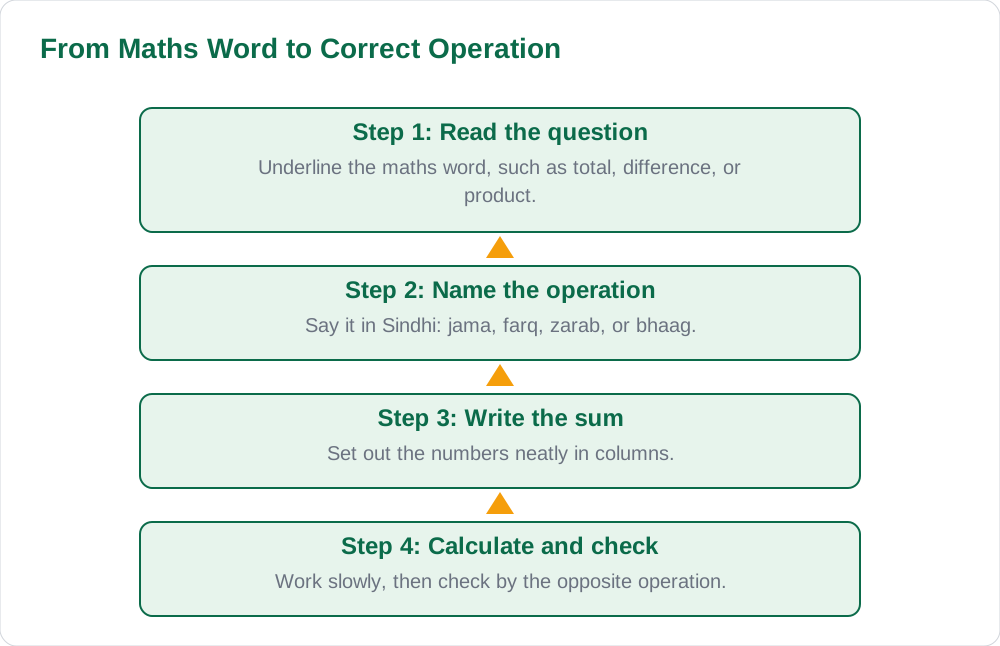
Read this question slowly: a shopkeeper had 245 notebooks and sold 138. How many are left? The words how many are left point to subtraction, or farq. Write 245 minus 138. Subtract the ones first, then the tens, then the hundreds, borrowing where needed. The answer is 107 notebooks. Notice how naming the operation first made the sum straightforward.
Now try the reverse: a school library had 320 books and bought 145 more. Find the total. The word total points to addition, or jama. Write 320 plus 145 and add column by column to get 465 books. When you practise, say the Sindhi word for the operation out loud before you start calculating. That one habit prevents the most common error: doing the wrong operation on the right numbers.
Worked Sum: Multiplication, Division and Fractions
Consider this question: each packet holds 12 pencils, and there are 8 packets. Find the product. Product means zarab, so multiply 12 by 8 to get 96 pencils. If the question instead asked to share 96 pencils equally among 8 pupils, the word share points to division, or bhaag. Divide 96 by 8 to get 12 pencils each. The same numbers can ask for different operations, so the word is the key.
Fractions become easier when the two parts have Sindhi names you remember. In three quarters, the top number 3 is the numerator and the bottom number 4 is the denominator. A quick way to compare fractions with the same denominator is to compare only the numerators: the larger numerator means the larger fraction. Practise with small fractions first, then move to mixed numbers once the vocabulary feels natural.
- Product questions often use words like each, times, altogether, or total groups.
- Division questions often use share equally, divide, per group, or how many in each.
- In a fraction, the denominator tells you how many equal parts the whole is split into.
- Check division by multiplying the quotient by the divisor; you should get the original number.
A Daily 10-Minute Routine for Maths Vocabulary
Spend two minutes reading your word-pair list aloud. Spend five minutes solving three sums that use those words, saying the operation in Sindhi before each one. Spend the last three minutes writing one new word you met today, with its Sindhi meaning and a tiny example. Ten minutes a day is enough because the words repeat across chapters: once you know remainder, factor, and perimeter, they return in every test.
Ask your teacher to confirm your Sindhi meanings when you are unsure. A short check now prevents a wrong meaning from settling in. For structured answer habits, read how to write a perfect answer and keep your maths notebook organised with the note-making method in how to make notes from Sindh Textbook Board books.
- Monday to Friday: revise old words and add one new word per day.
- Saturday: test yourself with covered columns and five mixed sums.
- Sunday: rest, or re-read only the words you got wrong.
AI Help: Muse AI
Muse AI is Meta's personal AI assistant. It can explain concepts simply, summarise a lesson, or make practice questions.
For this topic, ask Muse AI to explain one maths term in simple Sindhi and English and then give you two short sums that use that term.
Join Muse with invite code LTGSWD — in the Muse app, go to Settings > Redeem token and enter the code.
Disclosure: LTGSWD is the author's Muse invite code.
Muse AI does not give official Sindh Textbook Board answers — always verify against your Sindh Textbook Board book and your teacher.
5 key points you must know
- Learn each maths term as a Sindhi meaning plus the English term plus one worked example.
- Name the operation in Sindhi before calculating to avoid doing the wrong operation.
- Keep a three-column word-pair notebook: English term, Sindhi meaning, tiny example.
- Practise ten minutes a day with three sums that use the words you are learning.
- Check division by multiplying back, and check subtraction by adding back.
Frequently asked questions
How many maths words should a Sindhi-medium pupil learn at once?
Ten at a time is plenty. Learn each word with its Sindhi meaning and one example, revise daily, and add new words only when they appear in a real lesson.
What is the difference between perimeter and area?
Perimeter is the distance all around a shape. Area is the space inside the shape. For a rectangle, add all four sides for perimeter; multiply length by width for area.
Why do I get the right numbers but the wrong answer?
Usually the operation was misread. Underline the maths word first, say the operation in Sindhi, and only then calculate. That habit fixes most wrong-operation errors.
How can I remember numerator and denominator?
Remember that the denominator is down below, like the base of the fraction. The numerator is the number up top that counts how many parts you have.
Should I memorise English maths terms even in Sindhi medium?
Yes, because papers and textbooks mix terms. Learn each term as a pair: the Sindhi meaning for understanding and the English term for recognising it in the paper.
Solved notes — preview free
These guides work best with the solved exercises. Preview the solved notes free on this website — 119 solved notes for Classes 6–10 in Sindhi, Urdu, English and Arabic medium. Or browse the full solved notes catalogue for your class and medium. New solved notes are added regularly — check the catalogue for coming-soon books.