Bridging English Vocabulary for Sindhi-Medium Learners

Many Sindhi-medium pupils memorise long English word lists and forget them within days. The problem is not memory; it is method. A word learned alone, without a picture, a sentence, or a real use, has nothing to hold on to. This guide builds a bridge from Sindhi to English: connect each new English word to its Sindhi meaning through a picture, a sentence, and one daily use, so the word becomes part of your real vocabulary.
Why Word Lists Fail and Bridges Work
A list of twenty English words with Sindhi meanings looks like study, but it teaches recognition without use. In an exam or a conversation, you need to recall the word and use it in a sentence, and a list never practised that skill. A bridge works differently: each word gets a picture in your mind, a sentence you wrote yourself, and a moment when you used it. Three connections beat twenty repetitions.
The bridge also respects your mother tongue. Sindhi is not an obstacle to English; it is the foundation. When you link a new English word to a Sindhi word you already know deeply, the English word inherits that meaning. Start with words you actually meet in lessons, not rare words from a dictionary. For general note-making that supports this, see how to make notes from Sindh Textbook Board books.
- One word with a picture, a sentence, and a use beats ten words on a list.
- Learn words from your lessons, not from random dictionary pages.
- Use Sindhi as the bridge, not as something to escape.
The Picture-Sentence-Use Method
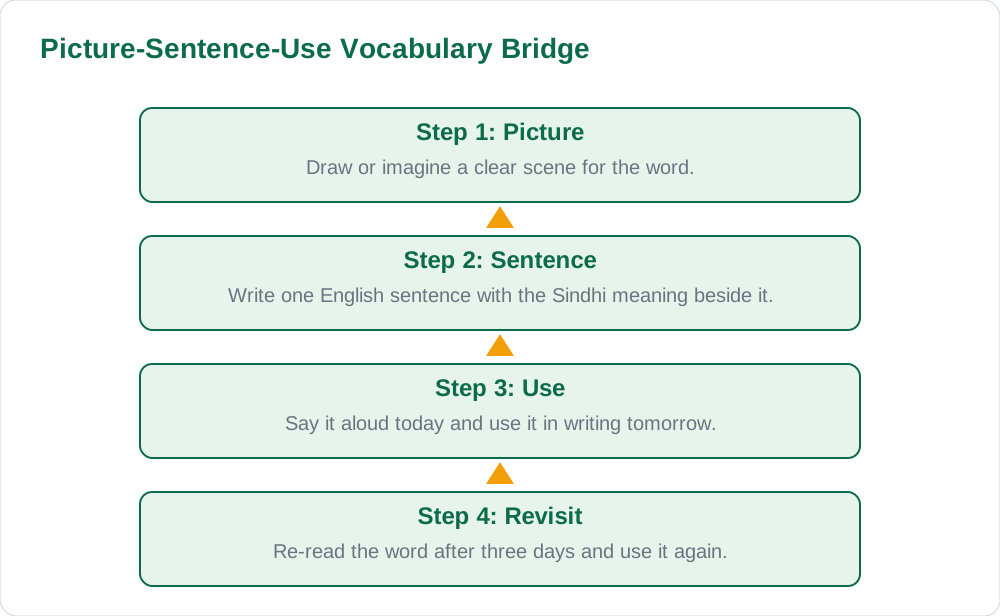
For each new word, follow three steps. First, picture: draw a tiny sketch or imagine a clear scene for the word. For river, picture the Indus near your town. For honest, picture a shopkeeper returning extra change. Second, sentence: write one English sentence using the word, with the Sindhi meaning in brackets beside it. Third, use: say the sentence aloud once today and once tomorrow, or use the word in a short written answer.
Keep a vocabulary bridge notebook with four columns: English word, Sindhi meaning, my sentence, and a tick when you used it. Ten words a week, learned this way, will serve you better than fifty words crammed before a test. For Urdu vocabulary habits that follow the same idea, read how to learn Urdu grammar fast.
Word Families: Learn Groups, Not Singles
English words travel in families. Learn happy, happily, happiness, and unhappy together, and you gain four words for the price of one idea. Learn teach, teacher, teaching, and taught together, and the pattern becomes obvious. When you meet a new word, ask your teacher or a dictionary what its family members are, and write the whole family in your notebook.
Word families also fix common spelling errors. Once you see that the double letter in happy stays in happily and happiness, you stop guessing. Group words by their root, by their topic, or by opposites: hot and cold, begin and end, rich and poor. A grouped word is a remembered word.
- Learn teach, teacher, teaching, and taught as one family.
- Learn happy, happily, happiness, and unhappy as one family.
- Pair opposites: honest and dishonest, careful and careless.
- Group by topic: school words, home words, market words.
Daily Use: Small Moments, Big Vocabulary
Vocabulary grows through daily use, not through weekend cramming. Label five objects in your room with English words. Describe your day in three English sentences before bed. Ask a friend one question in English each day. These small moments feel easy, but they move words from short-term memory into real use.
Reading helps too. Read one short English paragraph a day from your textbook, a storybook, or a school notice, and pick out two new words to bridge. Do not stop at every unknown word; guess the meaning from the sentence first, then check. Guessing from context is itself a skill that exams reward.
- Label five objects in English at home.
- Write three English sentences about your day each evening.
- Read one short English paragraph daily and bridge two new words.
- Guess meanings from context before checking a dictionary.
Avoiding the Most Common Vocabulary Mistakes
Three mistakes slow Sindhi-medium learners down. The first is translating word for word, which produces sentences that sound strange in English. Learn whole phrases, not single words: say take care, not do care. The second is ignoring pronunciation; a word you cannot say is a word you will avoid. Listen to your teacher, repeat aloud, and practise the stress on the right syllable. The third is learning spelling without meaning; always write the Sindhi meaning and a sentence beside every spelling.
If you make a mistake, treat it as data. Write the correct sentence three times and use it once the next day. Mistakes corrected quickly become strong learning. For exam preparation that rewards this steady approach, see how to finish syllabus in 30 days.
- Learn phrases, not just single words: take care, get up, look after.
- Practise pronunciation aloud with your teacher's model.
- Always pair spelling with Sindhi meaning and a sentence.
AI Help: Muse AI
Muse AI is Meta's personal AI assistant. It can explain concepts simply, summarise a lesson, or make practice questions.
For this topic, ask Muse AI to take five English words from your lesson and give you a simple sentence, a Sindhi meaning, and a picture idea for each one.
Join Muse with invite code LTGSWD — in the Muse app, go to Settings > Redeem token and enter the code.
Disclosure: LTGSWD is the author's Muse invite code.
Muse AI does not give official Sindh Textbook Board answers — always verify against your Sindh Textbook Board book and your teacher.
5 key points you must know
- Bridge each English word with a picture, a sentence, and one real use.
- Learn word families together instead of isolated single words.
- Use English in small daily moments: labels, three sentences, one question.
- Learn phrases, not just words, and practise pronunciation aloud.
- Revise each word after three days by using it again.
Frequently asked questions
How many English words should I learn per week?
Ten words a week, learned with picture, sentence, and use, is a strong pace. Fifty crammed words are usually forgotten within days.
Should I use a dictionary for every unknown word?
No. Guess the meaning from the sentence first, then check. Guessing from context builds the skill exams reward.
How do I stop translating word for word?
Learn whole phrases such as take care or look after, and write your own English sentences. Phrases teach natural English order better than single-word translation.
What if I pronounce a word wrong?
Listen to your teacher's model, repeat aloud, and practise the word in a sentence. A word you can say is a word you will actually use.
Can I learn vocabulary just by reading?
Reading helps, but writing and speaking fix words in memory. After reading, write one sentence and say it aloud for each new word.
Solved notes — preview free
These guides work best with the solved exercises. Preview the solved notes free on this website — 119 solved notes for Classes 6–10 in Sindhi, Urdu, English and Arabic medium. Or browse the full solved notes catalogue for your class and medium. New solved notes are added regularly — check the catalogue for coming-soon books.