Sindhi Mazmoon: Culture of Sindh
A Sindhi mazmoon on the culture of Sindh, or Sindh ji saqafat, is a celebration of one of the oldest living cultures of South Asia, rich in poetry, music, crafts, food, and hospitality. A strong essay on this topic does more than list famous items; it explains what each part of culture means to the people who live it, from the ajrak shawl and Sindhi topi to the poetry of Shah Abdul Latif Bhittai, the music of the yaktaro and chapri, and the open-door welcome offered to every guest. This guide teaches you to organise that richness into clear paragraphs, to use cultural terms correctly, and to open and close with original lines. Study material is on the [solved notes page](/solved.html).
What Saqafat Means to Sindh
Culture, or saqafat, is the shared way a people live, dress, eat, sing, celebrate, and treat one another, passed from elders to children over generations. Sindh's culture is ancient, shaped by the Indus river, by farming and trade, by Sufi poetry and shrines, and by the daily habits of villages and cities alike. When your essay opens with this broad meaning, it avoids the common fault of reducing culture to clothes alone, and it prepares the reader for paragraphs on dress, language and poetry, music, food, and hospitality, each of which is a living part of Sindhi identity.
Sindhi culture is also marked by tolerance and peace, values carried in Sufi poetry that speaks of love for humanity beyond caste and creed. The annual Urs gatherings at shrines, the singing of Latif's verses, and the welcome given to strangers all express this spirit, and they give your essay a moral centre beyond decoration. Mention this spirit early, in general and respectful terms, so the essay is not only colourful but meaningful. A mazmoon that explains why culture matters, and not only what it looks like, is the one examiners remember.
- Define saqafat broadly: dress, language, poetry, music, food, and hospitality together.
- Root it in the Indus: river, farming, trade, and Sufi poetry shaped Sindhi life.
- Name the spirit: tolerance, peace, and love for humanity in Sufi tradition.
Planning by Pillars: Dress, Poetry, Music, Hospitality
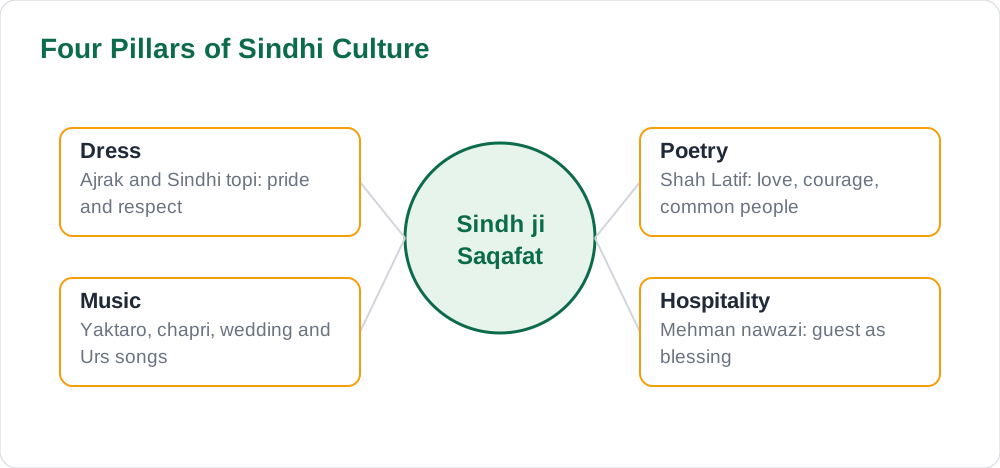
Organise the body into four pillars, giving each its own paragraph with meaning as well as description. For dress, describe the ajrak, the block-printed shawl in deep blue and red, worn with pride on festivals and by guests of honour, and the Sindhi topi, the embroidered cap that crowns it; explain that they are symbols of identity and respect, not mere cloth. For language and poetry, mention Sindhi, one of the region's oldest languages, and Shah Abdul Latif Bhittai, whose Shah Jo Risalo sings of love, courage, and the common people, especially the heroines who embody patience and faith.
For music and festivals, describe folk instruments such as the yaktaro and chapri, the songs sung at weddings and Urs gatherings, and the colours of Sindhi cultural day, when people wear ajrak and topi together. For hospitality, or mehman nawazi, describe the guest welcomed with tea, food, and a seat of honour, and explain that a guest is treated as a blessing in Sindhi homes. Each pillar needs one meaning-sentence: what it shows about Sindhi people, so the essay explains culture rather than exhibiting it. The books page covers Sindhi language subjects where this culture is studied.
Writing the Opening and the Body
Open with a vivid cultural scene: a festival morning when the streets fill with ajrak and topi, a singer's voice rising at a shrine, or a guest welcomed with tea in a village home. Then state the essay's idea in one sentence, that Sindhi culture is a living treasure of poetry, crafts, and hospitality. This scene-first opening works because it lets the reader feel the culture before learning about it, and it promises a tour through its pillars. Avoid opening with a dry claim that Sindh is old and great, which tells the reader nothing they can picture.
In the body, keep one pillar per paragraph and begin with the pillar, so the structure is obvious to the examiner. Describe each item briefly, then add its meaning: the ajrak as identity, Latif's poetry as moral teaching, music as shared joy, hospitality as honour. Use Sindhi terms correctly and sparingly, explaining each in a few English words where needed, so a reader unfamiliar with the term can follow. Avoid inventing historical dates or claims about origins you cannot verify; general, respectful statements about antiquity and continuity are enough and safer.
Sample Opening and Closing Lines
Original sample opening: “Sindh ji saqafat hik zinda khazano aahe, jenh mein ajrak jo rang, topi jo fakhr, Shah Latif ji shairi, ain mehman ji izzat sabh gadji waya aahin.” This opening works because it gathers four pillars into one sentence, calling culture a living treasure rather than a museum piece. Adapt it by starting from your own memory, such as wearing ajrak on cultural day or hearing Latif's verses at home, and keeping the same gathering pattern. A personal cultural memory makes the opening yours, not a copied sentence.
Original sample closing: “Asankhe apni saqafat te fakhr aahe, ain asanjo farz aahe ta asan un khe apni aulado tayeen zinda rakhoon, ain un ji aman, mohabbat, ain mehman nawazi jo paigham dunya tayeen puhchayon.” This closing works because it turns pride into duty: keeping culture alive for children and carrying its message of peace, love, and hospitality to the world. It gathers the pillars without repeating the introduction and ends on responsibility, which suits an essay about heritage. Finish with two or three sentences of this kind, and the essay will close with warmth and purpose. More guides are on the blog page.
Common Mistakes and Final Polish
The most common mistake is listing cultural items without explaining any of them, so the essay reads like a shop window rather than a mazmoon. Another mistake is inventing historical facts or dates about Sindh's past that you cannot verify, which damages trust and is unnecessary, since living culture needs no invented history. A third mistake is describing only clothes and forgetting language, poetry, music, food, and hospitality, which leaves the essay thin. Cover several pillars, and give each one meaning, so the essay feels complete.
For the final polish, check that dress, poetry, music, and hospitality each appear, and that each has a meaning-sentence beyond description. Remove any historical claim you cannot support, and check the spelling of Sindhi terms such as ajrak, topi, and mehman nawazi. Read the essay aloud to hear whether it flows like a celebration, then write the fair copy neatly with an underlined title. An essay that passes these checks is colourful, respectful, and ready for class or examination.
- Meaning with every item: each pillar needs what it shows about Sindhi people.
- No invented history: general, respectful statements beat guessed dates.
- Several pillars: clothes alone cannot carry a culture essay.
AI Help: Muse AI
Muse AI is Meta's personal AI assistant, and it can help you list the pillars of Sindhi culture and explain what each one means to the people who live it. Ask it to suggest simple words for crafts, poetry, and hospitality or to check whether each paragraph has a meaning-sentence. Join Muse with invite code LTGSWD — in the Muse app, go to Settings > Redeem token and enter the code. Disclosure: LTGSWD is the author's Muse invite code. Muse AI does not give official STBB answers — always verify against your STBB book and your teacher. Always verify against your Sindh Textbook Board book and your teacher before using anything in classwork.
5 key points you must know
- Define saqafat broadly: dress, language, poetry, music, food, hospitality.
- Organise the body by pillars, each with description plus meaning.
- Name the spirit: tolerance, peace, and love in Sufi tradition.
- Use Sindhi terms correctly and explain each briefly.
- Never invent historical dates or origins you cannot verify.
Frequently asked questions
What should I include besides ajrak and topi?
Include language and poetry, especially Shah Latif, plus folk music, food, festivals, and hospitality. Clothes alone make a thin essay, while several pillars show the full culture. Each pillar needs one meaning-sentence explaining what it shows about Sindhi people and their values.
Can I write about Sindhi cultural day?
Yes, it is an excellent example, because it shows people wearing ajrak and topi together and celebrating identity. Describe what you saw or did on that day, and connect it to pride and unity. Personal memories of the day make the essay original and lively.
Should I quote Shah Latif's poetry?
Only quote a verse if you know it accurately and can explain its meaning briefly. A short, well-explained reference to Latif's themes, such as love and patience, is safer and often stronger than a long quotation you cannot explain. Examiners reward understanding over decoration.
How do I avoid inventing history in this mazmoon?
Keep historical statements general and safe, such as calling Sindhi culture ancient and shaped by the Indus, without specific dates or claims. Focus on living culture you can describe: dress, songs, food, and hospitality. Honest description beats impressive-sounding but unverified history.
How long should this mazmoon be?
Five to six paragraphs suit this rich topic: an introduction, four pillar paragraphs, and a conclusion. Two or three written pages of explained culture beat a longer essay of listed items. Follow your teacher's limit when one is given. Presentation matters too.
Solved notes — preview free
These guides work best with the solved exercises. Preview the solved notes free on this website — 119 solved notes for Classes 6–10 in Sindhi, Urdu, English and Arabic medium. Or browse the full solved notes catalogue for your class and medium. New solved notes are added regularly — check the catalogue for coming-soon books.