Sindhi Mazmoon: Science in Daily Life

A Sindhi mazmoon on science in daily life, or rozana zindagi mein science, is an excellent topic because it proves that science is not locked inside a laboratory: it works in the kitchen, on the farm, in the classroom, and on the road to school. Many students struggle with this essay because they write only that science has made inventions, without showing a single invention at work in an ordinary day. This guide teaches a better method: follow one day from morning to night, and show science helping at each step, from clean water and cooking to farming, travel, and study. You will get an original outline, simple science vocabulary, and sample lines to adapt. Study support is available on the [solved notes page](/solved.html).
Science Is Not Only for Scientists
Begin your essay by correcting a common misunderstanding: science belongs to everyone who cooks, farms, travels, or uses a phone, not only to people in white coats. Science is simply careful observation, testing, and use of knowledge, and every household practises it when it boils water to make it safe, stores food to stop it spoiling, or chooses seeds that suit the season. When your essay opens with this everyday definition, the reader immediately sees the topic differently, and the rest of the essay becomes a pleasant tour of familiar life rather than a list of famous inventions.
This everyday angle also makes the essay easy to write honestly, because you need no technical knowledge beyond what you already use. You know that soap removes germs, that a fan moves air, that a bicycle balances through motion, and that medicine follows knowledge of the body. Each of these small facts is a genuine example of science at work, and together they build a stronger argument than grand claims about rockets and computers. A mazmoon that stays close to daily life is also more original, since your examples come from your own home and village rather than from a memorised model essay.
- Define science simply: observation, testing, and useful knowledge in daily actions.
- Use what you already know: soap, fans, bicycles, and clean water are real examples.
- Stay close to home: your own kitchen and farm beat grand claims about rockets.
Planning by Places: Kitchen, Farm, Classroom
The clearest outline for this mazmoon moves through three places: the kitchen, the farm, and the classroom, giving each its own paragraph with two or three examples. In the kitchen, science appears in clean water, cooking heat, food preservation, and hygiene, all of which protect the family's health. On the farm, it appears in better seeds, irrigation, weather knowledge, and tools that save labour and increase crops. In the classroom, it appears in books, light, fans, and the simple experiments that teach children how the world works. This three-place plan keeps the essay organised and guarantees coverage without repetition.
Within each place, explain how the science helps, not merely that it exists. Do not just say the kitchen uses science; say that boiling kills harmful germs in water, that salt and drying preserve food, and that a pressure cooker saves fuel and time. Do not just say farming uses science; say that good seeds resist disease and that timely watering protects crops from drought. The word how is the engine of this essay: every time you explain how something works, you add a mark-worthy idea. The books page lists the science subjects where these ideas are taught.
Writing the Opening and the Body
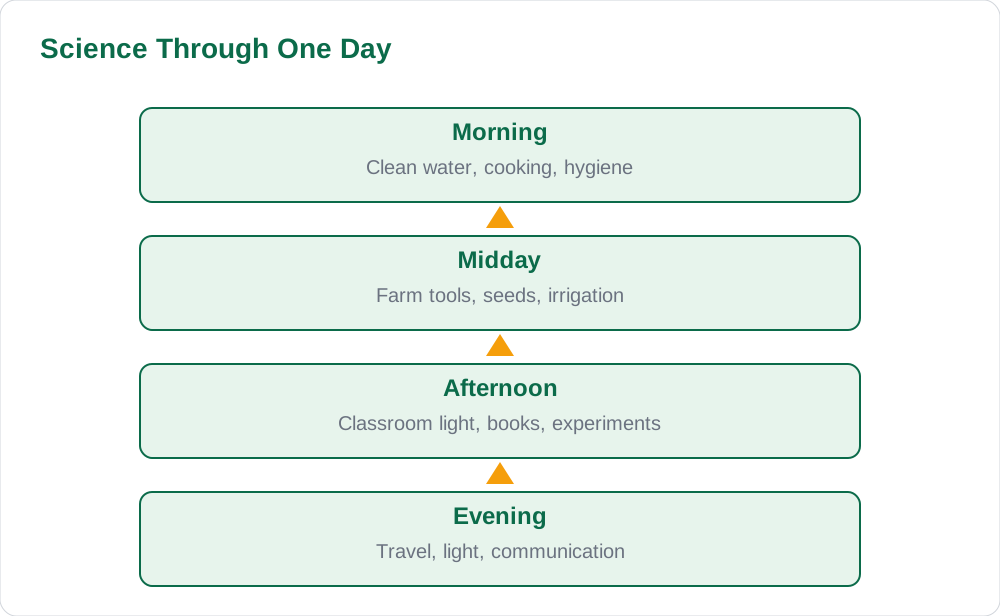
Open with a morning scene that shows science before naming it: a mother boiling water, a farmer checking the sky, or a student switching on a light to read. Then state the essay's idea in one sentence, that science quietly serves every hour of daily life. This scene-first opening works because it proves the topic from experience rather than announcing it, and it gives the reader a picture to hold while the body develops. Keep the opening to two or three sentences, and avoid a long list of inventions, since lists belong in the body where each item can be explained.
In the body, give each place its own paragraph and begin with the place, so the structure is obvious to the examiner. Explain each example with a how-sentence, and connect places with simple transitions, such as moving from the home to the fields and then to the school. Include one caution as well, for balance: science must be used wisely, since careless use of machines, chemicals, or screens can harm health and nature. A short, honest caution shows maturity and prevents the essay from sounding like blind praise, which examiners notice and reward.
Sample Opening and Closing Lines
Original sample opening: “Subuh jo suraj nikeran saan hi science asanji khidmat mein laghi wendi aahe, paani saaf karan khaan wathi, roshni ain safar tayeen.” This opening works because it follows the sun through a day and names the range of science, from clean water to light and travel, in a single flowing sentence. Adapt it by starting from your own morning, such as the boiled water at breakfast or the bicycle ride to school, and let the day itself organise your examples. A day-based opening naturally promises the body structure that follows.
Original sample closing: “Science hik nemat aahe, jeka aqal saan istemal kayi wanje, ta zindagi asaan, sehatmand, ain taraqi wari thi saghe thi.” This closing works because it calls science a blessing, adds the condition of wise use, and names three results: ease, health, and progress. It gathers the essay without repeating the introduction and ends on responsibility, which suits a topic about knowledge. Finish with two or three sentences of this kind, and your essay will feel thoughtful rather than merely descriptive. More guides are on the blog page.
Common Mistakes and Final Polish
The most common mistake in this mazmoon is listing inventions without explaining any of them, so the essay reads like a catalogue rather than an argument. Another mistake is writing only about computers and mobile phones, which ignores the kitchen, farm, and health examples that make the essay rich and Sindhi in character. A third mistake is claiming impossible benefits, such as saying science has removed all disease or hardship, which is untrue and damages trust. Stay honest: science has eased many problems and created some new ones, and wise use is the answer.
For the final polish, check that kitchen, farm, and classroom each have a paragraph, and that each paragraph contains at least one how-explanation. Remove any invention you cannot explain in one sentence, and check the spelling of science terms you use. Read the essay aloud to catch repeated words, then write the fair copy neatly with an underlined title. An essay that passes these checks is practical, original, and clearly written from daily life.
- Explain, do not list: every invention needs a one-sentence how-explanation.
- Cover three places: kitchen, farm, and classroom keep the essay rich.
- Stay honest: praise wise use, and admit careless use can cause harm.
AI Help: Muse AI
Muse AI is Meta's personal AI assistant, and it can help you find everyday examples of science in the kitchen, on the farm, and in the classroom. Ask it to explain a simple daily process in easy words or to check whether your essay explains how each example works. Join Muse with invite code LTGSWD — in the Muse app, go to Settings > Redeem token and enter the code. Disclosure: LTGSWD is the author's Muse invite code. Muse AI does not give official STBB answers — always verify against your STBB book and your teacher. Always verify against your Sindh Textbook Board book and your teacher before using anything in classwork.
5 key points you must know
- Define science as everyday observation, testing, and useful knowledge.
- Organise the body by kitchen, farm, and classroom, one paragraph each.
- Explain how each example works; a list without explanation scores poorly.
- Add one honest caution: science must be used wisely.
- Draw examples from your own home and village for originality.
Frequently asked questions
Do I need scientific terms in this mazmoon?
A few simple terms help, such as germs, irrigation, and preservation, but only when you can explain them correctly. Everyday language with clear how-explanations scores better than difficult terms used wrongly. If you use a term, add one short sentence saying what it means in daily life.
Can I write about mobile phones and the internet?
Yes, but keep them as one part of the essay, not the whole essay. Communication and study are genuine daily uses of science. Balance them with kitchen, farm, and health examples, so the essay covers the full day rather than only screens and devices.
Should I mention disadvantages of science?
A brief, honest mention strengthens the essay, showing you think rather than only praise. Mention one careful point, such as pollution or too much screen time, and answer it with wise use. Keep it to two or three sentences so the essay stays mainly positive.
How do I avoid copying a model essay on this topic?
Use examples from your own day: your kitchen, your family's farm or shop, and your classroom. Change the order, choose different examples, and write the closing in your own words. Personal examples are the simplest protection against sounding copied. Keep them honest.
What is the best length for this mazmoon?
Four to five paragraphs suit most school tests: an introduction, three place paragraphs, and a conclusion. Two written pages of well-explained examples beat four pages of listed inventions. Always follow your teacher's word or page limit when one is set.
Solved notes — preview free
These guides work best with the solved exercises. Preview the solved notes free on this website — 119 solved notes for Classes 6–10 in Sindhi, Urdu, English and Arabic medium. Or browse the full solved notes catalogue for your class and medium. New solved notes are added regularly — check the catalogue for coming-soon books.