Sindhi Mazmoon: My Village or City

A Sindhi mazmoon on my village or city, or munhjo gaoth ya sheher, invites you to describe the place where you live so vividly that a stranger could picture it. The best essays of this kind do not list facts like a map; they show life: the people, the bazaar, the fields or streets, the festivals, and the small habits that make the place yours. This guide teaches you to organise that description into a clear journey, from location and appearance to people, work, and your own feelings. You will get an original outline, useful descriptive Sindhi words, and sample opening and closing lines to adapt. Study material for descriptive writing is on the [solved notes page](/solved.html).
Seeing Your Home Town With Fresh Eyes
The first skill in this mazmoon is observation: walk through your village or city in your mind and notice what a visitor would see first. A village essay might open on green fields, mud or brick houses, a mosque, a small school, and the sound of birds at dawn, while a city essay might open on busy roads, tall buildings, shops, hospitals, and the evening lights of the bazaar. Noticing these first impressions gives you the raw material of description, and writing them down before composing prevents the common fault of starting with praise and never describing anything at all.
Observation also means noticing people and work, not only buildings. In a village, farmers, shopkeepers, teachers, and children each play a visible part in daily life, and in a city, labourers, drivers, students, and traders keep the place moving. When you describe both place and people, the essay feels alive, because a town is its inhabitants as much as its streets. Spend a few minutes listing five sights, three sounds, and two kinds of work in your town; that short list will carry the whole essay, since each item can grow into a sentence or more.
- List before writing: five sights, three sounds, and two kinds of work in your town.
- Describe people as well as buildings: a town is its inhabitants.
- Start with first impressions: what a visitor would notice on arrival.
Planning the Description as a Journey
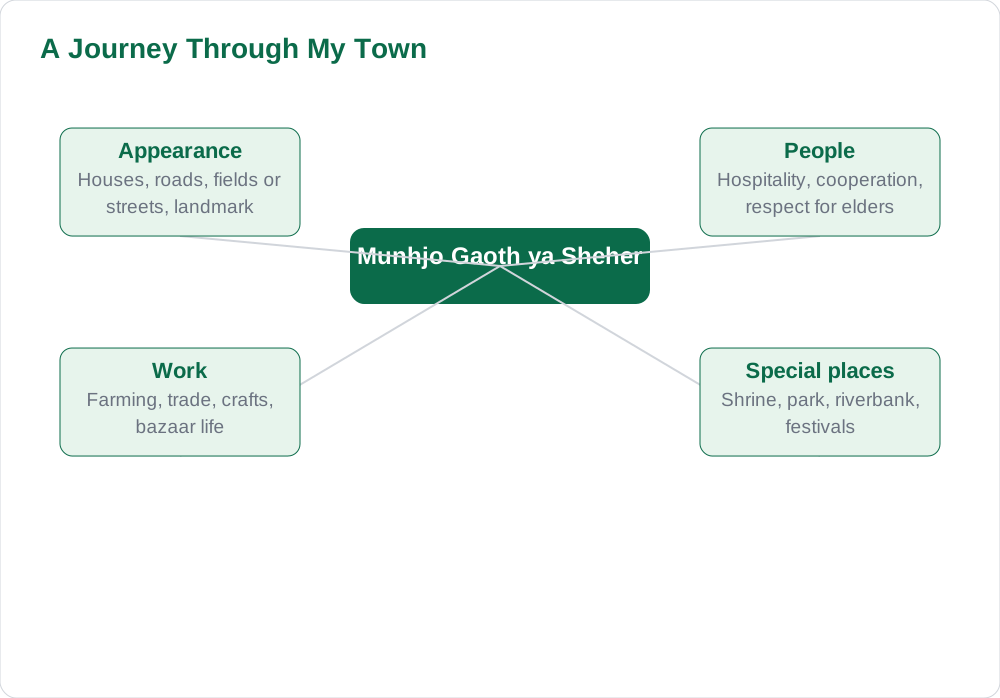
Organise the essay as a journey through the town: first its location and appearance, then its people and their character, then its work and daily life, and finally its special places and festivals. This journey order feels natural to a reader, because it moves from outside to inside, from what the town looks like to how it lives. In the appearance paragraph, cover houses, roads, fields or streets, and one landmark such as a mosque, school, or park. In the people paragraph, describe hospitality, cooperation, and respect for elders, with one small example, such as guests welcomed with tea and food.
In the work paragraph, describe how people earn their living: farming and livestock in a village, or trade, crafts, and services in a city, and mention the bazaar as the meeting place of all work. In the special places paragraph, mention a shrine, a park, a riverbank, or a festival that gives the town its identity, and explain why it matters to residents. Keep each paragraph focused on its own stage of the journey, and use connecting words that move the reader along, so the essay reads like a guided walk rather than a pile of facts. The books page covers subjects where descriptive writing is practised.
Writing the Opening and the Body
Open with a picture that places the reader in your town at once, such as dawn over the fields, the call to prayer echoing through lanes, or the evening rush of the bazaar. Follow with one sentence naming the town and its district or region in general terms, and stating that it is your home and the place of your childhood. This opening works because it combines beauty with belonging, and it promises a description rather than an argument. Avoid opening with dry facts alone, such as population figures you cannot verify; a living image earns the reader's attention far better.
In the body, keep one stage of the journey per paragraph, and support every general claim with a detail. If you say people are hospitable, describe a guest being served tea; if you say the bazaar is busy, describe its shops, sounds, and evening crowds. Use simple descriptive Sindhi words correctly, such as sohno for beautiful, wando for big, and mehman nawazi for hospitality, and avoid piling adjectives onto every noun, which tires the reader. One strong detail per sentence is enough, and the details together will paint the town more vividly than any string of praise words.
Sample Opening and Closing Lines
Original sample opening: “Munhjo gaoth munhji pehchan aahe, jite subuh jo suraj khetan te sonan wari roshni wadhendo aahe, ain maanji zindagi ja sabh khaan haseen deehan guzriya aahin.” This opening works because it ties identity to a dawn image over the fields and to childhood memories, giving the essay emotion as well as scenery. If you live in a city, adapt it by replacing fields with streets and bazaar lights, keeping the same pattern: identity, image, memory. The pattern matters more than the exact words, and adapting it makes the essay yours.
Original sample closing: “Maan jite bhi wanjan, munhjo gaoth ya sheher munhji dil mein rahandi, ain maan hamesha un ji taraqi ain khushhali lae dua kandus.” This closing works because it looks beyond the present, promising love and prayer for the town's progress wherever life takes you. It gathers the description into feeling without repeating the introduction, and it ends on hope, which suits an essay about home. Finish with two or three sentences of this kind, and the reader will close the essay feeling they have visited your town. More guides are on the blog page.
Common Mistakes and Final Polish
The most common mistake is writing a list of facts without life: names of roads and buildings with no people, sounds, or feelings. Another mistake is exaggeration, such as claiming your town is the best in the world or has everything, which sounds untrue and adds nothing. A third mistake is inventing statistics about population or history that you cannot verify; such claims damage trust and are unnecessary, because honest description is more convincing. If you mention history, keep it to one general, safe sentence, such as that the town is old and known for its fields or its bazaar.
For the final polish, check that appearance, people, work, and special places each have a paragraph, and that each paragraph contains at least one concrete detail. Remove any sentence that only praises without showing, and check the spelling of place names and Sindhi descriptive words. Read the essay aloud to hear whether it flows like a walk through the town, then write the fair copy neatly with an underlined title. An essay that passes these checks will feel like a real visit, not a copied description.
- Life, not lists: every fact needs a person, sound, or feeling beside it.
- No invented figures: honest description beats guessed population numbers.
- One detail per sentence: strong details paint better than strings of adjectives.
AI Help: Muse AI
Muse AI is Meta's personal AI assistant, and it can help you list sights, sounds, and daily work in your town and arrange them into a journey-shaped outline. Ask it to suggest simple Sindhi descriptive words or to check whether each paragraph has a concrete detail. Join Muse with invite code LTGSWD — in the Muse app, go to Settings > Redeem token and enter the code. Disclosure: LTGSWD is the author's Muse invite code. Muse AI does not give official STBB answers — always verify against your STBB book and your teacher. Always verify against your Sindh Textbook Board book and your teacher before using anything in classwork.
5 key points you must know
- Observe first: list sights, sounds, and kinds of work before writing.
- Follow a journey order: appearance, people, work, special places.
- Prove every claim with a detail, such as tea served to a guest.
- Use descriptive Sindhi words correctly and sparingly, not in piles.
- Never invent population or history figures you cannot verify.
Frequently asked questions
Should I write about a village or a city if I have lived in both?
Choose the place you know best and feel most connected to, because honest detail matters more than the choice itself. Mention the other place only briefly if it helps, such as visiting the city for study. One main place keeps the essay focused and lets your description stay vivid and true.
How do I describe a town I find ordinary?
Ordinary places make excellent essays, because their beauty lies in daily life: morning routines, the bazaar, neighbours helping each other. Look for small, specific moments rather than famous landmarks. A well-described ordinary street often impresses more than a grand but vague description.
Can I mention problems like dirty streets?
Yes, briefly and respectfully, as part of an honest picture, and end with hope for improvement. One or two sentences about a problem, balanced by love for the town, show maturity. Avoid long complaints, since the topic asks for description, not criticism.
Should I name my town and district?
Yes, naming your town and giving its general region makes the essay real and personal. Use the correct spelling of the name. Avoid adding unverified historical claims or figures; the name and your own description are enough to ground the essay.
How long should this mazmoon be?
Four to five paragraphs suit most school tests: an introduction, three or four journey paragraphs, and a conclusion. Two written pages of vivid, detailed description beat a longer essay of vague praise. Follow your teacher's limit when one is given.
Solved notes — preview free
These guides work best with the solved exercises. Preview the solved notes free on this website — 119 solved notes for Classes 6–10 in Sindhi, Urdu, English and Arabic medium. Or browse the full solved notes catalogue for your class and medium. New solved notes are added regularly — check the catalogue for coming-soon books.