Sindhi Mazmoon: My School

A Sindhi mazmoon on My School, or munhjo school, is one of the first essays every Sindhi-medium student learns to write, and it is also one of the easiest to make interesting, because every student already knows the subject from daily life. The secret of a good mazmoon is not fancy language but clear order: start with where the school is and what it looks like, then move to teachers, friends, lessons, and finally your feelings about the place. This guide teaches you that order step by step, gives you useful Sindhi words for school life, and shows you original sample lines you can adapt in your own words. By the end, you will be able to write a complete, neat mazmoon on your own school without copying anyone else, and you will understand why each part of the essay belongs where it does. Students preparing solved notes can also find helpful study material on the [solved notes page](/solved.html).
Why a Mazmoon on My School Matters
Teachers set this mazmoon because it tests something more important than memory: your ability to observe your own life and describe it in an organised way. A student who can describe a school clearly can later describe a village, a festival, or a historical event, because the same skill of moving from general to specific applies everywhere. When you write about your school, you practise choosing the right detail, putting sentences in a sensible order, and ending with a thought rather than stopping suddenly. Examiners notice this order immediately, and they reward it even when the vocabulary is simple, because a well-ordered essay is easy and pleasant to read.
A school mazmoon also builds confidence, since you are writing about something you truly know. You do not need to invent facts or memorise difficult material; you need only look around your own school with fresh eyes. Notice the gate, the playground, the classrooms, the library, and the morning assembly, and notice how your teachers speak and how your friends behave during break. When you collect these real observations first, the writing becomes easy, because you are describing memories rather than searching for words. That habit of observing before writing is the foundation of every good mazmoon you will write in later classes.
- Observation first: list ten real things about your school before you write a single sentence.
- Simple Sindhi wins: clear words like ustad, dost, and kitaab impress more than copied difficult words.
- Order matters: building, teachers, friends, lessons, and feelings is a natural sequence examiners follow easily.
Planning Your Outline Before Writing
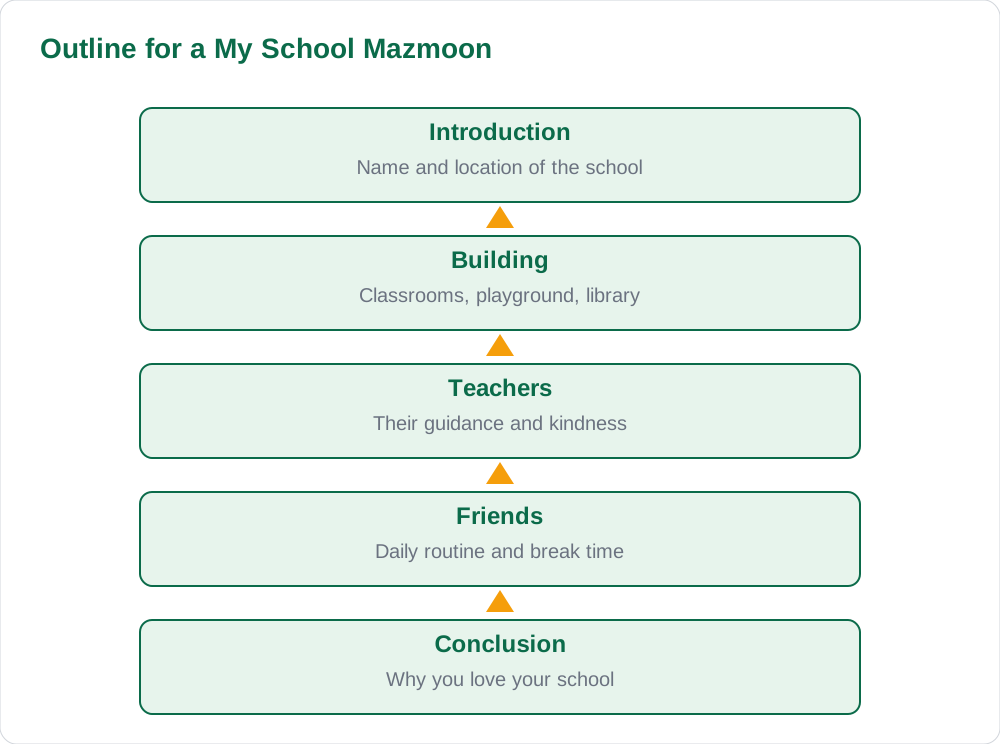
A strong outline is a short plan that saves you from repeating yourself or forgetting an important part. Before writing, divide your mazmoon into five short parts: an introduction that names your school and its location, a description of the building and grounds, a paragraph about your teachers and what you learn from them, a paragraph about your friends and daily routine, and a closing paragraph about why you love your school. Write one line for each part on rough paper, then expand each line into a paragraph. This method keeps your essay balanced, so no single part grows too long while another is missing entirely, which is the most common weakness in student essays.
Your outline should also decide which details deserve a place and which do not. Mention the size of the school, the number of classrooms if you know it, the playground, and any special room such as a library or science room, but avoid listing every teacher by name or every subject on the timetable. Choose two or three teachers who shaped you and one or two habits of school life, such as morning assembly or break time games, that show character. A mazmoon is a portrait, not a register, and selecting the best details is what makes it feel alive. Browse the books page for the classes and subjects these writing skills support.
Writing the Opening and the Body
Open with a simple, warm sentence that places the reader at your school at once, for example by naming the school and saying that it stands in your town or village and that you study there with pride. Follow that with one sentence about the building: its rooms, its playground, and the clean courtyard where assembly gathers each morning. Do not rush into praise; let the description speak first, because a reader who can picture the school will believe your praise later. Keep sentences short and connect them with simple words, so the opening paragraph reads smoothly and sets a calm, confident tone for everything that follows.
In the body, give each idea its own paragraph and support it with one concrete example. When you write about teachers, name a quality such as patience or hard work and show it through a small moment, like a teacher explaining a lesson twice without anger. When you write about friends, describe one shared activity, such as playing together at break or helping each other with homework, rather than listing names. When you write about lessons, mention the subjects you enjoy and what they teach you beyond marks. Concrete moments like these are what separate a living mazmoon from a list of general sentences that could describe any school in Sindh.
Sample Opening and Closing Lines
Original sample opening: “Munhjo school munhji zindagi jo sabh khaan pyaro hiso aahe, jite maan har rozh nayoon galhiyoon sikhan tho.” In English, this means your school is the dearest part of your life, where you learn something new every day, and it works as an opening because it is personal, simple, and immediately tells the reader what the essay will celebrate. You can adapt it by changing the feeling or the detail: mention the morning assembly, the sound of the school bell, or the road you walk with friends. The rule is to keep the opening your own observation, not a sentence memorised from a guidebook, because examiners value honesty of expression.
Original sample closing: “Maan umeed karaan tho ta maan apne ustaden ji mehnat jo qadar kandi, ain munhjo school hamesha fakhr saan yaad rakhandus.” This closing works because it looks forward instead of merely repeating the introduction: it promises gratitude and effort, which gives the essay a satisfying ending. A good closing should never introduce a new topic, and it should never be a single short line such as “I love my school” standing alone. Aim for two or three sentences that gather your feelings, thank your teachers, and state what the school has given you, so the reader finishes with a clear, warm impression. More essay and study guides are listed on the blog page.
Common Mistakes and Final Polish
The most common mistake in a school mazmoon is writing everything in one long paragraph, which tires the reader and hides your good ideas. Another frequent mistake is copying a model essay word for word, which teachers recognise at once and which teaches you nothing for the next topic. A third mistake is stuffing the essay with difficult words you do not understand, which usually breaks the grammar and confuses the meaning. Write in words you can use correctly, check the spelling of Sindhi names and terms, and read the essay aloud once: if a sentence sounds awkward when spoken, rewrite it before handing it in.
For the final polish, count your paragraphs and confirm each one has a single clear idea, then check that the first and last paragraphs match in feeling without repeating the same words. Remove any sentence that does not belong to its paragraph, and replace repeated words with simple alternatives where you can. Finally, write the fair copy neatly, leave a margin, and underline the title, because presentation is part of good writing and a clean page encourages the reader. With this routine, your My School mazmoon will be original, organised, and ready for class or examination use.
- One idea per paragraph: never mix teachers, friends, and building into a single block.
- Read aloud once: awkward sentences reveal themselves when spoken.
- Neat fair copy: clear handwriting, margins, and an underlined title complete the impression.
AI Help: Muse AI
Muse AI is Meta's personal AI assistant, and it can help you brainstorm ideas for describing your school and turn your rough notes into a clear outline. Ask it to suggest simple Sindhi words for school life or to check whether your paragraphs follow a logical order. Join Muse with invite code LTGSWD — in the Muse app, go to Settings > Redeem token and enter the code. Disclosure: LTGSWD is the author's Muse invite code. Muse AI does not give official STBB answers — always verify against your STBB book and your teacher. Always verify against your Sindh Textbook Board book and your teacher before using anything in classwork.
5 key points you must know
- Start with observation: list real details about your school before writing.
- Follow a five-part outline: introduction, building, teachers, friends, conclusion.
- Support every quality with one concrete example, such as a patient teacher or a break-time game.
- Keep vocabulary simple and correct rather than copying difficult words you do not understand.
- End with gratitude and a forward-looking thought, not a repeated introduction.
Frequently asked questions
How long should a My School mazmoon be for a school test?
For most class tests, three to five paragraphs of balanced length are enough, usually around two written pages. Length matters less than order: an introduction, two or three body paragraphs, and a conclusion will score better than a long, shapeless essay. Always follow your teacher's word or page limit first.
Should I write the mazmoon in Sindhi script or Roman Sindhi?
Write in the script your teacher and examination require, which for Sindhi-medium classes is normally Sindhi script. Roman Sindhi in this guide is only a learning aid for understanding words and sentence patterns. Practise the same sentences in Sindhi script so your fair copy matches the expected format.
Can I use the sample lines from this guide in my own essay?
Yes, you may adapt them, but change the details to fit your own school so the essay stays honest and personal. Replace the school description, the teacher quality, or the closing feeling with your own experience. A borrowed structure with your own details is good writing; a fully copied essay is not.
What makes a school mazmoon different from a paragraph about school?
A mazmoon is longer and organised: it opens with a general picture, develops separate ideas in separate paragraphs, and closes with a reflection. A single paragraph only states facts. The outline, the paragraph breaks, and the thoughtful ending are what turn a paragraph into a proper mazmoon.
How do I avoid repeating the same words in my mazmoon?
Collect a small word bank before writing: several words for school, teacher, friend, and learning, and use them in rotation. Reading your draft aloud also exposes repetition quickly. When a word appears twice in one paragraph, replace one use with a pronoun or a different simple word.
Solved notes — preview free
These guides work best with the solved exercises. Preview the solved notes free on this website — 119 solved notes for Classes 6–10 in Sindhi, Urdu, English and Arabic medium. Or browse the full solved notes catalogue for your class and medium. New solved notes are added regularly — check the catalogue for coming-soon books.