Sindhi Mazmoon: Importance of Education
A Sindhi mazmoon on the importance of education, or taleem ji ahmiyat, is a favourite examination topic because it lets a student write about something that shapes every part of life, from personal character to the progress of a whole village. A good essay on this topic does more than repeat that education is important; it explains why, with reasons a reader can recognise, such as better work, wiser decisions, and respect in society. This guide shows you how to build that argument step by step, how to use Sindhi proverbs naturally, and how to open and close with original lines that sound like your own voice. You will also learn how to keep the essay balanced, so it covers the student, the family, and the country without turning into a list of slogans. Useful background for study writing is available on the [solved notes page](/solved.html).
What Taleem Really Means
Education, or taleem, is often confused with passing examinations, but a thoughtful mazmoon begins by correcting that narrow idea. True taleem means learning to read, think, judge, and behave well: it teaches a child to tell right from wrong, to ask good questions, and to keep learning long after school ends. A student who only memorises answers for marks has collected information, while a student who understands lessons has gained something that stays useful in every new situation. Opening your essay with this distinction immediately shows maturity, and it gives you a strong idea to return to in the conclusion.
Taleem also includes character and manners, which is why elders in Sindh link learning with adab, or respectful behaviour. A learned person speaks politely, listens before answering, helps neighbours, and keeps promises, and these qualities earn respect even where wealth does not. When you write about importance, therefore, cover both sides: the practical side, such as jobs and skills, and the character side, such as honesty and responsibility. An essay that holds both sides together feels complete, while one that only mentions jobs sounds thin and forgets what Sindhi culture values most in an educated person.
- Define taleem broadly: reading, thinking, judging, and behaving well, not just passing exams.
- Pair practical benefits with character benefits: skills and jobs beside honesty and adab.
- Return to your definition in the conclusion to give the essay a satisfying full circle.
Planning the Argument: Student, Family, Country
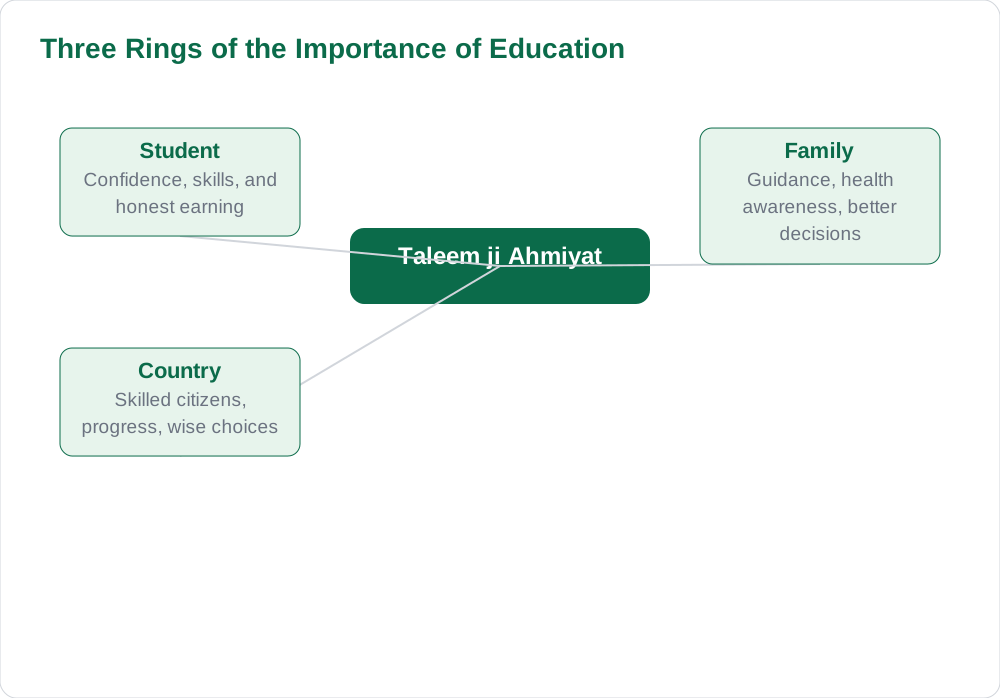
The simplest strong structure for this mazmoon moves outward in three rings: first the student, then the family, and finally the country. For the student, education builds confidence, clear speech, and the ability to earn a living through skill rather than dependence. For the family, an educated child helps parents with letters, health advice, and wise decisions, and often lifts the whole household out of difficulty. For the country, educated citizens build schools, hospitals, farms, and businesses, and they choose leaders with understanding instead of rumour. This three-ring plan prevents repetition, because each paragraph has its own subject and its own examples.
Within each ring, use one concrete example rather than many vague claims. A student who learns basic arithmetic can check a shopkeeper's bill; a daughter who can read can explain a medicine label to her mother; a village with educated farmers can try better seeds and methods. Such small, believable examples convince a reader far more than grand statements about progress, because they show education working in daily life. Keep each example short, tie it directly to the ring you are discussing, and move on, so the essay stays brisk and purposeful. The books page shows the subjects where these writing skills are practised.
Using Sindhi Proverbs Naturally
Sindhi proverbs, or pahaka, can lift a mazmoon, but only when they fit the sentence around them. A famous saying is “Ilm roshni aahe”, meaning knowledge is light, which fits perfectly after a paragraph about ignorance and darkness, because the proverb then summarises what you have already shown. Another useful idea is that a learned person is respected everywhere, a thought expressed in many Sindhi sayings about ilm and izzat. Use at most two proverbs in the whole essay, place each where its meaning matches the paragraph, and explain it briefly in your own words so the reader sees you understand it rather than merely decorating the page.
Avoid the common error of opening with a proverb you cannot explain, or stacking three sayings in a row, which makes the essay sound copied and stops your own voice. A proverb should work like a spice: a small amount improves the dish, while too much spoils it. After quoting a saying, add one sentence connecting it to your argument, for example that light removes fear just as learning removes superstition. That connecting sentence is the real skill, and examiners reward it because it proves the proverb is part of your thinking, not a borrowed ornament pasted onto the essay.
Sample Opening and Closing Lines
Original sample opening: “Ilm insan ji zindagi mein roshni wari aahe, jeka andheri khe door kare thi, ain taleem har bache jo bunyadi haq aahe.” This opening works because it states the central image, knowledge as light, and immediately adds a claim the essay will defend: education is every child's basic right. You can adapt it by starting from your own village or home, for instance by describing a child who could not read a signboard before school and can now help the whole family. The key is to promise an argument, not merely to announce the topic, so the reader expects reasons in the paragraphs that follow.
Original sample closing: “Jekadhen har bacho taleem hasil kando, ta asanjo gaoth, sheher, ain mulk taraqi kando, ain hik roshan mustaqbil asanji muntazir hondi.” This closing gathers the three rings of the essay and turns them into hope for the future, which is a fitting end for an essay about importance. A strong closing should not add a new reason; it should collect the reasons already given and state what they mean together. Two or three sentences of this kind, ending on a hopeful note about a brighter future, leave the reader with the feeling that education is not only useful but also a shared responsibility. More guides like this appear on the blog page.
Mistakes That Weaken This Mazmoon
The weakest essays on this topic repeat the same sentence in different words: education is important, education is very important, education is most important, without ever saying why. Another weakness is writing only about jobs and money, which ignores character, family, and country, and makes the essay one-sided. A third weakness is inventing statistics or claiming dates and figures about literacy that you have not verified; such claims damage trust and are unnecessary, because honest everyday examples prove the point better. Keep every claim either obviously true or supported by a small, believable example from daily life.
For final polish, read the essay and underline its reasons: you should find at least four distinct ones, such as confidence, earning, family guidance, and national progress. If two paragraphs make the same reason, merge them and add a missing one. Check that the proverbs are explained, that the opening promises an argument, and that the conclusion collects rather than repeats. Then write the fair copy neatly with an underlined title. An essay that passes these checks is original, balanced, and ready to present with confidence in class or examination.
- Count distinct reasons: at least four, or the essay is repeating itself.
- No invented figures: everyday examples prove importance better than fake statistics.
- Explain every proverb: an unexplained saying looks copied, not understood.
AI Help: Muse AI
Muse AI is Meta's personal AI assistant, and it can help you gather clear reasons for why education matters and arrange them into a balanced outline. Ask it to suggest simple Sindhi proverbs about knowledge or to check whether your paragraphs repeat the same reason. Join Muse with invite code LTGSWD — in the Muse app, go to Settings > Redeem token and enter the code. Disclosure: LTGSWD is the author's Muse invite code. Muse AI does not give official STBB answers — always verify against your STBB book and your teacher. Always verify against your Sindh Textbook Board book and your teacher before using anything in classwork.
5 key points you must know
- Define taleem broadly: thinking and character, not only examination marks.
- Structure the argument in three rings: student, family, and country.
- Use at most two Sindhi proverbs, each explained in your own words.
- Support every reason with a small, believable example from daily life.
- Never invent literacy figures or dates; honest examples are stronger.
Frequently asked questions
How many reasons should a mazmoon on education include?
Aim for four to six distinct reasons spread across your paragraphs, such as confidence, earning, family help, and national progress. Fewer reasons make the essay thin, while too many in one paragraph cause repetition. One reason per paragraph, each with a short example, gives the essay a clear and convincing shape.
Is it safe to use proverbs I found in this guide?
Yes, provided you understand each proverb and explain it briefly in your own words where you use it. A proverb works when it matches the paragraph's idea and you connect it to your argument. Never stack several proverbs together or open with one you cannot explain, because that looks copied.
Can I write about girls' education in this mazmoon?
Yes, and it strengthens the essay, because an educated mother teaches the whole family and raises educated children. Mention it as one part of the family or country paragraph, with a respectful, concrete example. Keep the tone positive and focused on benefits rather than blaming anyone.
Should I mention problems like lack of schools?
A brief mention of problems adds honesty, but keep it short and end with a hopeful solution, such as community support for schooling. The topic asks for importance, so problems should support the argument for more education, not replace it. Two or three sentences are enough.
How do I end this mazmoon without repeating the introduction?
Collect your reasons and turn them into a forward-looking hope, such as a brighter future when every child learns. Avoid restating the opening sentence word for word. A conclusion that gathers and looks ahead feels finished, while a repeated introduction feels like the essay ran out of ideas.
Solved notes — preview free
These guides work best with the solved exercises. Preview the solved notes free on this website — 119 solved notes for Classes 6–10 in Sindhi, Urdu, English and Arabic medium. Or browse the full solved notes catalogue for your class and medium. New solved notes are added regularly — check the catalogue for coming-soon books.