Sindhi Mazmoon: My Favourite Personality

A Sindhi mazmoon on your favourite personality asks you to write about a person you admire, whether a national hero, a teacher, a scientist, or a family member, and to explain clearly why that person deserves admiration. Many students fail this topic not because they lack feelings, but because they only list praise words such as great, kind, and brave without showing what the person actually did. This guide teaches a better method: choose one person, choose three qualities, and prove each quality with a deed or a habit from that person's life. You will get an original outline, useful Sindhi words for character, and sample opening and closing lines to adapt. Background study material is available on the [solved notes page](/solved.html).
Choosing the Right Personality
Choose a person you genuinely know something about, because a mazmoon written from real knowledge always sounds stronger than one written from vague admiration. A national hero such as Quaid-e-Azam Muhammad Ali Jinnah gives you well-known deeds to describe, while a teacher or a parent gives you personal memories that no other student can copy. Both choices work, but the personal choice often scores higher for originality, since your memories are unique. Whichever person you pick, make sure you can name at least three real deeds or habits of theirs; if you cannot, choose someone else or learn more before writing.
Avoid choosing a film star or singer only because you enjoy their work, unless you can explain a quality beyond fame, such as hard work, discipline, or charity. Examiners respect admiration that is based on character and effort, not on popularity alone. Once you have chosen, write the person's name, their field of life, and one sentence saying why they matter to you; that sentence becomes the backbone of your introduction. A clear choice made before writing prevents the common problem of drifting between several people in one essay, which confuses the reader and weakens every paragraph.
- Pick someone you know well: a hero, teacher, or family member with real deeds you can name.
- Admire character, not fame: hard work, honesty, and service beat popularity as reasons.
- One person only: drifting between several personalities weakens the whole essay.
Building the Essay Around Three Qualities
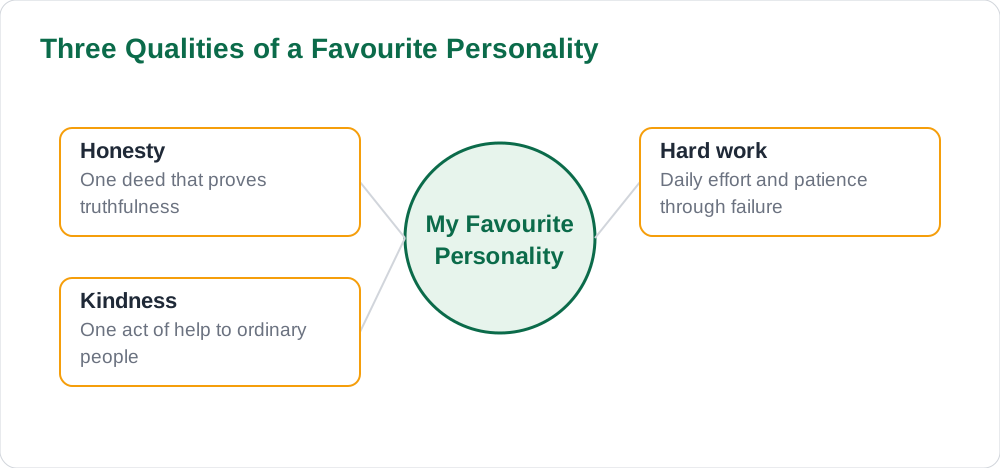
The strongest structure for this mazmoon gives each paragraph to one quality, proved by one deed. For example, if your hero is known for honesty, describe a moment when honesty cost them something yet they refused to compromise. If your person is known for hard work, describe their daily routine, their patience through failure, and the result that finally came. If they are known for kindness, describe one act of help toward ordinary people, not a general claim that they were kind to everyone. This quality-plus-deed pattern fills the body of the essay naturally, and it stops you from repeating the same praise in different words.
Between the qualities, use simple connecting sentences that keep the essay moving, such as moving from early life to work, or from public deeds to private character. A short paragraph about the person's early life or background can open the body, giving the reader context before the qualities begin. Keep that background brief, however, because the essay is about why you admire the person, not a full biography. Two or three sentences of background are enough, and then the qualities should take over. The books page lists subjects where biography and character writing are practised.
Writing the Opening and the Body
Open by naming the person and stating in one sentence why they stand above others in your eyes, for instance because their life taught you that honesty and hard work win respect. Follow with a brief line about who they are and what field they belong to, so a reader who does not know them can follow the essay. Do not open with a long list of titles or a memorised quotation you cannot explain; a plain, honest opening earns more respect than a grand one that sounds borrowed. The introduction should promise the reader three qualities, and the body must then deliver exactly those qualities in order.
In the body, keep each quality in its own paragraph and start the paragraph with the quality itself, so the examiner sees your structure at a glance. Write the deed first and the praise second: describe what the person did, then say what it teaches you, rather than praising first and searching for proof afterwards. This order makes your admiration feel earned, because the reader reaches the same conclusion you did. Use simple Sindhi words for character, such as sachai for truthfulness, mehnat for hard work, and humdardi for sympathy, and use them correctly rather than forcing difficult synonyms.
Sample Opening and Closing Lines
Original sample opening: “Munhji pasandeeda shaksiyat woh aahe, jenh jo kirdar mounkhe sikhae tho ta sachai ain mehnat saan insan har mushkil te fatah hasil kare saghe tho.” This opening works because it names the theme at once, character as a teacher, and promises that the essay will show honesty and hard work winning over difficulty. Adapt it by naming your person and their one quality that matters most to you, keeping the sentence personal and simple. An opening that states your reason for admiration is far stronger than one that only announces a name and leaves the reader guessing why.
Original sample closing: “Maan chahyan tho ta maan bhi un ji zindagi khaan sabak hasil karyan, ain sachai, mehnat, ain humdardi khe apni zindagi jo hiso banayan.” This closing is effective because it turns admiration into a personal promise, which is the natural ending for an essay about a role model. It does not introduce a new quality or repeat the introduction; it shows what the person's life means for your own future. End with two or three sentences of this kind, stating what you have learned and how you hope to act on it, and your essay will feel complete. More writing guides are on the blog page.
Common Mistakes and Final Polish
The most common mistake is pure praise without proof: five paragraphs calling a person great, without one deed the reader can picture. Another mistake is exaggeration, such as claiming the person never made a mistake or was loved by every person on earth, which sounds childish and untrue. A third mistake is writing a biography instead of a mazmoon, listing dates and events without saying why any of it matters to you. Keep the focus on admiration with reasons, and mention life events only when they prove a quality you have chosen to discuss.
For the final polish, check that each body paragraph begins with a different quality and contains one deed, and that the conclusion contains a personal promise rather than repeated praise. Remove any sentence that praises without evidence, and check the spelling of the person's name and of Sindhi character words. Read the essay aloud to catch repeated praise words, and replace repeats with specific details. A neat fair copy with an underlined title completes an essay that is honest, organised, and clearly your own work.
- Proof before praise: describe the deed, then state what it teaches you.
- No exaggeration: claims like never making a mistake sound untrue and weaken trust.
- Biography is not the topic: life events belong only when they prove a chosen quality.
AI Help: Muse AI
Muse AI is Meta's personal AI assistant, and it can help you choose three clear qualities for your favourite personality and match each one with a deed. Ask it to suggest simple Sindhi words for character traits or to check whether your praise is supported by examples. Join Muse with invite code LTGSWD — in the Muse app, go to Settings > Redeem token and enter the code. Disclosure: LTGSWD is the author's Muse invite code. Muse AI does not give official STBB answers — always verify against your STBB book and your teacher. Always verify against your Sindh Textbook Board book and your teacher before using anything in classwork.
5 key points you must know
- Choose one person you know well enough to name three real deeds or habits.
- Give each body paragraph one quality, proved by one deed or habit.
- Describe the deed first and the praise second, so admiration feels earned.
- Use simple Sindhi character words correctly: sachai, mehnat, humdardi.
- End with a personal promise about what you learned, not repeated praise.
Frequently asked questions
Can I choose my mother or father as my favourite personality?
Yes, and it often produces the most original essay, because your memories are unique to you. Describe specific habits, such as waking early for work or helping neighbours, rather than general praise. Personal examples prove character better than famous deeds you only half remember, and examiners value that honesty.
How many qualities should I discuss in this mazmoon?
Three qualities are ideal for a school mazmoon: enough to fill the body without repetition. Each quality gets its own paragraph with one deed as proof. Two qualities can feel thin, while five usually lead to shallow, repeated paragraphs. Three keeps the essay balanced and convincing.
Should I include dates from the person's life?
Only include a date if you are sure of it and it helps prove a quality, such as the year of a famous achievement. Avoid guessing dates, because a wrong date damages trust in the whole essay. When unsure, describe the deed without a date; the deed matters more than the year.
What if I admire a person I know only from books?
That is fine, provided you describe deeds you actually learned about, not invented ones. Use well-known facts, such as a leader's honesty or a scientist's patience, and say what each deed teaches you. Never invent stories about a real person to fill space.
How do I avoid sounding like I copied a model essay?
Use your own examples and your own closing promise, and write in words you understand. A model essay can teach structure, but the deeds, the order of qualities, and the final reflection should be yours. Reading your draft aloud helps you hear whether it sounds like your own voice.
Solved notes — preview free
These guides work best with the solved exercises. Preview the solved notes free on this website — 119 solved notes for Classes 6–10 in Sindhi, Urdu, English and Arabic medium. Or browse the full solved notes catalogue for your class and medium. New solved notes are added regularly — check the catalogue for coming-soon books.