Sindhi Mazmoon: Discipline

A Sindhi mazmoon on discipline, or nazm-o-zabt, is one of the most useful essays a student can master, because its subject is the habit behind every other success: doing the right thing at the right time, whether anyone is watching or not. A strong essay on discipline does more than praise order; it shows how discipline works in a student's day, from waking on time and completing homework to respecting teachers, keeping promises, and using free time wisely. This guide teaches you to organise those examples into a clear structure, to explain why discipline brings freedom rather than restriction, and to open and close with original lines. Study support is on the [solved notes page](/solved.html).
What Nazm-o-Zabt Really Means
Begin by defining discipline in simple, positive terms: nazm-o-zabt means order in life, so that time, work, and behaviour each have their proper place. A disciplined student wakes at a fixed hour, prepares lessons before play, keeps books tidy, and speaks respectfully, not because of fear but because order makes life easier. Contrast this with the common misunderstanding that discipline means harsh punishment; true discipline is self-control, practised willingly, and it grows stronger the more it is used. This definition gives your essay a clear idea to develop, and it prevents the essay from becoming a list of rules imposed by others.
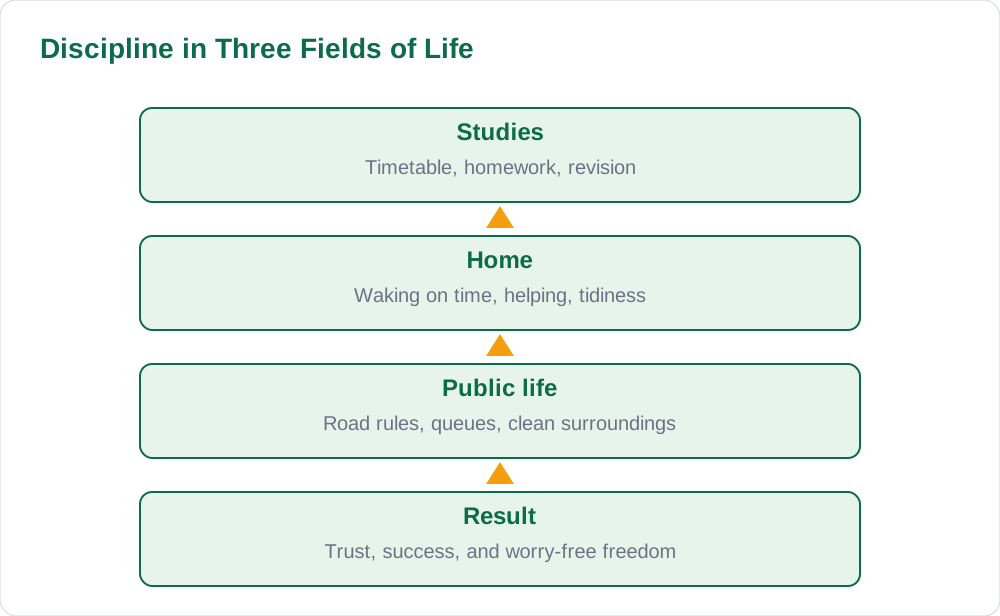
Discipline also brings a surprising reward: freedom. A student who finishes homework on time is free to play without worry, while a student who delays work carries worry into every game. A person who keeps promises earns trust and is given greater responsibility, while a careless person is watched closely. When your essay explains this connection between discipline and freedom, it shows mature thinking, and it gives the reader a reason to value discipline personally rather than merely obeying it. That reason is the heart of a good mazmoon on this topic.
- Define discipline as self-control and order, not as fear or punishment.
- Show the reward: finished work means worry-free play and earned trust.
- Keep the definition central: return to it in the conclusion.
Planning by Three Fields: Studies, Home, Life
Organise the body into three fields where discipline shows: studies, home, and public life, giving each its own paragraph with concrete habits. In studies, discipline means a fixed timetable, homework completed daily, attention in class, and revision before examinations rather than cramming at the last moment. At home, it means waking on time, helping parents, keeping belongings tidy, and speaking politely to elders and guests. In public life, it means following rules on the road, waiting for one's turn, keeping surroundings clean, and respecting the rights of others. This three-field plan covers the topic fully and keeps each paragraph distinct.
Within each field, describe one habit in detail and name its result, rather than listing many rules quickly. For example, explain how a fixed study hour each evening prevents examination panic, or how waiting patiently for one's turn teaches respect for others. Detailed habits convince the reader, while long lists of rules sound like a lecture. You can also admit honestly that discipline is difficult at first, such as waking early on cold mornings, and that it becomes easier with practice; that honesty makes the essay believable. The books page covers subjects where character and civic habits are taught.
Writing the Opening and the Body
Open with a small, true scene of discipline or its absence: a student who reaches school on time and calm, or a morning ruined by delay and rushing. Then state the essay's idea in one sentence, that nazm-o-zabt turns effort into ease and earns trust. This scene-first opening works because it shows discipline working before explaining it, and it gives the reader a contrast to remember. Keep the opening short, and avoid beginning with a long definition copied from a book, since your own scene and sentence will define the topic more vividly.
In the body, keep one field per paragraph and begin with the field, so the structure is visible to the examiner. Use active sentences about habits: who does what, when, and with what result. For instance, write that a student who revises a little each day faces examinations calmly, rather than writing abstractly that discipline is important for success. Concrete habit-and-result sentences fill the essay with real life, and they are easy to write because they describe routines you already know. End each paragraph with its result, so the reader feels discipline paying off again and again.
Sample Opening and Closing Lines
Original sample opening: “Nazm-o-zabt zindagi jo woh usool aahe, jeka waqt, kam, ain kirdaar khe sahih raah te rakhe tho, ain kamyabi jo darwazo khole tho.” This opening works because it calls discipline a principle that guides time, work, and character, and promises that it opens the door to success, giving the essay a claim to prove. Adapt it by starting from your own routine, such as your fixed study hour or your habit of reaching school early, and drawing the same lesson. A personal opening proves you practise the topic, not merely praise it.
Original sample closing: “Jeko shakhs nazm-o-zabt khe apni aadat banaye tho, un lae har mushkil asaan thi wendi aahe, ain kamyabi un jo qadam chumndi aahe.” This closing works because it turns discipline from a rule into a habit, and promises that difficulty becomes ease for the disciplined person. It gathers the three fields without repeating the introduction and ends on confidence, which suits an essay about self-control. Finish with two or three sentences of this kind, and the essay will close with a sense of earned success. More guides are on the blog page.
Common Mistakes and Final Polish
The most common mistake is writing only about punishment, such as teachers scolding late students, which confuses discipline with fear and misses self-control entirely. Another mistake is listing rules without results, so the essay reads like a noticeboard rather than an argument. A third mistake is claiming to be perfectly disciplined, which sounds untrue; admitting that discipline takes effort, and describing how you practise it, is far more convincing. Keep the focus on habits, results, and honest effort, and the essay will feel mature.
For the final polish, check that studies, home, and public life each have a paragraph, and that each paragraph names a habit and its result. Remove any sentence that only repeats that discipline is important, and replace it with an action. Check the spelling of Sindhi terms, read the essay aloud, and write the fair copy neatly with an underlined title. An essay that passes these checks is practical, honest, and ready for class or examination.
- Self-control, not fear: discipline means willing order, not punishment.
- Habits with results: every rule needs the good result it brings.
- Honest effort: admitting difficulty beats claiming perfection.
AI Help: Muse AI
Muse AI is Meta's personal AI assistant, and it can help you list disciplined habits for studies, home, and public life and arrange them into a clear outline. Ask it to suggest simple Sindhi words for order and self-control or to check whether each paragraph shows a result. Join Muse with invite code LTGSWD — in the Muse app, go to Settings > Redeem token and enter the code. Disclosure: LTGSWD is the author's Muse invite code. Muse AI does not give official STBB answers — always verify against your STBB book and your teacher. Always verify against your Sindh Textbook Board book and your teacher before using anything in classwork.
5 key points you must know
- Define discipline as willing self-control and order, not fear of punishment.
- Organise the body by studies, home, and public life.
- Describe each habit with its result: ease, trust, or success.
- Admit honestly that discipline takes effort and grows with practice.
- Show that discipline brings freedom: finished work means worry-free play.
Frequently asked questions
Is discipline the same as obeying teachers?
Obedience is only one part of discipline; true discipline is self-control practised even when no one watches. A disciplined student completes homework without reminders and keeps promises without pressure. Your essay should emphasise this willing, inner order, because it shows maturity beyond simple obedience to authority.
Can I admit that I sometimes lack discipline?
Yes, a brief honest admission strengthens the essay, because it shows self-knowledge. Describe one difficulty, such as delaying homework, and the habit you use to overcome it, such as a fixed study hour. Honest struggle with a practical solution convinces far more than a claim of perfection.
Should I mention punishment in a discipline mazmoon?
Mention it only briefly, to contrast it with self-discipline, not as the main idea. The essay should celebrate order chosen willingly, not fear of scolding. One sentence distinguishing the two is enough; the rest should describe habits and their good results.
How do I avoid making this essay a boring list of rules?
Tell small stories: a morning saved by waking on time, an examination faced calmly through daily revision. One habit with its result per paragraph keeps the essay lively. Stories and results turn rules into life, while a bare list of rules reads like a noticeboard.
How long should this mazmoon be?
Four to five paragraphs suit most school tests: an introduction, three field paragraphs, and a conclusion. Two written pages of habits with results beat a longer essay of repeated praise. Follow your teacher's limit when one is given. Presentation matters too.
Solved notes — preview free
These guides work best with the solved exercises. Preview the solved notes free on this website — 119 solved notes for Classes 6–10 in Sindhi, Urdu, English and Arabic medium. Or browse the full solved notes catalogue for your class and medium. New solved notes are added regularly — check the catalogue for coming-soon books.