Sindhi Mazmoon: Cleanliness

A Sindhi mazmoon on cleanliness, or safai, is a topic every student can write well, because its examples are found at home, at school, and in the street outside. The well-known saying safai nisf iman, meaning cleanliness is half of faith, gives the essay a strong moral centre, but a good mazmoon must go beyond repeating the saying: it should show how cleanliness protects health, improves learning, and earns respect. This guide teaches you to organise the essay around home, school, and surroundings, to use the saying naturally, and to open and close with original lines of your own. You will also learn the common mistakes that make this easy topic score poorly. Helpful study material is on the [solved notes page](/solved.html).
Why Safai Matters More Than Looks
Many students begin by saying cleanliness looks beautiful, and that is true, but a strong essay starts with the deeper reasons: health, dignity, and discipline. Dirty surroundings breed flies, bad smells, and disease, while a clean home and classroom protect children from illness and help them concentrate on lessons. Cleanliness also shapes character, because a child who keeps a desk tidy learns order, responsibility, and respect for shared spaces. When your essay explains these reasons first, the reader understands that safai is not about appearance alone but about a healthy and disciplined life.
The saying safai nisf iman connects cleanliness with faith and daily duty, and it belongs early in the essay, explained in your own words rather than merely quoted. In Islam, purity of body, clothes, and surroundings is part of worship, which is why elders teach children to wash hands, keep clothes clean, and avoid littering. You do not need religious detail beyond this simple, respectful explanation; one or two sentences are enough to give the essay its moral weight. From there, move to practical examples, so the essay balances belief with daily action, which is exactly what examiners want to see.
- Lead with health and discipline, not only beauty: clean places prevent disease and aid learning.
- Explain safai nisf iman briefly in your own words before using it again.
- Balance belief with action: faith gives the reason, daily habits give the proof.
Cleanliness at Home, at School, and Around Us
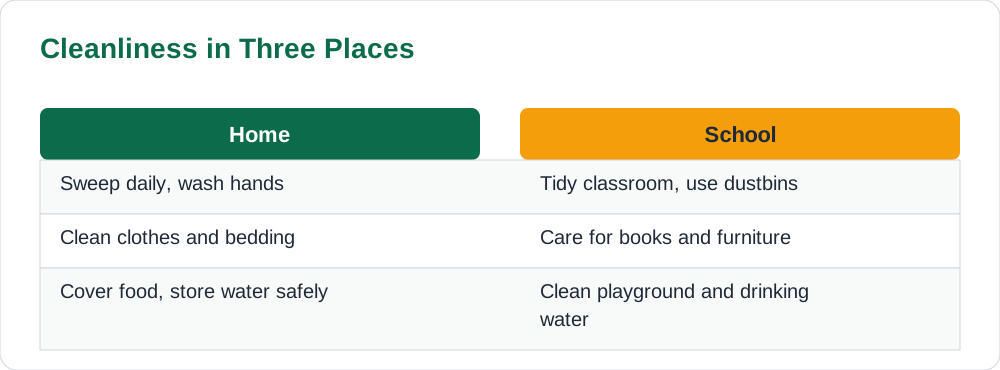
Organise the body of the essay into three clear places: home, school, and surroundings, giving each its own paragraph with concrete habits. At home, cleanliness means sweeping daily, washing hands before meals, keeping clothes and bedding clean, and storing food covered and safe. At school, it means a tidy classroom, a clean playground, dustbins used properly, and respect for shared books and furniture. Around us, it means not throwing rubbish in streets or canals, keeping water sources clean, and planting trees that freshen the air. This three-place structure is easy to follow and guarantees the essay covers the topic fully without repetition.
Within each place, describe one habit in detail rather than listing ten habits in a rush. For example, explain how washing hands before eating protects the whole family from stomach illness, or how a classroom dustbin used by every student keeps the room pleasant for learning. Detailed habits convince the reader, while long lists tire them. You can also mention your own role, such as helping your mother sweep the courtyard or reminding friends to use the dustbin, because personal action makes the essay honest and lively. The books page covers subjects where health and civic habits are taught.
Writing the Opening and the Body
Open with a vivid, everyday image, such as a clean courtyard in the morning or a classroom that smells fresh after sweeping, and then connect that image to the saying safai nisf iman. This kind of opening works because it shows the reader cleanliness before explaining it, and it proves you have observed the topic in real life. Follow with one sentence stating that cleanliness protects health and reflects good character, which promises the reader the two themes the body will develop. Keep the opening short and warm, and avoid starting with a memorised quotation you cannot explain, since an unexplained quotation weakens rather than strengthens the first impression.
In the body, keep one place per paragraph and start each paragraph with the place itself, so the structure is visible to the examiner. Use simple, active sentences about habits: who does what, where, and why it helps. For instance, write that students throw waste in the dustbin so the classroom stays pleasant, rather than writing abstractly that cleanliness is good for the environment. Concrete sentences of this kind fill the essay with real life, and they are easy to write because they describe actions you already know. End each paragraph with a small result, such as fewer flies, better health, or a happier classroom.
Sample Opening and Closing Lines
Original sample opening: “Safai insan ji zindagi jo zevar aahe, jeka sehat, izzat, ain sukoon dendi aahe, ain safai nisf iman jo paigham asankhe har rozh yaad dilae tho.” This opening works because it calls cleanliness an ornament of life, names three gifts, health, respect, and peace, and ties them to the familiar saying. You can adapt it by starting from your own home, such as the swept courtyard at dawn, and then drawing the same lesson. The strength lies in the combination of image, reason, and saying, each supporting the others in two sentences.
Original sample closing: “Jekadhen har shakhs apne ghar, school, ain gali ji safai jo khayal rakhe, ta asanjo sheher saaf, sehatmand, ain khushgawar thi saghe tho.” This closing gathers the three places of the essay and turns them into a shared promise, which is the right way to end a mazmoon about a public habit. It does not repeat the introduction or add a new topic; it shows the result of everyone acting together. Finish with two or three sentences of this kind, and the essay will close with hope and responsibility. More essay guides are listed on the blog page.
Common Mistakes and Final Polish
The most common mistake in a cleanliness mazmoon is writing only general praise, such as repeating that cleanliness is good, without describing a single habit. Another mistake is blaming others, such as saying only the government or neighbours are dirty, while saying nothing about the student's own duties. A third mistake is using the saying safai nisf iman in every paragraph, which turns a strong idea into a tiresome repetition. Use the saying once or twice, explain it once, and let the habits carry the rest of the essay.
For the final polish, check that home, school, and surroundings each have a paragraph, and that each paragraph names at least one concrete habit and one result. Remove any sentence that only repeats that cleanliness is important, and replace it with an action. Check the spelling of Sindhi terms, read the essay aloud, and write the fair copy neatly with an underlined title. An essay that passes these checks is practical, honest, and ready for class or examination.
- Habits, not praise: every paragraph needs a concrete action and its result.
- Own duty first: write about your habits before blaming others.
- Saying used sparingly: quote safai nisf iman once or twice, explained once.
AI Help: Muse AI
Muse AI is Meta's personal AI assistant, and it can help you list daily cleanliness habits for home and school and organise them into a clear three-part outline. Ask it to suggest simple Sindhi words for cleaning habits or to check whether your essay repeats the same praise. Join Muse with invite code LTGSWD — in the Muse app, go to Settings > Redeem token and enter the code. Disclosure: LTGSWD is the author's Muse invite code. Muse AI does not give official STBB answers — always verify against your STBB book and your teacher. Always verify against your Sindh Textbook Board book and your teacher before using anything in classwork.
5 key points you must know
- Start with health, dignity, and discipline, not only with beauty.
- Explain safai nisf iman briefly in your own words, early in the essay.
- Organise the body by three places: home, school, and surroundings.
- Describe one concrete habit per paragraph, with its result.
- Write about your own duty first, before criticising others.
Frequently asked questions
How do I use the saying safai nisf iman without overusing it?
Quote it once in the opening or early body, explain its meaning in one sentence, and refer to it once more at most in the conclusion. Let concrete habits carry the rest of the essay. Repeating the saying in every paragraph makes it feel copied and weakens the writing rather than strengthening it.
Should a cleanliness mazmoon mention disease?
Yes, briefly, because health is the strongest practical reason for cleanliness. Mention in general terms that dirty places spread illness, without naming diseases you are unsure about. One or two sentences linking habits like handwashing to fewer illnesses are enough and keep the essay honest.
Can I write about my own cleaning habits?
Yes, personal habits make the essay original and believable. Describe one or two habits you actually practise, such as sweeping the courtyard or using the classroom dustbin. Personal action shows responsibility, which is exactly the character lesson this mazmoon is meant to teach.
What if my school or street is not clean?
Write honestly about what should happen, and about your own small part, without blaming people rudely. Suggest practical steps, such as dustbins and daily sweeping, and end with hope. A respectful tone about problems scores better than angry complaints about others.
How long should this mazmoon be?
Four to five paragraphs are enough for most school tests: an introduction, three place paragraphs, and a conclusion. Quality matters more than length, so a well-organised essay of two written pages beats a long essay that repeats itself. Follow your teacher's limit when one is given.
Solved notes — preview free
These guides work best with the solved exercises. Preview the solved notes free on this website — 119 solved notes for Classes 6–10 in Sindhi, Urdu, English and Arabic medium. Or browse the full solved notes catalogue for your class and medium. New solved notes are added regularly — check the catalogue for coming-soon books.